
Surgical Reserve
The Hidden Risk Behind Unequal Recovery

ENERGY SCIENCE
Our TSEE guest writer Mohammed Alhalees, MD, is a vascular surgery trainee at
Klinikum Mittelbaden in Baden-Baden, Germany. In this piece, he reflects on the idea of surgical reserve and the factors he believes may shape recovery after surgery.

In surgery, technical success during the procedure doesn’t always lead to successful biological recovery.
I have performed the same operation, with the same instruments, on two patients of the same age and the same diagnosis. The procedure went well in both cases. The anaesthesia went smoothly. The blood loss was acceptable. I closed the wound with the same technique, in the same number of layers, and had both patients in the recovery room within minutes of each other.
The next morning, one patient was independently walking down the corridor.
The other had a fever. His wound was swollen and weeping. He was confused, agitated, and unable to eat. His inflammatory markers tripled overnight. Three days later, he was still in bed while his counterpart was preparing for discharge.
Nothing went wrong in the operating room. And yet, something had gone profoundly wrong for one patient.
Every surgeon knows this pattern. We have all stood at the bedside of the patient who should, by every measure, be recovering—and is not. We reach for explanations: perhaps the comorbidities, perhaps the age, perhaps something we missed. But often, we do not find a satisfying answer. Because the answer may not lie in what happened during surgery. It may lie in the state of the body before the surgery even began.
What We Measure—And What We Don’t
Before every elective operation, we assess our patients carefully. The assessments done before, during, and after surgery provide valuable and often life-saving insights into patient risk and tolerance. We examine their pre-operative health using a range of validated classifications, tests, and risk scores. These tools have transformed surgical safety over decades and remain essential to good medical practice.
But these tools share a common limitation: they describe risk, and they describe organ function. They do not fully describe capacity for recovery—the body’s ability to absorb the biological cost of surgery and still have enough energy left to rebuild.
A patient may have normal results on all the tests we run, but still be living at the edge of his biological reserve. His metabolism may be chronically strained. His mitochondria may be operating below optimal efficiency. His immune system may be in a state of low-grade, sustained activation. His microcirculation may be quietly compromised. None of this will appear clearly in a blood test.
A reserve-based perspective does not replace our current tools, but it may help interpret their results within a broader physiological context. This is distinct from the concept of frailty, which describes a multidimensional state of vulnerability. Surgical reserve, as considered here, refers specifically to the dynamic behavior of biological capacity for recovery under the acute and time-bound stress of surgery.
Risk is not the same as reserve. And reserve is what surgery actually consumes.
The Body Under Stress: An Allocation Problem
The moment the skin is cut, a cascade begins. A confluence of factors, including tissue injury, the introduction of anaesthesia, fasting, blood loss, inflammation, and the psychological experience of surgical threat, converge to activate a coordinated stress response we call neuroendocrine alarm.
The sympathetic nervous system accelerates heart rate and constricts blood vessels, increasing vascular resistance. The hypothalamic–pituitary–adrenal (HPA) axis, a key neuroendocrine system that regulates the body’s response to stress and helps maintain homeostasis, releases cortisol into the bloodstream within minutes. Hormones and neurotransmitters responsible for your body’s fight-or-flight response flood the bloodstream. The body shifts into survival mode.
This is not merely a stress response. It is a biological energy reallocation system.
The body is deciding, in real time, how to distribute its available energy across competing demands. Survival comes first. Defence comes second. Repair—the very process that determines whether the patient recovers—comes last. And it receives only the energy that remains after the other priorities have been met. While the underlying mechanisms of this redistribution are tissue-specific, parallel, and context-dependent, the net clinical consequence observed at the organism level is that certain processes are effectively prioritized over others during acute stress.
In many ways, both the surgeon’s hand and the neuroendocrine system are key operators managing the body’s energy allocation under stress.
A Century of Evidence We Have Not Fully Applied
This framing is not new. The evidence has been accumulating for nearly a hundred years—distributed across disciplines that have rarely spoken to one another.
In the 1930s, David Cuthbertson described what he called the ebb and flow response following injury and surgery. There is an initial phase of circulatory depression and reduced metabolic activity, followed by a prolonged catabolic surge in which the body breaks down muscle, fat, and protein—not from starvation, but by deliberate biological choice.
The body dismantles its own structural reserves to fuel the stress response. Cuthbertson framed this as physiology. In retrospect, it is also a description of energy allocation under pressure: the body spends from its reserve to survive.

Decades later, Bruce McEwen and colleagues formalized the concept of allostatic load—the cumulative biological cost paid by a body that has been held under chronic stress for too long. Each stressor—metabolic, inflammatory, psychological, environmental—leaves a deposit of physiological debt. A patient with years of uncontrolled diabetes, chronic low-grade inflammation, and cardiovascular disease does not enter surgery with a full biological account. He enters it already overdrawn. And surgery is a large, sudden withdrawal.
At the cellular level, the work of David Grahame Hardie revealed how individual cells themselves function as energy accountants. When energy supply is falling short of demand, the ratio of the molecules adenosine monophosphate (AMP) to adenosine triphosphate (ATP) rises. This triggers a cellular austerity program.
Cellular austerity halts protein synthesis, suppresses growth, and shuts down energy-expensive processes, including tissue repair. The cell is not failing. It is making a rational choice under constraint. But the clinical consequence is that repair is deferred in the cells that need it most.
the clinical consequence is that repair is deferred in the cells that need it most.

More recently, the Energy Constraint framework, including the work of Martin Picard and colleagues, offers a useful lens through which these observations can be interpreted. We can think of it as a problem of constrained biological energy allocation under stress. Living systems operate within a finite energy budget, and under stress, that budget is redistributed according to priority. Survival consumes what it needs. Defence takes its share. Repair receives what remains—which, in a depleted system, may be very little or nothing at all.
When I encountered this work, I did not feel like I was reading a new idea. I felt like I was reading a precise, physiological description of something I had been watching for years in the operating room, without having the language to name it.
A technically successful operation may still be followed by biological failure if the patient does not have enough reserve to finance both the stress response and the recovery afterwards.
Where Reserve Lives: Five Domains of Biological Capacity
If surgical reserve is a clinically meaningful phenomenon, where does it live? It’s unlikely to be something we can capture with a single number or measure within a single organ. It may be better understood as a coordinated capacity expressed across several physiological domains. These domains may not be a definitive or exhaustive list, but they represent clinically observable expressions of how biological capacity is mobilized and constrained under stress.
These domains are not independent silos. They are each orchestrated by the same neuroendocrine control system and may interact with each other.
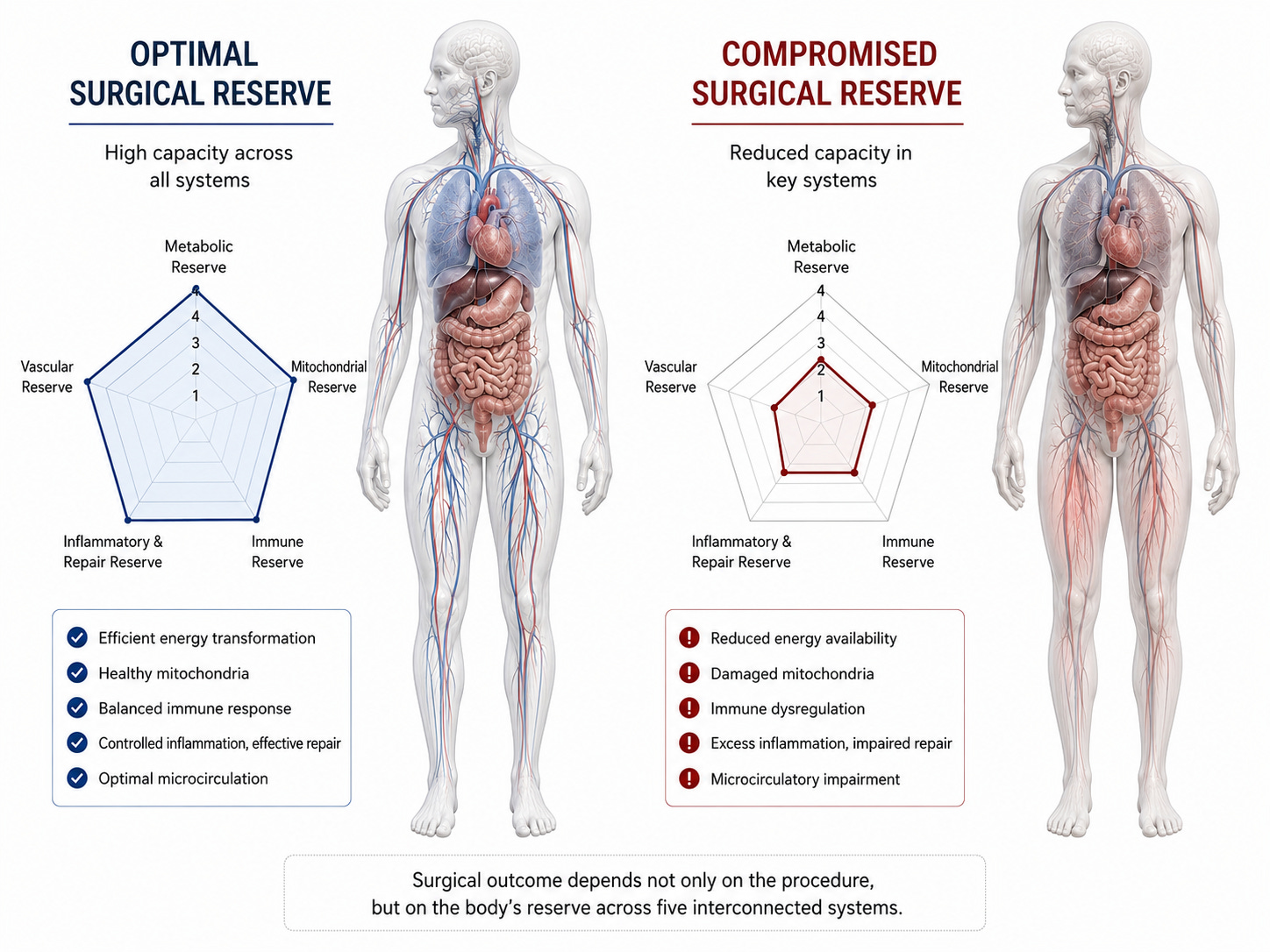
The stress hormone cortisol influences gene expression across multiple biological pathways involved in metabolism, immune regulation, and stress adaptation. It simultaneously activates some processes and suppresses others according to what the body demands in that moment.
The sympathetic nervous system and the HPA axis issue concurrent commands to metabolism, immune function, inflammation, cellular energy production, and the vascular system. What follows are five domains where the consequences of those commands become visible in the patient’s recovery.
1. Metabolic Reserve
Surgical stress rapidly shifts metabolism. Stress-related neurotransmitters and hormones like cortisol drive the breakdown of stored glycogen in the liver and the generation of glucose from non-carbohydrate sources for fast energy. Fatty acids are mobilized from adipose tissue. Insulin resistance increases in your muscles and other peripheral tissues. These are all parts of a deliberate mechanism that redirects circulating glucose away from insulin-sensitive peripheral tissues and toward the brain, heart, and immune system.
This is physiologically rational under acute threat. But it means that the tissues responsible for repair—the wound, the gut, the healing muscle—find themselves competing for glucose in a system reconfigured to deny them priority.
A patient with type 2 diabetes, chronic inflammation, age-related muscle loss, or malnutrition may enter surgery with already-limited metabolic flexibility. His fasting glucose may appear acceptable. What is not visible is whether his metabolic system can shift fluidly between fuel sources under stress—or whether it will stall, leaving repair tissue fuel-deprived at precisely the moment it needs energy most.
2. Cellular and Mitochondrial Reserve
Securing fuel is not sufficient. Energy must be converted into ATP in the mitochondria through a process called oxidative phosphorylation. Surgical stress increases oxidative burden dramatically. Reactive oxygen species (also known as free radicals)—generated by inflammation, ischaemia, and reperfusion—damage mitochondrial membranes and impair the efficiency of ATP synthesis.
As we mentioned earlier, when the availability of ATP falls, the cell enters austerity mode: it suppresses protein synthesis, halts anabolic processes, and reallocates remaining energy toward immediate survival. Growth stops. Repair stops. The wound waits.
In patients with aging biology, chronic metabolic disease, or prolonged inflammatory exposure, mitochondrial reserve may already be reduced before surgery begins. Standard blood tests will not reveal this. Yet this layer of cellular energy capacity may be one of the most important determinants of whether the repair machinery functions after the operation ends.
3. Immune Reserve
Surgery activates the innate immune system immediately and forcefully. White blood cells flood the wound site, begin cleanup, and defend against any pathogens that may have entered the body. Immune cells sharply increase their release of inflammatory proteins called cytokines in the first hours after surgery. This is not pathology—it is biology acting as it should in response to this kind of stressor. Controlled early inflammation is a prerequisite for wound healing.
But the same cortisol surge that mediates the stress response is also a potent immunosuppressant. It reduces the activity of immune cells that detect and eliminate foreign invaders, promotes immune cell death, suppresses the function of white blood cells that destroy infected and diseased cells, and shifts the cytokine balance in ways that can impair adaptive immunity for days following a major surgery. The result is a paradoxical postoperative window: inflammatory markers are high, but immune competence may be fragile. Immune reserve is not about whether the immune system activates. It is about whether it has the depth to sustain activation throughout the recovery period without exhaustion or dysregulation.
4. Inflammation and Repair Reserve
Recovery from surgery is an active biological program that unfolds in phases. The early inflammatory phase clears cellular debris, prepares the wound bed, and signals for new vasculature to grow .
Inflammation is not inherently harmful; its clinical significance depends on its timing, magnitude, and resolution.
This phase must transition into an active resolution process, mediated by specialized molecules that come from omega-3 fatty acids.
If inflammation fails to resolve—because there aren’t enough molecules to support resolution, or because the pro-inflammatory signal goes on for too long—it transitions from a tool of repair into a source of tissue damage. Inflammation after surgery is normal, but what differentiates patients is how well their inflammation resolves. Those with obesity, vascular disease, chronic infection, smoking exposure, or nutritional deficiency may initiate inflammation appropriately, but lack the biological capacity to move through inflammation into repair.
5. Vascular and Microcirculatory Reserve
Every repair process depends, ultimately, on delivery. Oxygen, glucose, growth factors, immune cells, and repair substrates must reach the wound through our body’s blood vessels. A delicate balance of signalling processes regulate the dilation or constriction of our blood vessels, how easily molecules can enter and exit them, and the movement of immune cells throughout our circulatory system.
Under surgical stress, inflammatory cytokines and reactive oxygen species impact vascular signalling. In patients with diabetes, hypertension, plaque buildup in their blood vessels, or other conditions this can have negative consequences. Tiny blood vessels may over-constrict or leak, resulting in insufficient oxygen delivery to the tissue that needs it most. The surgeon can connect vessels with technical precision. But if the tiny blood vessels infusing the wound bed cannot deliver oxygen, healing will be slow, incomplete, or absent.
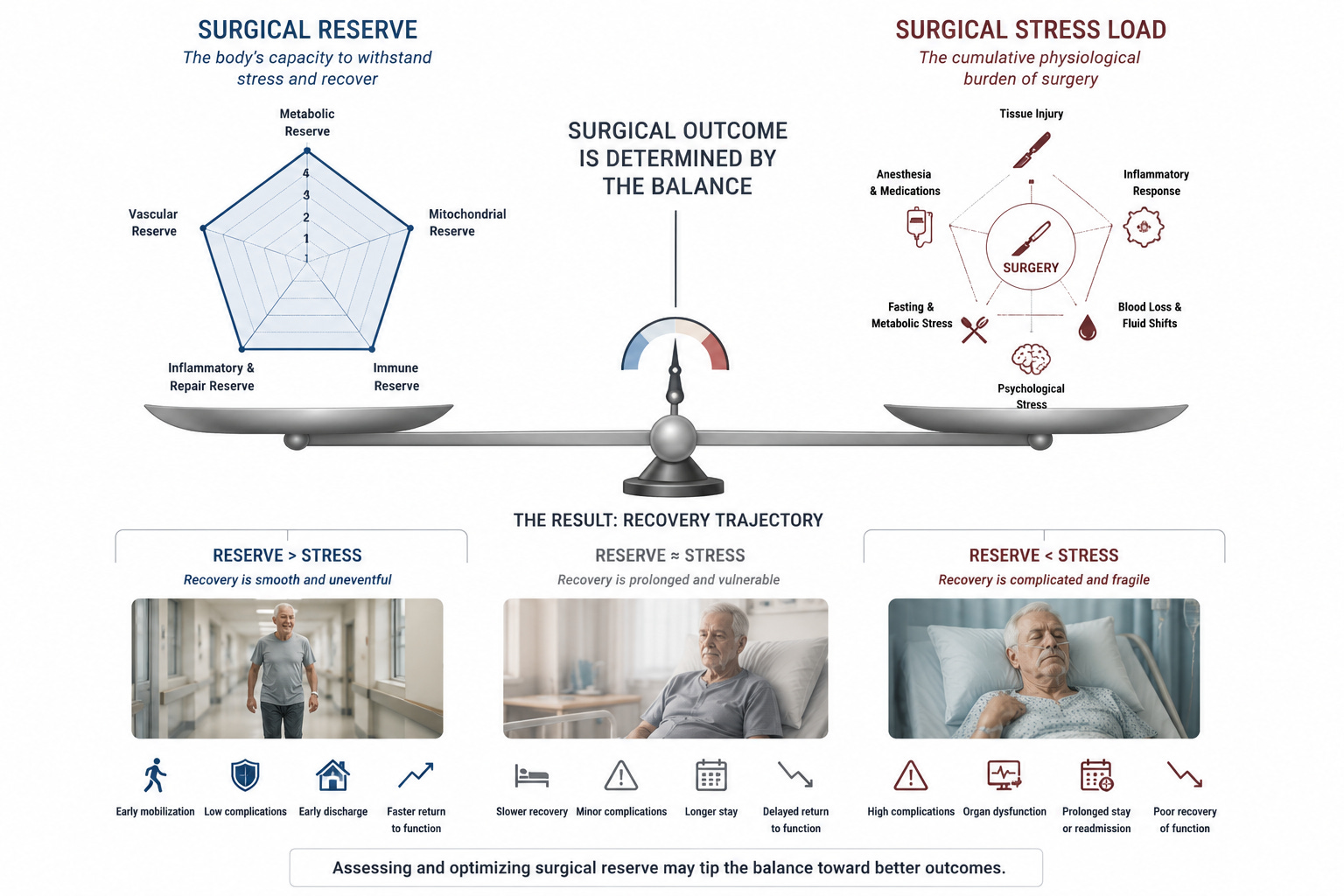
The relevance of these domains does not lie in their independent measurement alone. We hypothesize that their combined behavior under stress may explain the variability we see in recovery after surgery better than single-system assessments. It is important to note that the specific biomarkers and measurement strategies that best capture each domain remain to be defined and validated in research studies.
Surgery As A Scientific Opportunity
Most forms of biological stress are difficult to study with precision. Infection emerges unpredictably. Psychological trauma accumulates over years. Chronic inflammation builds slowly, without a clear starting point.
Surgery is different. We know exactly when the biological stress will begin. We can estimate its magnitude from the procedure type and the patient’s physiology. We can measure baseline biology before the stress event, capture the acute response in its earliest hours, and follow the recovery trajectory across clearly defined postoperative windows. While surgical environments are inherently complex and not fully controllable, elective procedures still provide a uniquely time-defined and clinically observable stress window, compared to most other biological stressors.
In this sense, elective surgery may serve as a rare, controlled human model of acute biological stress—one in which reserve depletion and recovery can be observed, measured, and ultimately studied with a degree of temporal precision that few other clinical settings allow.
The Question We Are Not Yet Asking
Current preoperative assessment has become extraordinarily sophisticated in measuring what is present. It measures organ function, disease burden, pharmacological risk, and the statistical probability of complications. It has made surgery safer than at any point in history.
Prehabilitation has further demonstrated that improving a patient’s condition before surgery—through exercise, nutrition, and psychological preparation—can meaningfully influence their outcomes after surgery.
A reserve-based perspective does not replace these advances. It may help extend them by offering a more physiologically explicit framework for understanding why the same preparation produces different outcomes in different patients, and by identifying which domains are most constrained in each individual.
This perspective is not intended as a replacement for existing frameworks, but as an extension that may help integrate them. What it adds is a different set of questions. Not only: what diseases does the patient have? But: how close is this patient to the edge of biological compensation? Not only: what is the statistical risk of complications? But: which physiological domain is most likely to fail first under surgical stress?
The hypothesis that follows is simple, but it has not been formally tested: some patients who appear operable by every conventional risk measure may already carry insufficient biological reserve for the recovery that surgery demands.
This framework is currently conceptual and requires formal validation. A logical next step is performing new research to examine whether domain-specific reserve measures correlate with postoperative recovery trajectories—including outcomes such as length of stay, inflammatory response patterns, wound healing, functional recovery, and complication rates.
Can reserve-based preoperative assessment differentiate patients who will or won’t recover well before the operation—before the morning after when one patient walks the corridor and the other cannot rise from bed?
This remains a hypothesis—but one that is now testable within the controlled stress environment that surgery uniquely provides.
A Note For Anyone Facing Surgery
The key points presented here are relevant not only for clinicians and researchers, but also to every patient.
If you are preparing for an elective operation, you are not simply presenting a diseased organ or a structural problem to be fixed. You are bringing your entire biological system into contact with one of the most demanding stressors the body can face. How well you recover will depend not only on the skill of your surgical team—though that matters enormously—but on the biological resources your body carries into the room.
Sleep, nutrition, physical conditioning, the management of chronic inflammation, and the control of metabolic disease—these are not peripheral concerns to be addressed sometime after the operation. They are the inputs that determine what reserve your body has available when the stress of surgery arrives.
The questions worth asking your surgeon—and worth asking yourself— are not only: can this operation be done safely? But also, is my body prepared, at a biological level, to pay for it and recover from it?
That question does not complicate surgical care. It begins to complete it.
We’re excited to be assembling a community around the Science and Experience of Energy with this Substack. We hope to bring people together to reflect on
how we experience energy in our everyday lives.
If this post made you take a pause or if it resonated with you,
please share with someone you love.
 | A guest post by
|
Excellent points, and I agree this is probably the best clinical optimization we can do today.
But even after optimization, some patients still fail unexpectedly. That tells us there may be another layer or missed variable we are not mapping well enough.
For me, the bigger question is simple:
Can we stop looking only at isolated variables and start studying the surgical stress-response cycle as a full system, before, during, and after major surgery?
Very interesting and it’s also something I’ve considered over my career. The question becomes what do you test for pre/postop and how do you do it?
I take care of a lot of recalcitrant diabetic and other chronic pressure wounds. I don’t even consider bringing any patient in this situation to the OR until they’ve been clinically “optimized.” The things we are aware of come from the nutrition panel of labs including prealbumin, albumin, transferrin (which are adjuncts for protein and caloric reserves); iron, total iron binding capacity (TIBC), ferritin, and CBC (adjuncts for the body’s ability to produce blood cells, iron reserves, and chronic inflammation). These are the quick and easy labs. If you’re worried about inflammation, sometimes erythrocyte sedimentation rate and C-reactive protein (ESR/CRP) is important as well.
Beyond that are the slew of minerals responsible for wound healing - zinc, magnesium, manganese, calcium, chromium, copper - but these are not always readily available and can take weeks to come back.
There are other aspects I work on clinically to ensure success in the OR, such as smoking cessation, postop specialty bed, pressure offloading, proper wound care. But this doesn’t account for the patient’s preop reserve nor provide an understanding of their allostatic load. What do you envision for this? I’d love to learn more and discuss!