


LIVED EXPERIENCE
In the first week of March, we set out on a long trip to Nepal for a “spirituality-meets-science” gathering. The trip was challenging, inspiring, and full of special moments.
Why We Went to Nepal: Discovering Tibetan Buddhism and A Path to Genuine Happiness
The meeting with Tibetan Buddhism was organized by our friend Dr. Richie Davidson. Richie was accompanied by Dr. Cortland Dahl, his former student, colleague, and co-author of Born To Flourish—a book that just came out.
Together, Richie and Cort have done amazing work helping to understand how mindfulness and meditation can help us lead healthier lives and be at our best—how we can flourish. They host fabulous dialogues on Dharma Lab, which we encourage you to check out.
Back to our event in Kathmandu: Richie had been invited by Khandro-La to organize a dialogue between Buddhists and Western scientists about the nature of awareness and the mind, and what two very different traditions of rigorous inquiry might discover when they finally sit down together.
At the heart of both traditions is the same question: what does it mean to truly understand the mind?
And a question more closely related to everyone’s life: How can an understanding of the mind lead us toward something that we all want: a path to genuine human flourishing?
Coming from our research around the biophysics of energy (Nirosha) and the mind-mitochondria connection (Martin), we were there to understand how energy and mitochondria fit in this picture.
Before the Meeting: In the Mountains
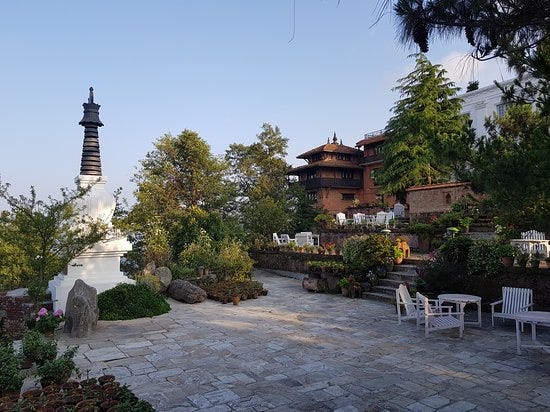
Before settling in Kathmandu for the meeting, we headed up the hills towards the Himalayas to see the mountains and spend a few days writing. We stayed in a simple, beautiful lodge perched on top of a mountain. It was known as one of the best places around to see the morning sunrise.
The lodge itself, The Fort Resort, felt suspended between worlds. It had a main building, plus a collection of little cottages encrusted on the mountainside like precious stones in the rockface. Our cottage, more like a hut, had a simple room, a few beds and a bathroom. Nothing more, and nothing missing.
Martin’s plan was to use this precious time away from home and the lab to work on the ENERGY book (it’s coming along, now writing Chapter 14 of 20). Nirosha’s plan was to finally finish a set of perspective pieces exploring how biological information may lie less in the signal itself, and more in its temporal dynamics.
Different projects, same instinct: to arrive in Kathmandu with something rare in our usual fast-paced lives—time (this will be important later).
We had time to read, reflect, and prepare for a conversation we’d never had before: a genuine dialogue between Tibetan Buddhist scholars and Western scientists. These two traditions have spent centuries studying the mind, and would finally be together in the same room.
Well, as it often happens with plans, they kind of went down the drain… literally.
We had a couple of relaxing, productive days where we walked around, including a hike deep in the Nepalese jungle. We did some reading, thinking, and writing.
But food poisoning hit us both.
Collapsed in our encrusted mountainside cottage, we laid like half-dead bodies on our small beds. No productivity. No ideas. Just survival. For about 36 hours, we alternated between the bed and the toilet—purging ourselves from both ends.
Nepal, we thought, is a place where experiences are made. Where people come to seek something deeper, go on spiritual walks, hike, climb, and shed what they no longer need.
Maybe this was our cleansing phase, preparing us for what was to come over the next few days?
The Freshness of Life
Once that episode passed, we felt a sort of freshness about life and our trip here.
Have you, after a bout of illness, experienced a sort of “renouveau” in your life? A kind of renewal that lets you see things around you, or the thoughts in your mind, with an unusual distance. Or
with a new contrast.
We’ve certainly felt this before. Maybe it was the illness. Maybe it was the obligated fasting and the state of ketosis we were probably experiencing. Or a mix of both.
To get some fresh air, one afternoon, we went to the lodge’s garden. It was superb. Full of colorful flowers to contemplate. And full of beautiful, bumbling bees.
Here’s one of them—we nicknamed it the tumbling Nepalese bee—struggling to nail its landing!
The garden had 4-5 sizable beehives. Thousands of bees were buzzing over our heads as we sat, feeble and recovering from our temporary illness.
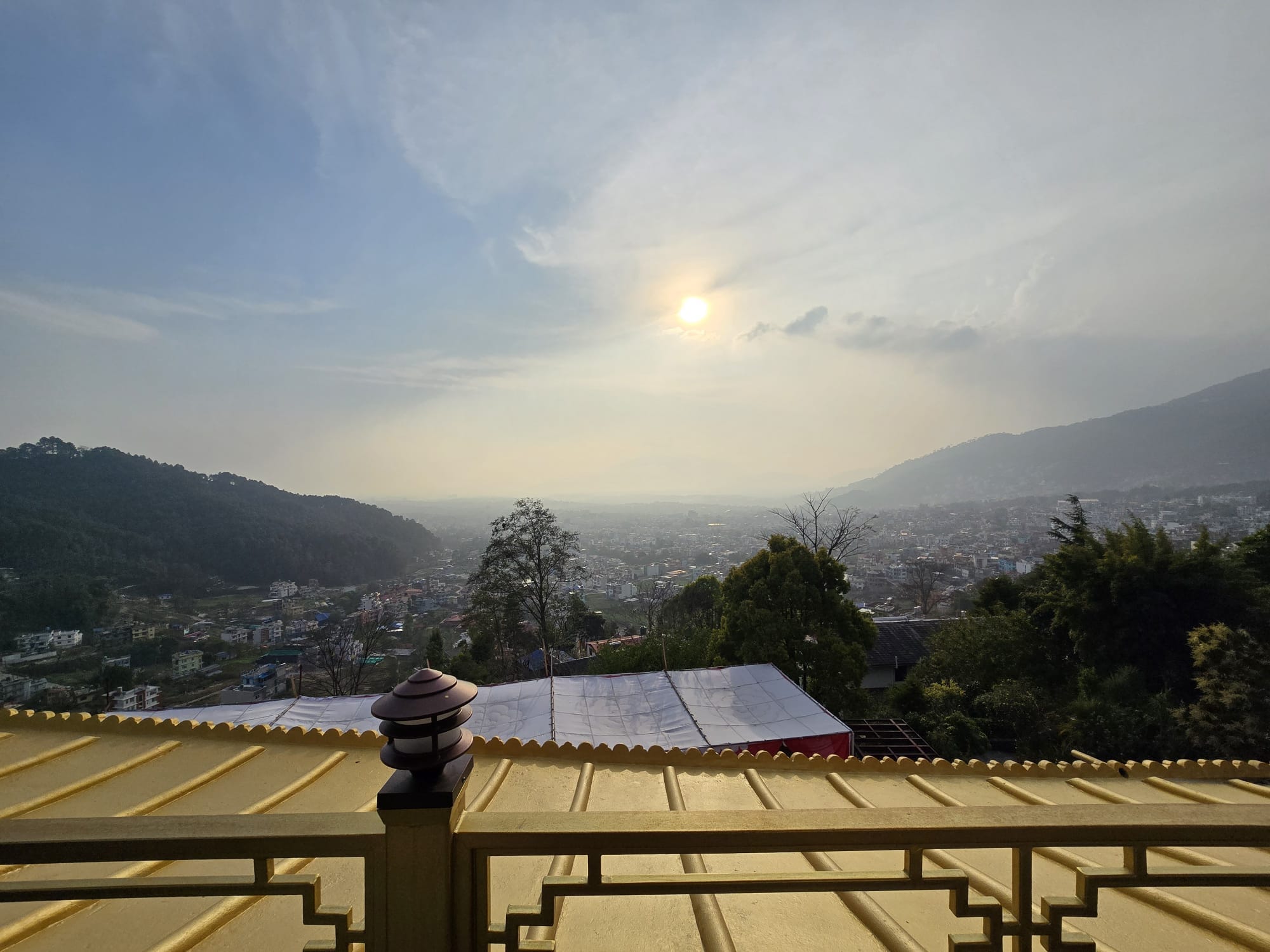
On day 5, we were still hoping we’d see the sunrise, but alas. It never came. Even at that altitude, 2,000 meters high, pollution and clouds prevented us from seeing the blueness of the sky.
Perhaps this was an invitation to look inside, feel, and get ready for our Kathmandu meeting.
Who Was In the Room?
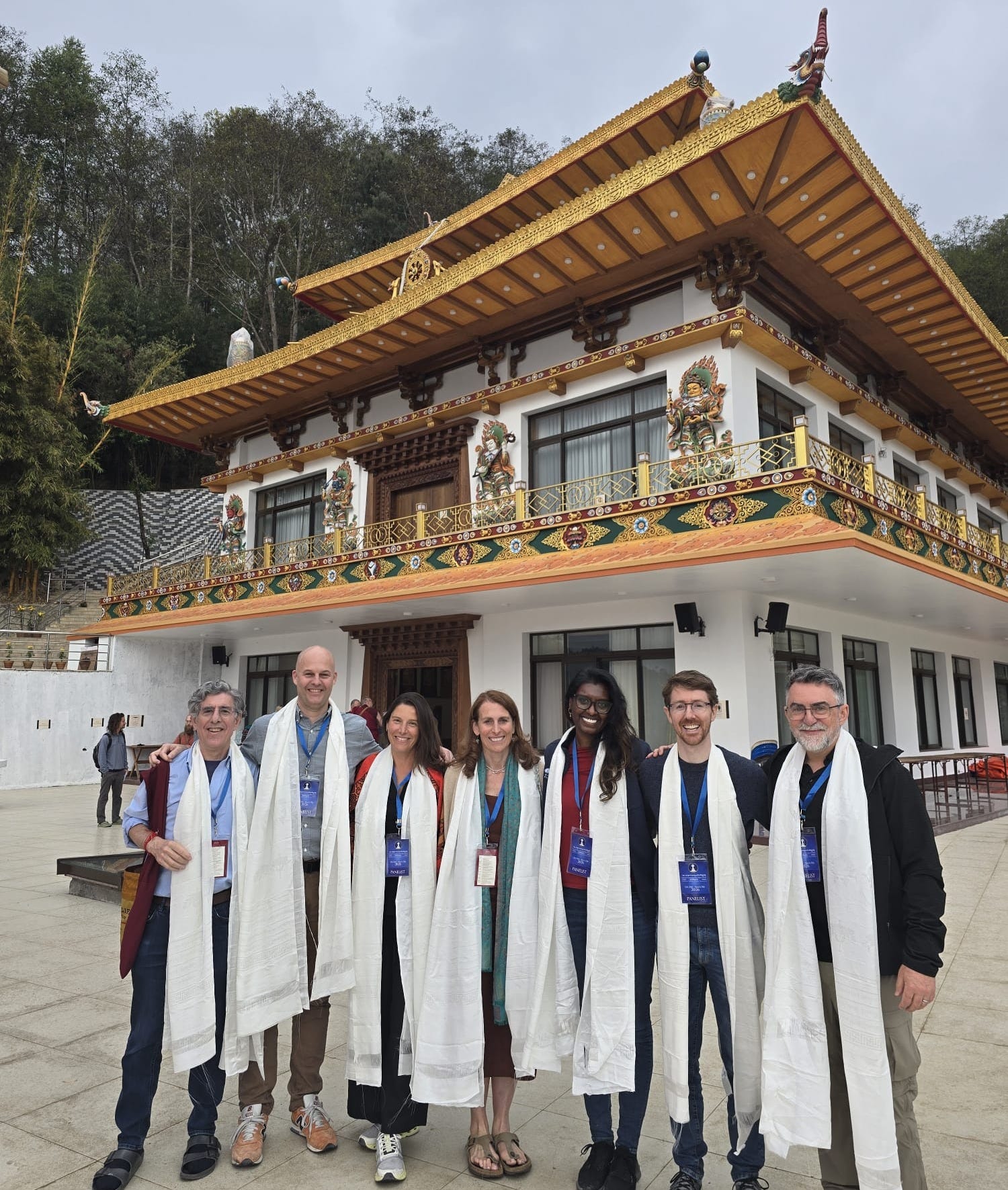
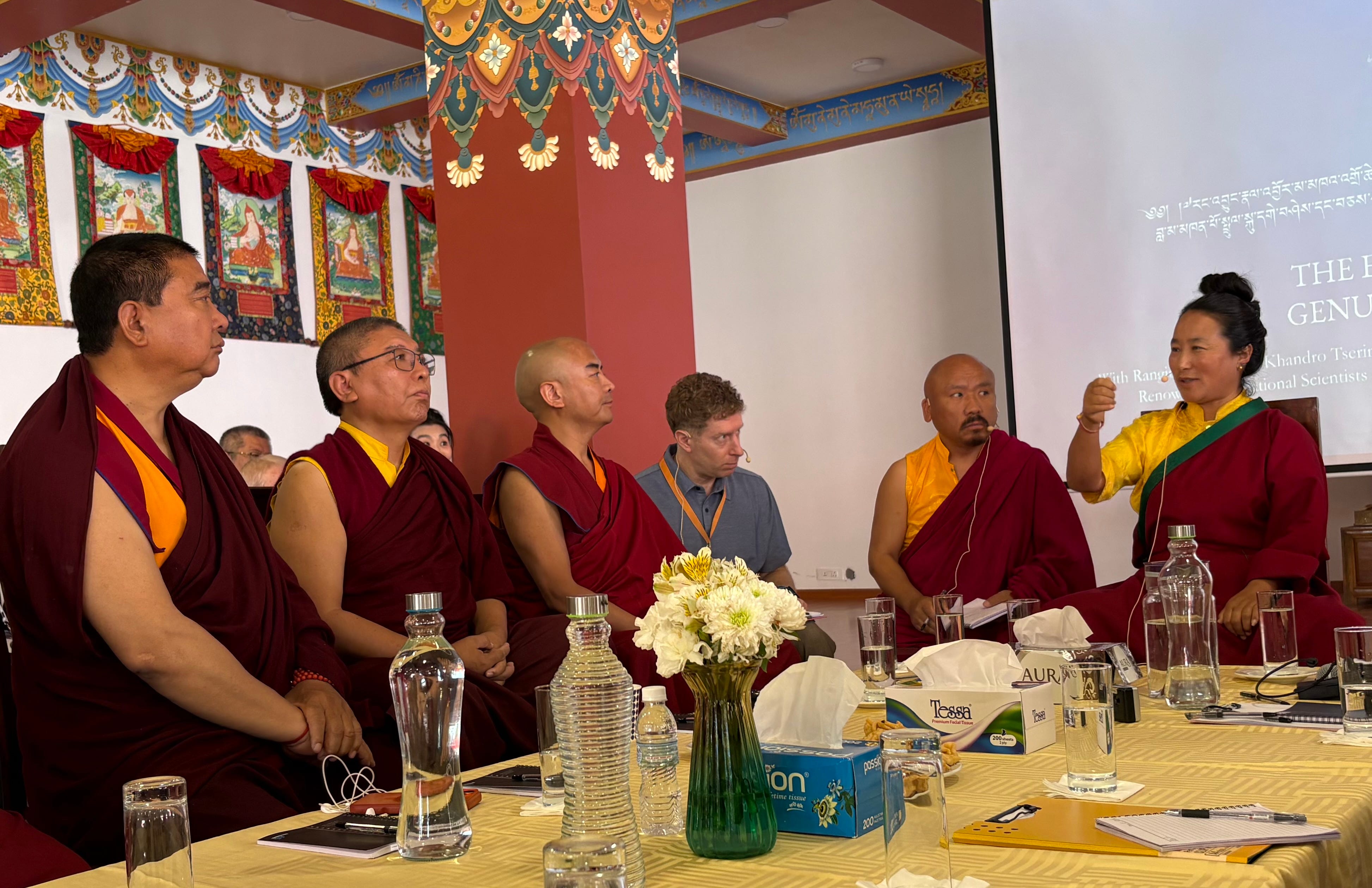
Along with Ritchie and Cort, we were a part of a small group of wonderful people: Sona Dimidjian, Adam Weismann, Christina Glavas, and Elena Antonova, fellow scientists and visionary thinkers who have each dedicated their careers to understanding the relationship between mind and body.
We were also blessed to have amongst us 2 of the most well-known Rinpoches (an honorific title to high lamas, accomplished spiritual teachers)—Tsoknyi Rinpoche and Mingyur Rinpoche. Plus ten other Khenpos, Geshes, and Lamas.
Think of these titles the way you’d think of academia: a hierarchy earned through decades of study, and practice running from postdoc all the way to full professor. Except here, the curriculum is study of mind, ethics, and reality, all cultivated through disciplined practice, meditation, inquiry, fueled by nurtured curiosity and direct experience.
The invitation and agenda for this meeting itself was simple. Come with an open mind. Listen. Learn. And explore how these two traditions, often developed in parallel, might begin to speak to one another more directly.
What brought us together was not just curiosity, it was a shared recognition that the biggest questions we face as humans, including how to cultivate sustainable happiness, cannot be answered by science alone.
We are both, in different ways, scientists of energy. Martin uses his science to try and understand how mitochondria transform the energy that powers every thought, every emotion, every moment of consciousness. Nirosha studies how energy moves through tissue and between cells through a biophysical lens. We work at the edge of psychobiology, where the material and the experiential begin to blur.
And so, naturally, we had questions. As a group we wanted clarity about what Khandro-La thinks about the interdependence of all things (a key concept in Buddhist philosophy) and the brain. We wanted to pinpoint insights that would be both meaningful to scientists, and beneficial to human beings.
Though we were limited to a few questions, Martin asked Khandro-La about energy and experience. How does energy flowing in the body related to subjective experiences?
Nirosha wanted to know about time—how do Buddhist teachings understand the relationship between consciousness, the mind, and time? Is the experience of time a product of the mind, or does the mind arise within time? These were not small questions. And the answers, as it turned out, were illuminating.
At the center of it all was Khandro-La.
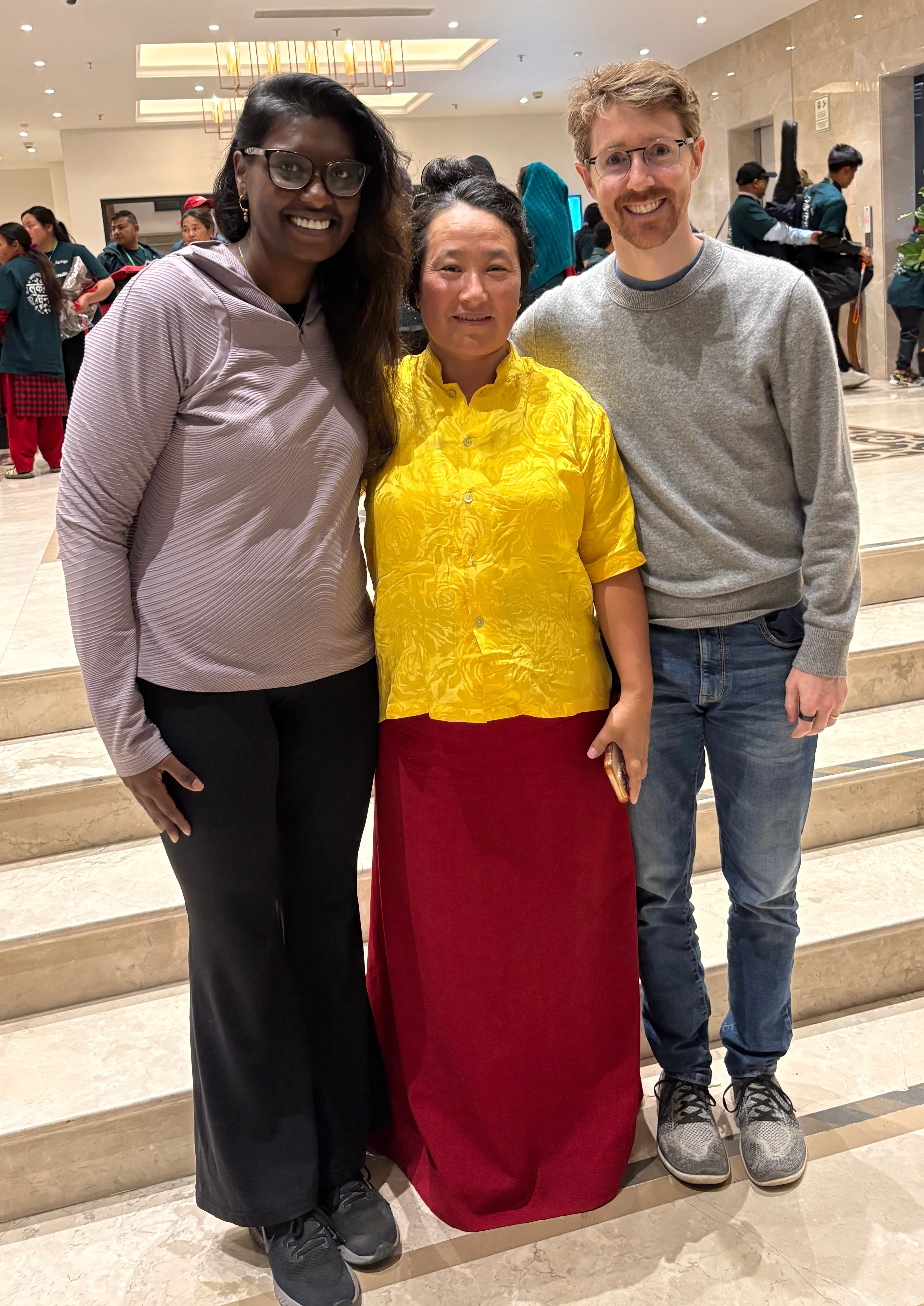
Her life story is itself remarkable.
Born in rural Tibet without access to formal education, she later came to be recognized for her insight and understanding of centuries-old teachings. Her life trajectory didn’t follow the usual path of an academic or scholar, or not even of a lama. And yet, her clarity about the nature of mind, experience, and reality was inspiring–all of which started with her thinking about deep existential questions at the age of 7!
She told stories of her childhood when she started to question the nature of mind. What allows plants to grow from little, inert seeds into gorgeous living organisms. Or the pain that a baby goat experiences when it’s pulled from his mother so the humans can take her milk.
Early on, she wondered about what makes the human mind different than the mind of other animals.
Sitting in the room with her, listening to her stories, what struck us most was not her accolades or titles. It was her presence: she spoke with a refreshing directness and ability to weave experience with deep philosophy.
She answered questions with humility, assurance, and a grace we don’t typically see at scientific meetings. All of that, wrapped in a contagious laugh that melted the potential distance between conceptual questions the reality of being human.
What We Learned: Outer and Inner Sciences
Central to Buddhist philosophy are two deceptively simple questions for truly appreciating genuine happiness: what is the mind, and where is it?
To understand it, Buddhist tradition holds two things together. There is the inner science of the mind—it is subjective, first-person, and the felt sense that emerges from being alive and aware.
And there is the outer science of material phenomena: the stuff we have instruments to measure, like brains, neurons, and electrochemical and molecular machinery that science has become expert at describing.
The point here: neither inner and outer sciences are complete without the other.
One thing that struck us is that they talk about the inner science of the mind, they really mean “science.” The systematic collection of data, organized and critically examined in a way that allows one to derive generalizable principles. Only here, the data is experience, rather than a magnetic resonance imaging-derived brain activity signal, or the abundance of a molecule circulating in the blood.
What We Learned: Eight Layers of Experience
Buddhist teaching describes eight layers of experience.
The first five are the five senses that bring in raw experiences from the world—turning patterned energetic signals into experiences. These are the most coarse, material layers.
The sixth is the conceptual mind (manovijñāna), where the thinking, categorizing, judging, and narrating mind hangs out.
The seventh is the defiled mind (kliṣṭa-manas) or the ego—the subtle, persistent sense of “I” that clings to experience and colors everything with self-reference, attachment, and aversion.
And then there is the most subtle layer: the deeper stratum of awareness that underlies all experience, the luminous quality of knowing itself.
That’s the eighth layer, the universal consciousness (ālaya-vijñāna)—understood to be the vast, foundational ground that holds the seeds of all past impressions, habits, and tendencies. This is the quiet reservoir from which the other seven layers continuously arise, like waves from the ocean.
The coarse layers relate to material stuff. While the subtle layers are experiential. Sound familiar?
This is precisely the architecture we are trying to cultivate with our Science.
We’ve studied energy at the material level: ATP, electrons, membrane potentials, and other tractable forms. But we are increasingly confronted with the fact that this story is incomplete.
And if you stop for a moment, close your eyes even perhaps, or try to meditate to observe the movement of your own mind, you realize that there is an experiential dimension to being alive. Living systems experience things–at least we do–that our laboratory instruments can gesture at, or capture traces of, but never not fully capture.
Buddhist scholars have been mapping the territory of the mind for centuries. In search of a fuller truth, we now have the opportunity to explore these models of mind in the context of the biology of energy, and see if and how experiences can be woven into the Western scientific domain.
On Awareness, Emptiness, and What Is Nothing
Khandro-La spoke about awareness in a way that really changed our perspectives on experience.
In the Buddhist understanding, awareness is not a product of the brain. It is not manufactured by neural activity, nor does it vanish when neural activity ceases. It is the ground condition of experience itself—self-arising and luminous. That’s pretty different than anything we’ve ever heard at academic events.
She spoke, too, about emptiness, careful to correct our Western reflex: emptiness is not the absence of something. It is not a void.
In Buddhist terms, emptiness is the open, unobstructed quality of reality that allows everything to arise—more like an empty sky than a hole.
The sky is not empty of blue; it is the condition for blue to appear. Emptiness is the condition for experience to appear.
This could have implications for our mind-mitochondria science. If awareness is not reducible to the material substrate that generates it–like physicists and philosophers including Bernardo Kastrup (Analytic Idealism In a Nutshell), Donald Hoffman (The Case Against Reality) and others, as are now beginning to suggest–then the study of the mind cannot be only the study of the brain.
That idea suggests that there is something else to account for. The question is not whether science can accommodate this, but whether it is willing to.
How do we tie this all into a Western scientific framework? What is there to gain from bridging our perspectives?

Not Siloed, But Together
One of the most important moments of our meeting came when the group asked, collectively: how do we bring the advanced teachings of Buddhism to science so that we can work together, and not in silos? This is not a new question. But who we were asking this to… really was new.
The temptation for scientists is to extract what is testable, translate it into the language of mechanisms, and leave the rest behind. This is useful, but limited. It treats over a thousand years of first-person inquiry into the nature of mind as a pre-scientific approximation. It tries to boil down experiences into things we can objectively measure.
What Khandro-La and the broader Buddhist teaching suggests is something more radical: that first-person investigation of experience is itself a valid and rigorous form of knowledge generation. Done systematically, it is science.
From their view, contemplative scientists and the laboratory scientists are both, in their own ways, empiricists.
The question of what the mind is cannot be answered from the outside alone. It needs to be experienced. You need to feel it directly.
This doesn’t mean abandoning the third-person or objective perspective. It means expanding it and building methodologies that can hold both. It involves contemplative “inner” and material “outer” scientists sitting in the same room—as we did in Kathmandu—not translating for each other, but genuinely listening and learning from each other.
To what end? We’ll find out, we hope. We don’t know, but have an open mind about what this might lead to.
This trip was a beginning. It was the first conversation of many.
Discussions over the two-day gathering brought to the forefront a recognition that the biggest problems we face—understanding consciousness, healing the mind, and restoring the energetic vitality of living systems—require this kind of collaboration that joins science and experience.
Coming Home
We left Nepal tired, changed, and carrying more questions than we arrived with.
The mountains did not reveal the sunrise to us. The meeting did not produce a grand unified theory of mind and matter. The food poisoning was deeply unpleasant.
But something changed. Sitting with a teacher who has spent decades investigating the nature of mind and the process of awareness from the inside felt quite special, and unconventional.
Perhaps more importantly as we develop a field of science, we realized how sitting alongside inner scientists of the mind and our colleagues, outer scientists of material phenomena, we felt the edges of our own frameworks soften a little. The dialogue spawned curiosity and openness.
And this is perhaps where all good science needs to begin.
The conversation is just starting. We’ll keep you posted as it continues. Through
The Science and Experience of Energy, we hope to bring people together to reflect
on what these kinds of topics mean for our daily lives.
If this post resonated with you, share it with someone you love.
Thanks for sharing this story! First-person investigation of experience is something that's invaluable to not only understanding the mind but also understanding health, so I'm glad its importance was highlighted here.
In one of your Energy X spaces, I shared some thoughts/questions my research brought to mind about the relationship between intrinsic health, mitoception, and interoceptive capacity/resolution. My work involves using a field-based framework to explore the physics of consciousness and experience, and the biggest source of insights have often come from the massive amounts of data collected by eastern spiritual systems, such as the Yogic Sciences. The data that's been collected through these systems after centuries of first-person investigation of experience is so unique and valuable because the practitioners who immerse themselves in these systems and devote their lives to expanding their awareness have trained their interoception to a level that changes the phenomenology of their everyday experience, much like how the "renouveau" you experienced after your bout with food poisoning allowed you to perceive both your inner and external environment differently.
The resolution of a person's interoception is important when considering one of the three pillars of intrinsic health: communication. We know that impaired communication can dysregulate the human system and hinder its ability to maintain dynamic equilibrium, and interoception is how we're able to perceive that communication. Impaired interoception hinders our ability to perceive our system's internal communication, which consequently hinders our ability to engage in restorative interventions. However, what would it mean if interoception is no different than our body's physical muscles that have to be exercised and developed?
If these monks are like the spiritual equivalent of body builders who have trained their interoception to levels the average person hasn't, that means they've gained access to their system's internal communication that the average person hasn't. And the centuries of data they've collected from observing this communication is what's informed their understanding of the human system, health, energy, mind, and the nature of reality itself. Because as open systems, our cells don't just communicate with each other; they communicate with the environment as well. And if all of these different eastern systems have come to similar conclusions about the nature of the human system, health, energy, mind, and even reality, that tells me that there's a disconnect between what western academia considers to be impaired communication and impaired interoception and what these eastern systems would consider to be healthy communication and healthy interoception.
The relationship modern Western society has with the environment is much like the relationship a cancer cell has with its environment. Michael Levin's research on cancer helps illustrate this from a physics perspective. Levin has shown that cancer isn't fundamentally a genetic story but rather a communication breakdown. When cells lose their bioelectric connection to the collective, they lose access to the morphogenetic goal state that tells them what to be and how to behave in relation to the whole. Without that connection, they default to an ancient unicellular program: prioritize individual survival, proliferate, and consume resources without regard for the organism. The "selfishness" of cancer is what cells do when they can no longer hear the field that coordinates them.
Now consider how modern Western living mirrors those exact conditions. Chronic social, environmental, and spiritual isolation. Sensory environments designed to overstimulate the external senses while drowning out internal signals. Lifestyles that systematically strip away the conditions for coherent communication between the individual and their environment. It seems as though what we're looking at is the same physics operating at a different scale, especially when you describe intrinsic health as a field-like state emerging from energy, communication, and structure. A society that has severed its communicative relationship within the living systems it depends on is exhibiting the same organizational breakdown that Levin observes in cancerous tissue.
And this is where the need for bridging inner and outer science becomes more than philosophical interest and turns into a necessity for understanding the science of health. The communication architecture that keeps a living system coherent doesn't just need to exist. It needs to be perceived. That's what interoception is. And the centuries of convergent data from Eastern spiritual systems aren't just interesting historical artifacts; they're the most extensive empirical record we have of what becomes accessible when that perceptual capacity is developed to its full potential.
The challenge is that integrating what these traditions have observed with what Western science has measured requires the right kind of framework. One that can hold both field-level coordination and first-person experience without reducing one to the other. I think field-based physics offers that bridge, because it gives us a shared formal language for the organizational dynamics that both traditions are describing from different vantage points. The outer scientists measure the field. The inner scientists train themselves to perceive it. Neither perspective is complete alone.
Fantastic learning shared here. I have explored the Buddhist meditation technique of Vipassana. Presently, I am practising a specific yogic technique taught through the inner engineering program by the Isha Foundation. I am noticing how operating from the space of awareness is so incredible for myself and others. The key point here is exploring your inner self. A lot of focus is put of intellectual pursuit and quest for knowledge. However, without experiencing for yourself, it still remains theoretical knowledge and does not become experiential wisdom. What I have experienced in the past month of my regular practice is profound.
I say this while acknowledging that I am about to defend my PhD in clinical sciences, exploring the role of non-invasive vagus nerve stimulation in chronic pain management, immune system and autonomic regulation. Science quenches intellectual quest, but spirituality allows for an inner experience that intellect often doubts, questions or debates with.
Looking forward to reading your book and following your research with great intent.