


ENERGY SCIENCE
Full-Text Link to Primary Source
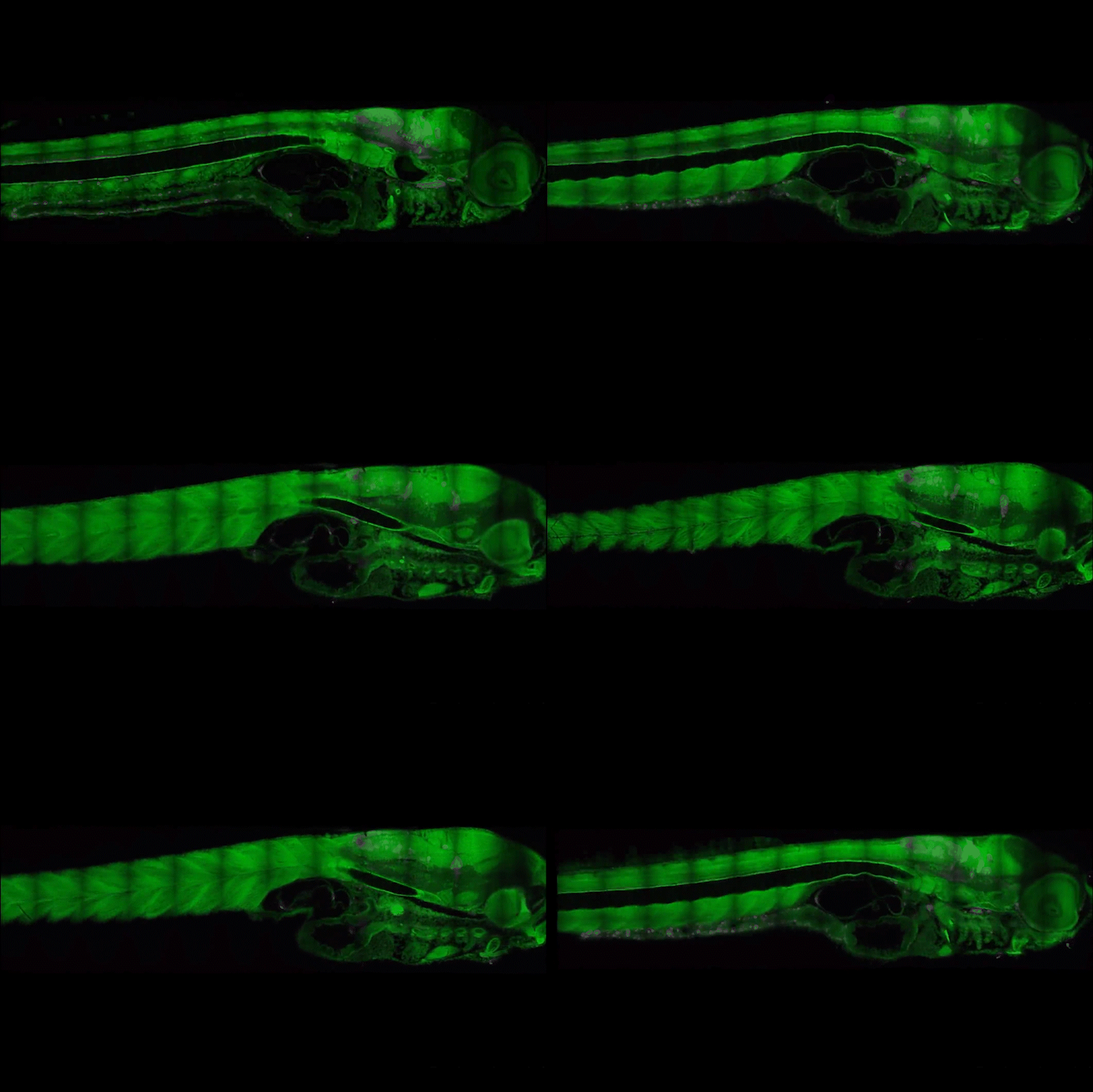

In this post, we explore a recent study using advanced imaging in zebrafish that gives us valuable insights into what is happening across the whole body of a living organism.
Zooming Out to View a More Complete Picture of Biology
With its reductionist lens, biology has become amazingly good at taking things apart. As biologists, we analyze life—that is, we take it apart.
We can identify and study individual genes, proteins, molecules, organelles, cells, tissues, organs, and circuits in the brain. This reductionist approach has given us tremendous knowledge, but biology isn’t just the sum of all these separate pieces.
Life doesn’t happen one molecule or one cell at a time.
The authors start their abstract with this statement: “An animal’s ability to survive and thrive—whether fleeing from danger, eating a meal, or fighting an infection—arises from the collective moment-to-moment activity of many interacting cell types throughout the body.”
That applies to my and your body’s systems, organs, and cellular processes, too. Every cell in the body continually interacts with others. All parts of the body are interconnected. Just think about how our blood flows, touches, and binds every cell together as a whole.
Energy and information are ultimately what binds everything together. Energy moves through these systems at different speeds and across different scales. Somehow, all of this activity is coordinated into one living organism.
The new study offers us a window into this whole-body, coordinated dimension of life.
Researchers led by Virginie Ruetten and Misha Ahrens developed a technology they call WHOLISTIC. This is short for WHole-Organism Live-Imaging System for recording Tissue and IntraCellular activity—clever. It allows us to simultaneously watch cellular activity across almost the entire body of a living fish.
When I first saw their images and videos, my mind was blown.
Not simply because they are beautiful, but because it allowed us to look at the inside of a whole organism—in motion. Not a human, mind you. A small fish—but a whole organism nevertheless.

Making the Invisible Visible
Much of their work was done with zebrafish, which are small, striped fish and a common model used in research. When the fish are young, they are mostly transparent. Convenient if you want to look inside!
The team engineered the fish so that their cells produced a fluorescent sensor that responds to calcium. Calcium isn’t just a mineral that strengthens our bones. Inside our cells, calcium acts as an important signaling molecule—it’s a pretty universal “ON” signal. Changes in calcium triggers neurotransmitter release in neurons, for example. It induces muscle contraction. And many other cells do what they need to do to keep us alive and healthy in response to a pulse of calcium.
Virginie and Misha’s fluorescent sensor lights up when calcium levels in different parts of the fish change.
This imaging approach translates cellular activity that is normally invisible into light that we can see and measure.
By combining this biological sensor with rapid three-dimensional microscopy and sophisticated computational methods, they managed to watch large numbers of cells across multiple organs—all at once.
Think about what this means.
Much of our knowledge of biology has come from choosing where we wanted to look, and then pointing the microscope specifically at that region. Ignoring the rest of the organism because of technical shackles. If you study the brain, you place your sensors in the brain. If you study the kidney, you measure the kidney.
But what if the most interesting activities happen somewhere you didn’t expect?
Or cooler still—what if the most important activities, or the most meaningful deficiency in a certain context, involves the way in which different cells or organs (fail to) interact with each other. If you looked at a single marker or organ, you’d never see it. To get at the true dynamics, you need to look at the interactions between systems.
WHOLISTIC gives researchers an opportunity to look across the entire organism first. Doing this could help us discover new, meaningful dynamic processes we’ve missed all along.
Seeing What We Didn’t Know to Look For
The study contains several wonderful examples of these unexpected findings.
When the team put the zebrafish in cold water, they found a strong response in chondrocytes. Those are the cells responsible for producing and maintaining cartilage. That’s not necessarily where most people would have thought to look.

Then they gave the fish the dissociative anesthetic ketamine (used now in clinics to treat depression, or recreationally to explore the confines of the mind). Ketamine triggered calcium responses in cells associated with the membranes surrounding the brain.
Ketamine also affected the kidneys. The team observed slow calcium waves traveling through structures responsible for filtering the blood and regulating the body’s internal environment.
When the fish weren’t moving, they also saw slow waves of calcium activity in cells lining regions of the brain and spinal cord during longer periods.
These discoveries are what makes this technology so exciting. Science is often hypothesis-driven, and this is a sensible and useful approach. We formulate an idea and design an experiment to test it.
These kinds of tools can reveal things we couldn’t have even guessed were relevant.
Groundbreaking discoveries can happen by looking with an open mind—in some cases, with a fancy microscope—at something.
Examining the Body as an Interconnected Living System
This work is important because it raises the possibility of moving beyond individual cellular responses. In a way, it’s a bit of a remedy for our spatial reductionism. It gives us a way to start to better understand delocalized relationships and cross-body energy patterns.
Everything we do requires coordination across different cells and parts of our bodies.
Something like going to the kitchen to get a snack requires impressive coordination of multiple processes. Neurons generate and transmit signals, muscles contract, the heart contracts faster and more strongly, blood vessels regulate pressure, and we start to breathe faster.
All in service of delivering energy and oxygen to the right place at the right time. This kind of short-term adaptation relies on neural, hormonal, and metabolic processes that shape energy resistance here and there. And in so doing, they determine where energy and oxygen are delivered.
In traditional Chinese medicine, it is said that the mind controls the qi (Chi). And that the Chi then moves the blood. Where the mind goes, qi follows; where qi goes, blood follows. Measuring blood flow at the scale of the organism in humans could allow us to start looking at these kinds of concepts.
Manipulating Activity With Light
Virginie and Misha didn’t just use WHOLISTIC to watch. They combined their whole-body imaging with optogenetics, the technique for which Karl Deisseroth, Peter Hegemann, and Georg Nagel just won the Nobel Prize in Physiology or Medicine. Using optogenetics, we can use light to control activity in specific groups of cells.
Optogenetics allows researchers to go beyond asking which cells are active at the same time—correlations, basically. With optogenetics, we can directly activate certain cells, and then observe how other cells respond. We can test relationships and functional networks.
When one cell type kicks in, what happens in the other cells in the body?
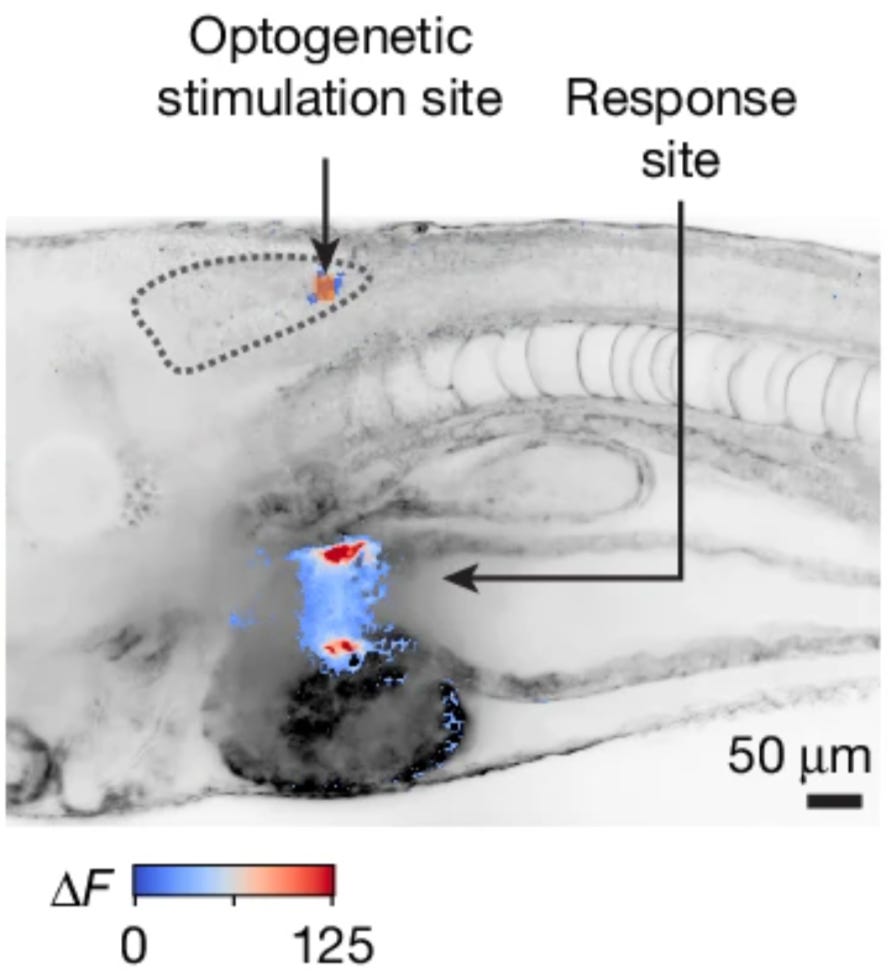
The research team found that calcium fluctuations in a cluster of cells in the brain were highly related to those in the smooth muscle cells that act like a valve between the throat and the intestines.
When they activated those brain cells with optogenetics, calcium immediately increased in the smooth muscle cells. This suggests that stimulating the brain cells likely caused the activation of those particular smooth muscle cells. Another example of how the gut and the brain are linked—in zebrafish.
Watching the Body Respond to an Energy Challenge
But how do body systems coordinate a response to stress? To test this, the researchers lowered the amount of oxygen available to the fish. That’s called hypoxia.
We know from work on mitochondria that decreasing oxygen takes away the terminal electron acceptor in mitochondria. Without oxygen to accept flowing electrons from metabolism, electrons begin to stall. That increases energy resistance (éR) and triggers several adaptive changes within organisms.
When oxygen becomes scarce, it’s an energetic problem. And it’s a problem for the entire organism.
Using red blood cells with fluorescent tags, the researchers watched blood flow throughout the fish. In low oxygen conditions, blood flow patterns changed. Circulation was reduced in some peripheral regions, maintained in others, and prioritized to critical tissues. Energy reallocation!
Energy reallocation is precisely what organisms facing energy constraints must do, following core energetic principles. That’s how we adapt to energetic challenges.
The research team even identified circuits in the brainstem that may be orchestrating aspects of this response. This is a beautiful example of the dynamic nature of our biology. When an energetic challenge occurs, the organism reorganizes as a whole.
Virginie and Misha’s work showed us that the response didn’t happen in one molecule, one cell, or even one organ. It emerged from coordinated changes across the whole living system.

Seeing Life as Process
Some of the greatest advances in science have come from being able to make visible and see things that previously remained invisible.
Back in 1665, Robert Hooke’s microscope first revealed the existence of cells. Electron microscopy later opened our eyes to intricate structures within cells and organelles. And since the 1950’s, modern molecular biology has given us insights into once invisible genes, proteins, and biochemical pathways.
WHOLISTIC is exciting, not because it allows us to see one thing in more detail, but because it lets us observe more of the living system at once.
Living beings are dynamic, energetic systems whose expressions unfold over time. That’s how we grow and develop. It’s how we experience our lives and form memories. It’s how we heal.
Likewise, mitochondria are dynamic and multi-faceted organelles whose behaviors unfold over time, in a dynamic, distributed manner. They fuel our nervous, endocrine, immune, cardiovascular, and metabolic systems that, in turn, continually influence one another in a dance of energy transformation.
Imagine being able to understand illness by seeing how relationships among tissues become disrupted. Think about what we could learn about healing by watching this coordination gradually return as the body heals. That’s the next frontier—to understand the dynamic, energetic process of healing. And to find ways to support it—not to control it, using non-invasive energy-based approaches.
That new study represents a meaningful step in developing tools for the science and medicine of tomorrow. To help see and understand ourselves not as molecular machines, but as dynamic, energetic systems operating based on holistic, energetic principles.
When you watch the whole-body recordings from the study, focus on what happens in the organism as a whole, rather than on one flashing cell.
What patterns do you notice? We would love to hear your thoughts.
Amidst all these exciting insights, one core question stands out: If calcium plays such a vital role as an information carrier, what logical system response lies behind the widespread condition of osteoporosis?
It feels to me as though an energy-centric approach casts an entirely new light on chronic diseases — long overdue and envisioned from many directions already, but overlooked amidst past dogmas. That is why it is so valuable when rigorous academic frameworks and cutting-edge technologies establish these insights.
The line I was most excited to read was “by looking with an open mind.” In Form 27 of the Tao it says, “Although a good scientist observes, it is done for the first time every time.” WHOLISTIC seems to enforce that stance, removing the hypothesis allows the organism to be what it actually is. And that reminds me of another line of the Tao from Form #45 “…By removing herself, and her need to know, She can see Tao express itself fully.” From that point stepping back to observe the whole system under hypoxia gives a perfect example, and you were able to witness the whole system express itself fully.