
By Caroline Trumpff and David Shire
ENERGY SCIENCE
Full-Text Link to Primary Source
Our TSEE guest writer Caroline Trumpff is an Associate Professor in the Department of Psychiatry at Columbia University and a member of the Mitochondrial Psychobiology Group.
In this post, she shares the story of several years of research on cell-free mitochondrial DNA across different biofluids. She also describes results from a new paper examining the rhythmic dynamics of this potential stress signal.

Most of us think of stress as a feeling. A racing heart before a presentation. The knot in your stomach before difficult news. The mental exhaustion after a conflict with someone you love.
But beneath those experiences lies a fundamental biological challenge: stress costs energy.
Every time we adapt to a challenge, our bodies must rapidly mobilize resources: heart rate increases, hormones are released, immune cells shift behavior, and the brain becomes more alert. All of this requires energy.
Because mitochondria transform nutrients and oxygen into usable cellular energy, they sit at the center of the stress response.
For decades, scientists have studied hormones like cortisol to understand how the body responds to stress. But over the past ten years, our group and others have been building a body of evidence focused on a different character in the stress signaling story.
We’ve seen that mitochondrial signals are measurable in blood, saliva, and other biofluids, in the form of cell-free mitochondrial DNA (cf-mtDNA).
What is Cell-Free Mitochondrial DNA?
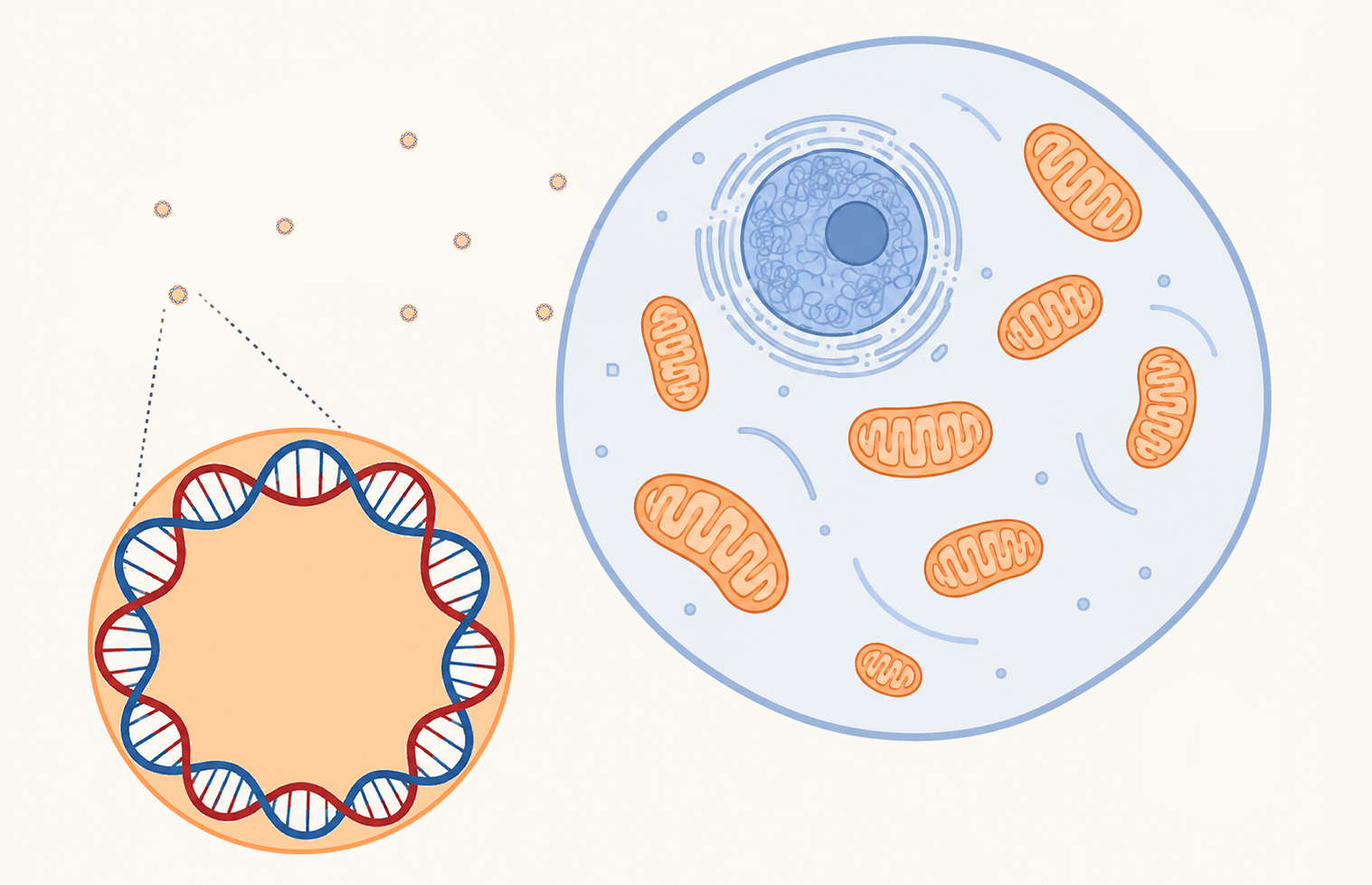
Unlike most cellular structures, mitochondria possess their own genome. This mitochondrial DNA (mtDNA) is inherited almost exclusively from our mothers and contains genes that help mitochondria perform the important task of transforming energy.
Mitochondrial DNA is mostly contained within mitochondria, but it can also circulate freely throughout your body through your body fluids. When outside of cells, it is known as cell-free mitochondrial DNA (cf-mtDNA).
We used to think it existed as little piece or circles of naked DNA, but we now know it’s mostly surrounded by membranes—many of which could be fragments of mitochondria.
Researchers initially viewed cf-mtDNA primarily as a marker of injury, inflammation, or disease. Elevated levels were reported in trauma, infection, aging, cancer, and psychiatric disorders.
But over time, a different picture began to emerge. Rather than a static marker of damage, cf-mtDNA is surprisingly dynamic.
Stress Can Change cf-mtDNA Within Minutes
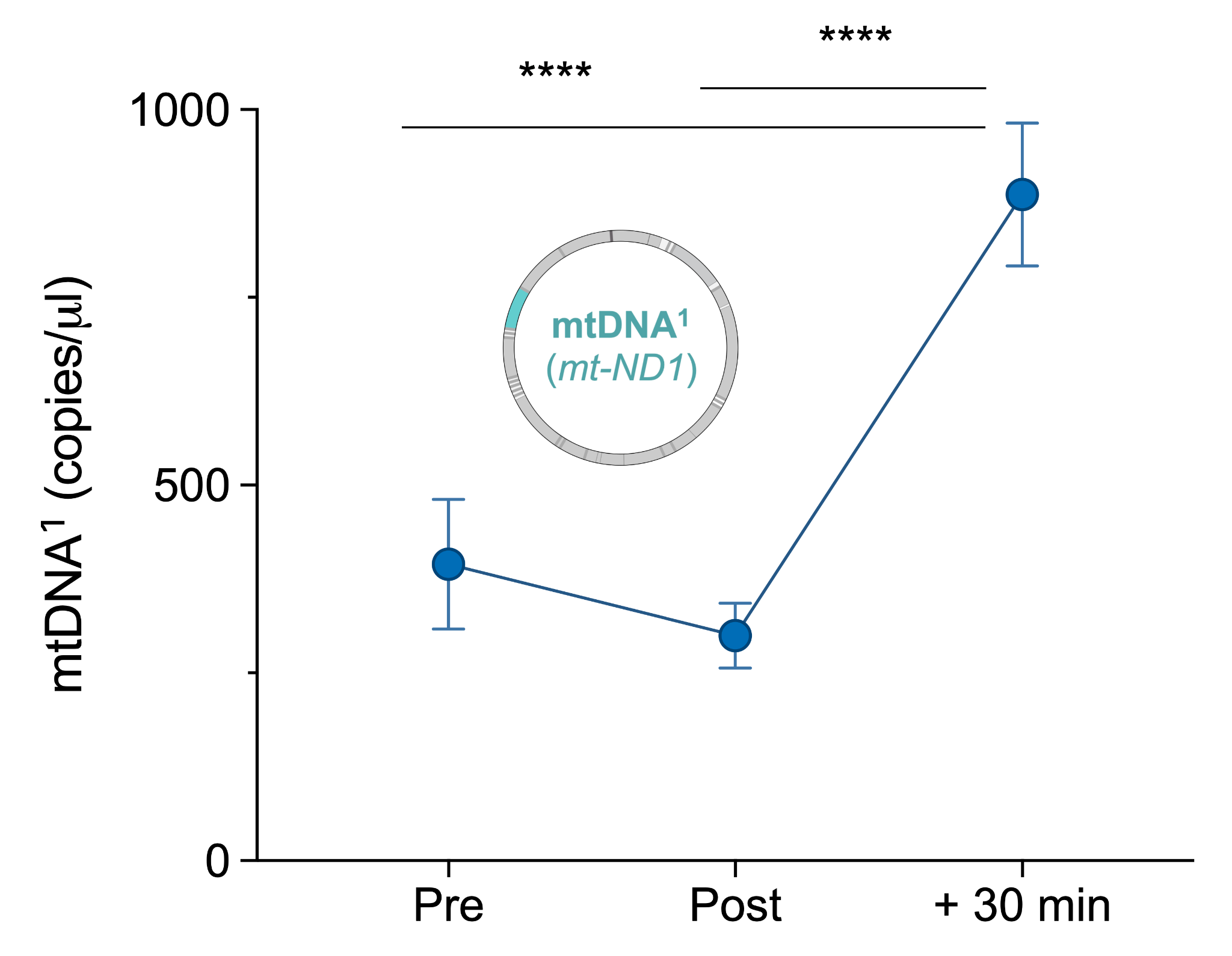
In 2019, our group reported that a brief psychological stressor increased circulating cf-mtDNA within minutes. Participants performed a short task that most people find stressful. They had to give an impromptu speech while being judged by an evaluator wearing a white coat.
Within 5 to 30 minutes, cf-mtDNA levels in the blood increased substantially. This suggests that mitochondria are signaling in response to stress.
After this initial study, we wanted to scale up. Would the findings hold if we studied more people, across biofluids, and built in the controls the first study lacked?
To test this, we had to build a fast, inexpensive method that could break apart membranes to allow us to measure cf-mtDNA. We called this approach MitoQuicLy. It can quantify cf-mtDNA from just 10 microliters (less than one drop) of blood or saliva, and it is cheap enough to run on thousands of samples.
That scalability made new studies below possible.
Putting It to the Test: MiSBIE and MaPS
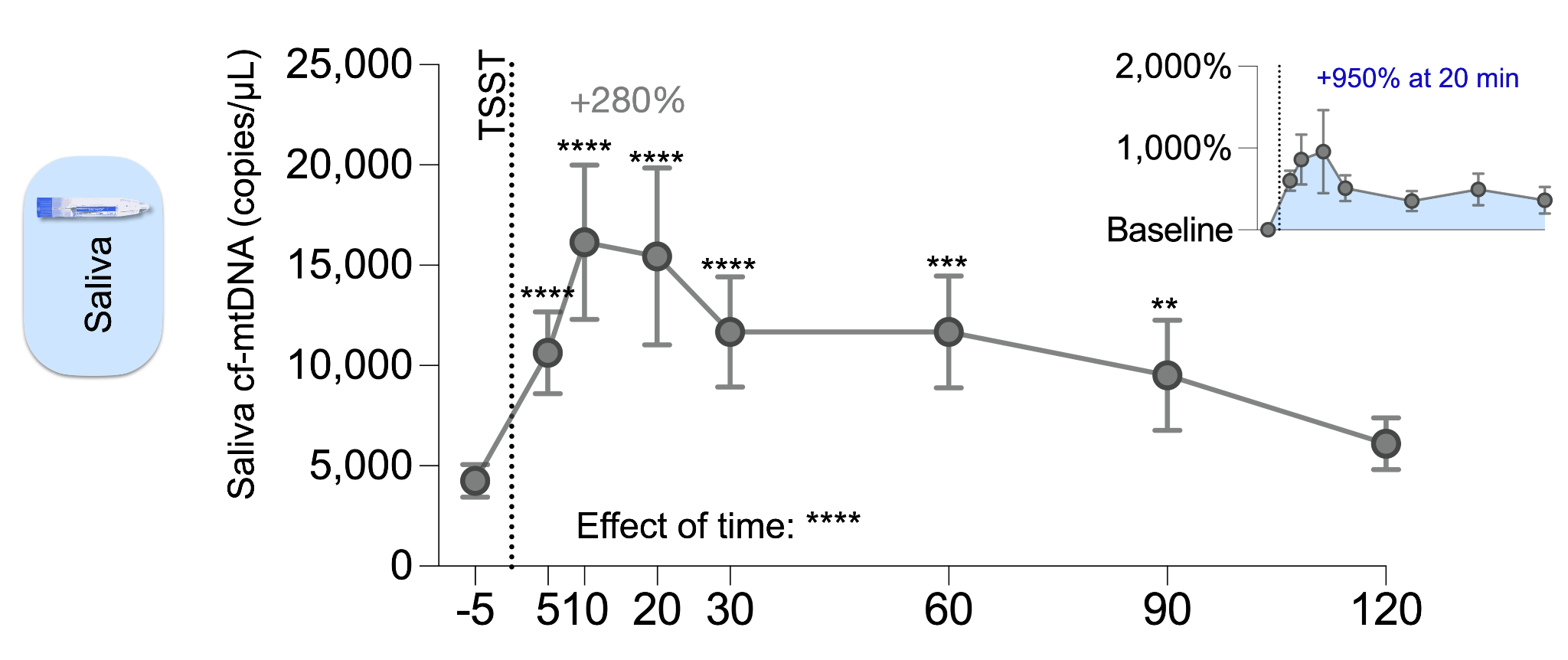
The MiSBIE (Mitochondrial Stress, Brain Imaging, and Epigenetics) study that followed exposed participants to the same kind of likely stressful speech task. We enrolled healthy adults plus people with rare mitochondrial diseases. Saliva, serum, and plasma were collected for analysis.
Saliva cf-mtDNA rose fast and dramatically. There was a 280% increase within 10 minutes.
Blood told a quieter, messier story. Serum took a full hour to show any change. Plasma barely moved before quietly declining below baseline by two hours. The response in saliva was 20-fold larger than in serum and 18-fold larger than in plasma.
In people with rare mitochondrial diseases, the saliva response was blunted, most dramatically in those with a large mitochondrial DNA deletion. This suggested the magnitude of the response depends on having healthy, intact mitochondria.
The second study, MaPS (Mitochondria and Psychological Stress), was conducted by our collaborator Anna Marsland at the University of Pittsburgh. It was designed to interrogate our own findings.
Participants completed a real stress visit where they completed the same speech task. And they did a separate resting control visit where they sat quietly with an IV catheter for the same length of time. The stressor worked as intended, raising anxiety, heart rate, blood pressure, and cortisol relative to rest.
But blood cf-mtDNA did not follow suit. Serum levels showed no significant change in either visit. Plasma levels rose and fell over two hours in a nearly identical pattern regardless of whether people were stressed or resting. This told us the signal was tracking the visit, not the stress.
We concluded that saliva, collected non-invasively, gives a fast, large cf-mtDNA stress signal. On the other hand, the cf-mtDNA response in blood was harder to interpret, likely because the process of drawing blood may be an added stressor.
A Mitochondrial Signal in Saliva
Blood collection is useful but not always practical for repeated sampling. And as results from the MaPS study suggest, the draw itself might be a confound. Saliva, in contrast, can be collected at home, relatively conveniently, without a needle, across many days.
When we first looked for cf-mtDNA in saliva, we did not know whether it would even be detectable. It was, and it displayed remarkable day-to-day dynamics.
Most strikingly, there was a robust awakening response. Similar to cortisol, salivary cf-mtDNA increased dramatically in the first 30 to 45 minutes after waking, in some cases by nearly two orders of magnitude.
We recently confirmed this pattern in a larger study. Hourly saliva samples were collected across a weekday and a weekend day in 25 healthy adults.
We found that cf-mtDNA rose 2.5-fold within 45 minutes of waking, climbing to a 5.7-fold peak around three hours later, before settling into a stable plateau. It tracked closely with cell-free nuclear DNA, hour by hour, but its relationship with cortisol was much weaker.
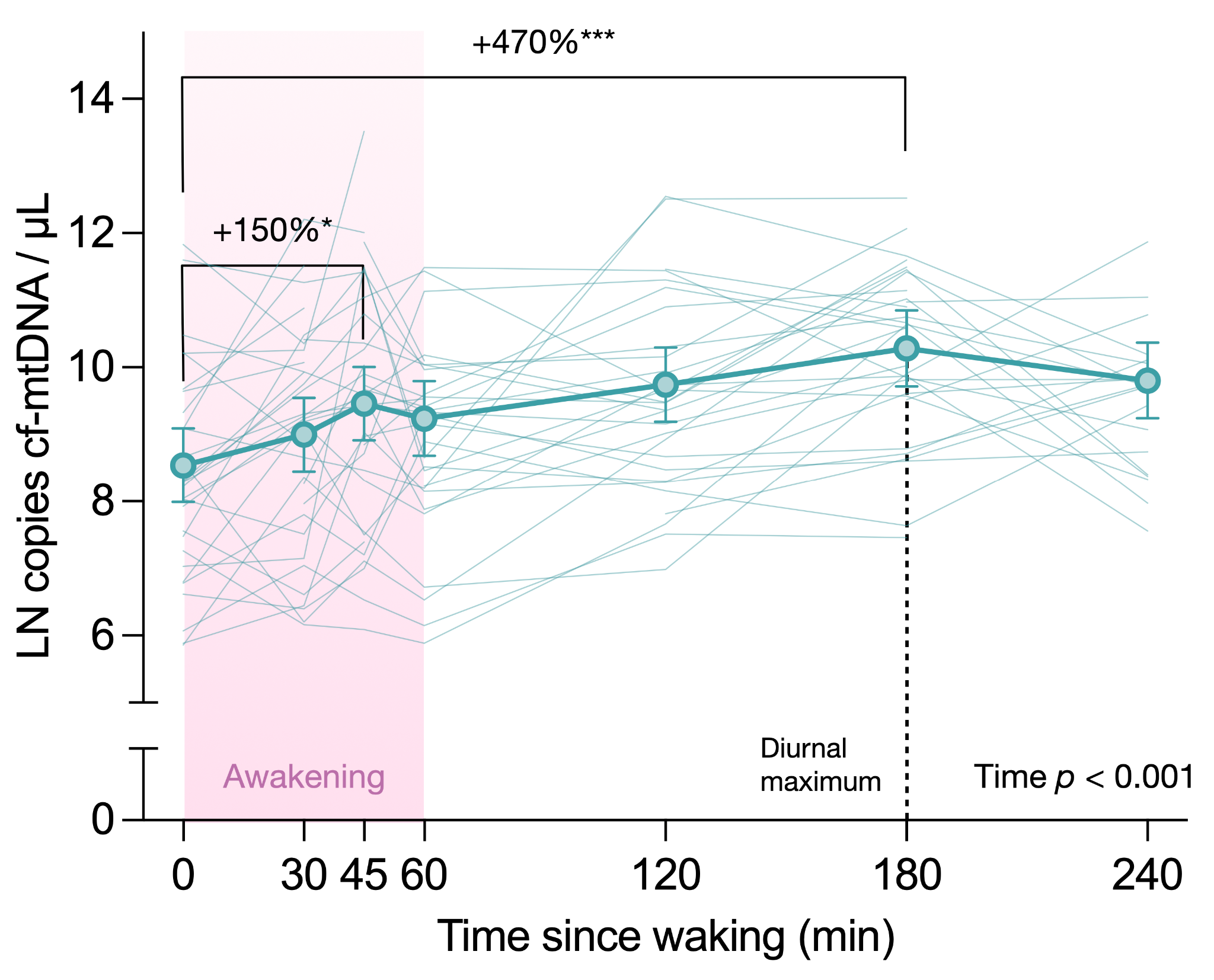
These findings indicated that cf-mtDNA isn’t just mirroring the pattern of the classic stress hormone. It follows its own rhythm.
That study also suggests this rhythm is influenced by individuals’ states of mind. People who reported more daily hassles, less social support, and greater anxiety, fatigue, or depressive symptoms tended to show higher cf-mtDNA at waking, a blunted rise afterward, and a flatter profile across the day. This echoes how chronic stress flattens cortisol rhythms and reduces heart rate variability.
The Cost of Waking Up
Why does waking up increase cf-mtDNA?
From an energetic perspective, waking is a major physiological transition.
Think about it. When you transition from sleeping to awake, your body temperature rises, heart rate increases, attention sharpens, and metabolism accelerates. All of this requires energy provided by mitochondria.
cf-mtDNA may reflect this shifting energetic landscape. It may be an anticipatory signal preparing the body for the day ahead.
Does This Hold Up Outside the Lab?
A lab stressor is controlled and time-locked. Everyday life is messier. So we asked whether saliva cf-mtDNA tracks stress and mood as people actually live it, using two intensive, real-world sampling studies.
In the first study, young adults, half with major depressive disorder, collected their saliva four times a day for four days. They also reported nightly on stressful events.
Diagnosis alone did not predict cf-mtDNA levels. What mattered was the interaction. On stressor days, cf-mtDNA in participants with major depressive disorder dropped by 68% relative to stress-free days, falling further as stressors grew more numerous and severe. Healthy controls showed a similar but weaker, non-significant dip in cf-mtDNA.
In the second study, we collected hourly saliva and mood ratings across two days in 25 healthy adults. Our results showed that momentary positive emotions, like happiness, energy, calm, and feeling in control, were each linked to higher cf-mtDNA levels. Conversely, stress and frustration tracked with lower levels.
The cf-mtDNA increase from positive emotions weakened as negative emotions rose, showing their interplay matters for cf-mtDNA signaling.
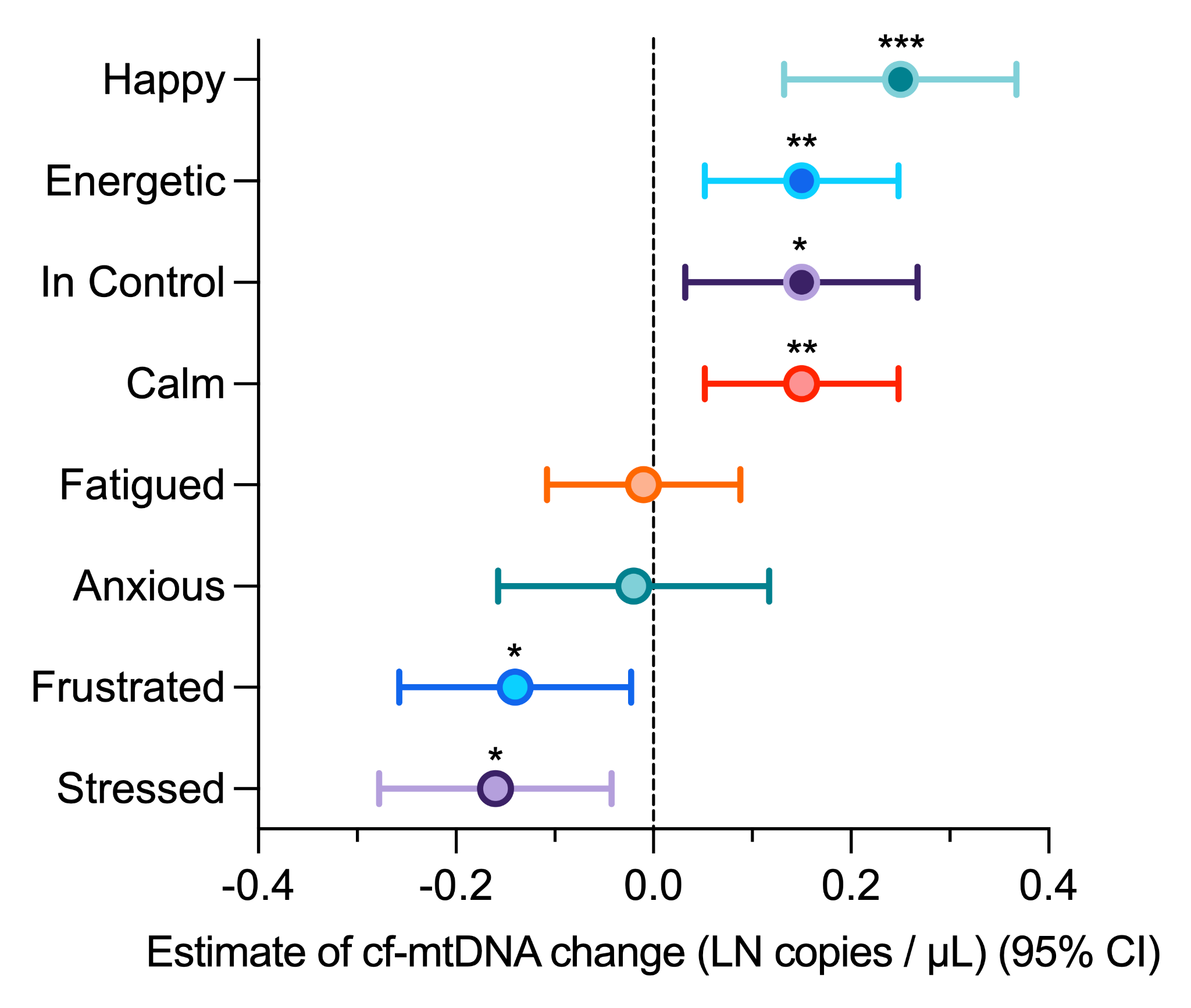
Together, these findings complicate the simple story about what cf-mtDNA does.
Real-world, sustained stress seems to suppress cf-mtDNA rather than increase it, perhaps because chronic stressors call for energy conservation rather than rapid mobilization.
cf-mtDNA may behave less like a fire alarm and more like a gauge of adaptive flexibility, similar to heart rate variability. From this viewpoint, a narrower range of movement, not one elevated reading, signals strain.
What Does cf-mtDNA Actually Mean?
For me, this remains one of the most important open questions. cf-mtDNA may function as a signal communicating energetic demand, a marker of mitochondrial activation, a by-product of remodeling, a molecule involved in immune signaling, or a component of broader adaptation and tissue-repair processes. Or it could be more than one of these things depending on the circumstances.
One possibility deserves special mention. Not all of what we measure as cf-mtDNA in blood is naked, fragmented DNA. some of it appears to be packaged inside whole, intact, cell-free mitochondria. This was discussed in a prior post.
That matters, because separate research shows cells can transfer intact mitochondria to one another. Perhaps at times to rescue the bioenergetic transformation capacity of struggling cells. If some circulating cf-mtDNA is inside cell-free mitochondria in transit, part of what we measure may be less of a debris signal and more of a resource transfer. In other words, the cf-mtDNA measure we’ve been using may include energy being shared cell to cell.
Most likely, several of these mechanisms operate simultaneously. There is mounting evidence though that cf-mtDNA should not be viewed solely as cellular debris. It appears to be part of a dynamic biological language linking mitochondria, stress, energy, and adaptation.
Looking Ahead
For decades, stress biology has focused largely on hormones, such as cortisol. Those hormones remain important, but mitochondria may offer a complementary perspective.
If stress is fundamentally an energetic challenge, mitochondrial signals could reveal aspects of adaptation that hormones alone cannot capture.
cf-mtDNA gave us one of the first ways to observe those mitochondrial responses directly in humans. And we watched them during the flow of daily life, rather than only in the lab, using nothing more than saliva samples collected at home over time.
Research on cf-mtDNA still has real limitations, including open questions about what it is measuring and how to interpret it across biofluids and contexts. But it suggests that the next generation of stress research should ask how our mitochondria respond to stress, and how flexibly they recover. How efficiently our mitochondria mobilize and recover from stress could shape our long-term health and resilience.
Curious about mitochondria and how mtDNA is linked to energy and health?
Visit MitoLife to learn more and discover your energetic self through mitochondria.
This post left me perplexed. I know why it makes total sense why this explanation left me feeling lost. Caroline & Martin are documenting a beautiful, non-linear quantum phenomenon but are forced to describe it using the flat, reductionist language of centralized biology. Cell-free mitochondrial DNA (cf-mtDNA) is not random cellular debris; it is the macroscopic signature of the mitochondrial colony wirelessly broadcasting charge density and structural updates across your Inter-Mitochondrial Junction (IMJ) network bus. When Trumpff’s 2026 data shows salivary cf-mtDNA exploding by 280% within minutes of acute stress, or dropping by 68% during chronic depression, she is tracking the real-time phase transitions of your inner mitochondrial membrane (IMM) exiting or locking into a Marcus Inversion event. Why does not Nirosha weigh in on this. two people with biochemical myopia missing the biggest parts of the data set is sad. When a tissue experiences an abrupt change in local field density, the IMJ alignment sheets perform a topological "surgery." They shed these lipid-wrapped mitochondrial packets into the extracellular fluid to wirelessly transfer bioenergetic capacitance and rescue distant, struggling cells [MICHAELI, 2019]. What have you missed in your translation? The paper states that salivary cf-mtDNA rises 2.5-fold within 45 minutes of waking, peaking at 5.7-fold three hours later. This tracks an independent biological rhythm completely separate from cortisol. Waking up is the most demanding field transition a mammal executes daily. As we open our eyes, our system must match the planetary dawn magnetic transition wave. This 5.7-fold morning surge is our Neuropsin (Opsin-5) compass capturing the 380 nm UV-A solar signal [WANG, 2019]. It uses that frequency to spin-pin our corporate iron-heme networks, allowing the IMJ bus bar to broadcast a coordinated, host-wide software update [PALMER, 2000, HORE, 2016]. The cristae adjust their brachistochrone curves to prepare for the day’s thermodynamic load [BERERA, 2009].The most counter-intuitive finding in the paper is that real-world, chronic stress and major depression do not increase cf-mtDNA—they forcefully suppress it by 68%.Under chronic field mismatch (living indoors under unpolarized blue LEDs and nnEMF), the Zeeman splitting lines collapse. Oxygen undergoes an unauthorized spin-flip into the diamagnetic Singlet State, completely blinding it to the planetary lines [PALMER_2000]. The Tunneling Blockade: Electrons lose their spin filtering, backscatter violently, and get stuck in deep charge-carrier traps along Complexes I–III [NAAMAN, 2012, MICHAELI, 2019]. Diabetics and depressed patients completely exhaust their matrix superoxide trying to clear this bottleneck. The Dielectric Collapse (k = 78): When it fails, the system experiences a massive thermal dump of heat (kB Tln 2), matching Fritz-Albert Popp's work on non-coherent Ultra-weak Photon Emission (UPE) leaks [CIFRA, 2014]. Water's dielectric constant crashes from 160 down to 78. The Frozen Network Bus: The cell over-redlines its voltage, driving the entire IMM straight into The Marcus Inverted Region, where electron transfer velocity drops to zero [MICHAELI, 2019]. How you guys missed this is beyond me.
The researchers are observing at the cellular level the physical expression of psychological and psychic activity. Consciousness doesn't merely inhabit a biologically functioning organism and then react to it. The organism is continually formed and maintained as the physical expression of consciousness.
beliefs/expectations/meaning → organization of experience → simultaneous psychological and bodily expression
The mitochondrial event wouldn't therefore be the cause of the emotional state. Nor would emotion simply be an external force acting upon otherwise passive mitochondria. They would be different levels of manifestation of one underlying event.
That becomes especially interesting in the article because cf-mtDNA doesn't behave like a simple damage meter. The authors explicitly conclude that it may be better understood as a marker of adaptive flexibility, and acknowledge that its meaning remains unresolved—it could reflect energetic demand, mitochondrial activation, remodeling, immune signaling, repair, or several processes simultaneously.
Your entire organism participates in expectations, probabilities, intentions, and anticipated experience. The waking response is physical evidence of the body's enormous preparatory intelligence: billions of cellular events organizing themselves around the transition into the waking world before the conscious ego has issued any instructions.
The ego wakes up: I am beginning my day. My entire bodily consciousness is already participating in the creation of the day I am entering.
What continuing beliefs and expectations organize the person's habitual psychological and biological response to experience?
You are not merely discovering how psychological events affect biological machinery. You are discovering that the distinction you've made between “psychological” and “biological” events is less absolute than you assumed.
A belief isn't an immaterial sentence floating around in the head which subsequently sends commands downward into matter. Belief, emotion, neural activity, hormonal activity, cellular activity, and bodily behavior would be interconnected expressions occurring at different levels of the same multidimensional event.
The research itself refuses a simplistic stress = high cf-mtDNA = bad model. The emerging picture is rhythmic, context-dependent, adaptive, and concerned with the organism's flexibility and capacity to mobilize and recover. That is much closer to my conception of a spontaneously organizing, responsive living body than the older metaphor of the body as a machine whose parts simply deteriorate under psychological pressure.