

LIVED EXPERIENCE
Our TSEE guest writer Matt Bernstein, MD, is a psychiatrist, Co-founder, CEO, and Medical Director of Accord Mental Health, Chief Medical Officer of Ellenhorn, and a Lecturer in Psychiatry at Harvard Medical School.
In this article, Matt shares clinical insights from his time treating individuals with mental health conditions. Through his work and personal experiences that shaped him as a clinician, Matt has learned that examining the role of energy may help clinicians better understand the problems patients face, and provide more effective solutions.
Patients tell me they have no energy. They have been telling me this for twenty-five years.
It is one of the most common sentences spoken in a psychiatrist’s office, and for most of my career I did with it what I was trained to do. I wrote it down as a symptom, checked the box for fatigue or loss of pleasure, and moved on to the parts of the interview I could do something about.
But it troubled me.
I was trained to treat energy as something the diagnosis explains, rather than as a problem in its own right. The patient offers a report about their bioenergetic state; psychiatry converts it into evidence for a diagnosis. Depression explains the low energy, the low energy confirms the depression, and the vital communication originating in that person’s mitochondria never gets heard.
The Gap I Couldn’t Explain
I trained in psychiatry at Massachusetts General and McLean Hospitals in the early 2000s and spent the first eight years of my career working in an inpatient unit for patients with schizophrenia and bipolar disorder. I’ve seen antipsychotics, mood stabilizers, and electroconvulsive therapy save lives. Some of my patients do well on medication and will likely use it for the rest of their lives.
Many of the same patients became chronically ill. We would address symptoms, but they still could not return to their usual lives. That gap, between symptom reduction and functional recovery, has never stopped bothering me. It never felt right to say: “they’re having a good outcome with their severe mental illness” when in fact they were miles off their previous life trajectory.
Well before any of this became personal, I also thought that the diagnostic system had a problem at its foundation. Since 1980, when the modern diagnostic system took shape (DSM-III), psychiatry has been optimizing for reliability—whether two clinicians examining the same patient reach the same conclusion—rather than validity, whether the label names something real. Reliability was a genuine crisis in the 1970s, and the field solved it.
But a system optimized for agreement between observers has no place for a variable that is invisible in the interview room. Cellular energy availability is exactly that kind of variable.
I carried that discomfort for a decade and did not change how I practiced.
What I Had to Learn When My Sons Got Sick
Then, two of my sons became seriously ill. The most dramatic symptoms were related to their mental health.
I am not going to tell that whole story here. It belongs to them. They are adults now, and they are deciding for themselves what part of it they want permanently attached to their names.
What I want to share is what it did to me as a physician.
Standard psychiatric treatment did not help. In stretches, it clearly made things much worse. This was very hard to say out loud, given what my career had been built on.
The eventual explanation for what afflicted them was not “psychiatric” in origin. What finally helped them was a long, expensive, exhausting bundle of medical and alternative treatments that one would put in the category of functional or environmental medicine. More than 15 years out of my medical training, I learned about immunology, infectious disease, endocrinology, cell biology, and metabolism to vet the treatments proposed for our boys.
The treatment bundle helped in a way that far surpassed anything psychiatry had offered them.
But how can I say that it was definitely these treatments that helped them? The strongest clue is in the trajectory of their recovery. They did not drift up and down over years the way a waxing-and-waning illness does. They remained in very rough shape when we transitioned from traditional psychiatric treatments to the most common integrative interventions. Their condition only began to improve when the intensity of the treatments was vastly stepped up and many were running at once.
That timing is why I don’t think we were watching the natural course of their illness. What I cannot tell you is which components mattered. The physician treating them believed every one of them was necessary. I think it’s impossible to know for sure.
What I Offer Patients Now
If I do not know which element worked, the responsible move is not to reproduce the whole bundle for other people. Every person is unique.
The right thing to do is to ask which interventions are worth offering under uncertainty?
Trial evidence is one factor. But in this field, the trials are thin–and each case is so unique. So I ask two more questions: 1) Is it safe enough that being wrong costs the patient very little? And 2) does it act on physiology that is shared across conditions, rather than on one presumed cause?
That is a much shorter list than the one our family endured.
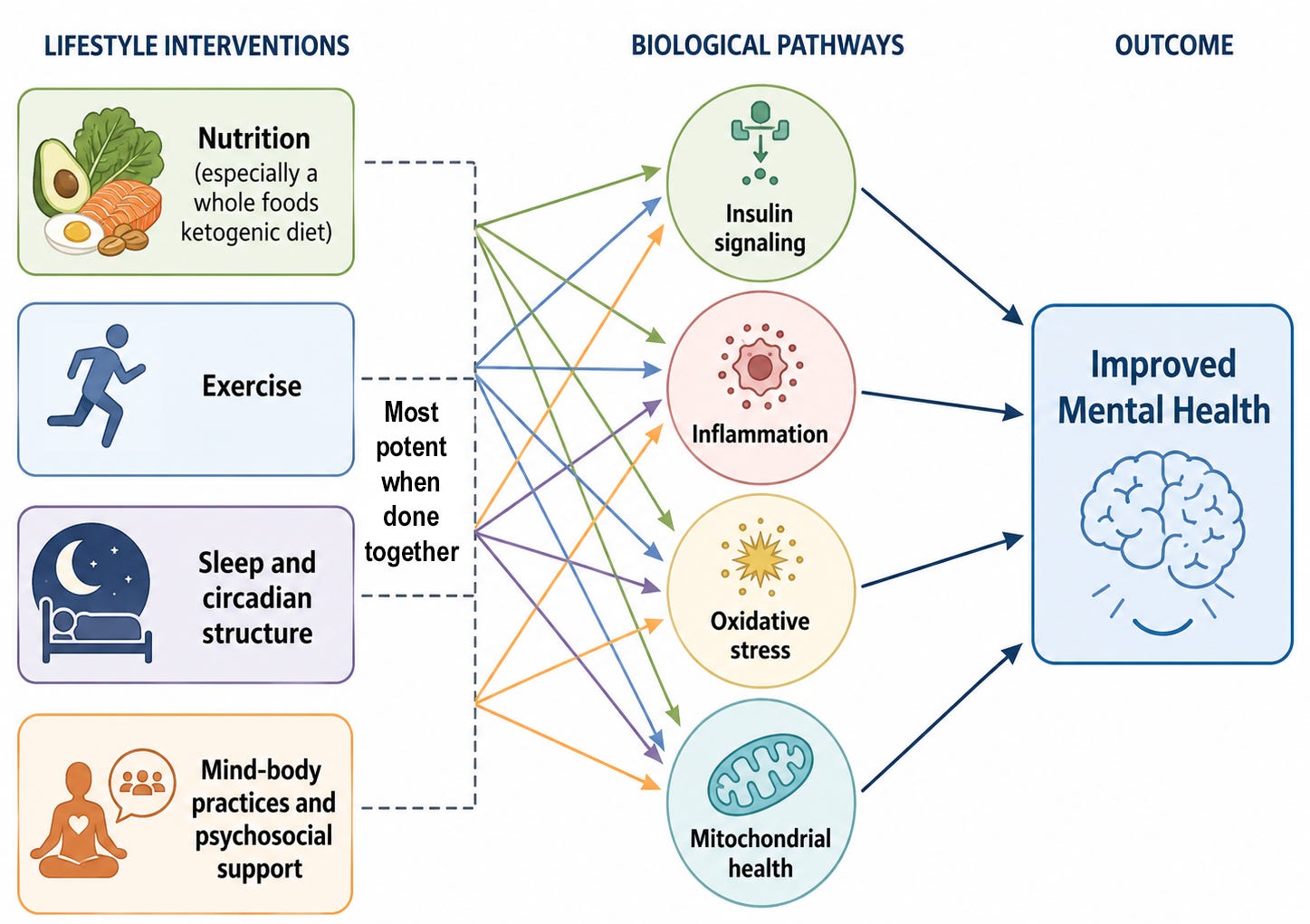
Nutrition, especially a whole foods ketogenic diet.
Exercise.
Sleep and circadian structure.
Mind-body practices and psychosocial support.
I can defend each of these interventions to a skeptic on its own evidence.
I can also defend the combination of them based on mechanism: they converge on insulin signaling, inflammation, oxidative stress, and mitochondrial health.
We also carefully reduce medication when appropriate, being mindful not to induce withdrawal syndromes.
With this approach, I have since watched dozens of people who are not my children recover. It doesn’t happen for everyone, and I have patients who have not benefitted. But I have seen people who had been through every reasonable version of standard care—good care, from good clinicians—recover levels of function that nobody expected.
These human experiences motivate me to keep doing this.
Of course you need to weigh that against an obvious bias: I have an ownership stake in a program that provides this intervention, and I stand to benefit financially if it succeeds. That is the kind of interest that could make you discount an uncontrolled clinical observation, and I would rather name it than have you find it out later.
I cannot separate the ketogenic diet from the rest of the program: the exercise, the mind-body practices, and the work on circadian rhythms and relationships. I don’t see that as a problem. If metabolic state is the target, then everything that improves it is an intervention.
So what happens when someone leaves?
That is the problem the recent trial by Gao and colleagues (described below) ran into. Benefits were correlated with adherence, and adherence fell once the dietitian support stopped. The residential piece is not the whole treatment. It is where the treatment gets learned. A lot of what we do is teach people to cook, to sleep, to move, and to notice how their own behaviors and symptoms track together, so they can keep doing it at home.
A program where people improve on site and relapse at home has not done its job.
What I Think the Evidence Actually Shows
The first randomized controlled trial of a ketogenic diet in treatment-resistant depression (88 participants) found a real but modest advantage over a well-matched control diet at six weeks. The benefits faded by week twelve.
The most dramatic results in the literature come from uncontrolled studies: a retrospective inpatient case series and a small pilot with no comparison group. These studies and others provide much-needed hope for individuals and families who have hit a wall with standard treatment approaches.
The observational picture is much stronger. In a longitudinal birth cohort study, children on a persistently high insulin trajectory from age nine had markedly elevated odds of both a psychosis-risk state and psychotic disorder at twenty-four.
The insulin signal predates the psychosis by about fifteen years. Insulin resistance and mitochondrial abnormalities show up consistently in people in their first episode of psychosis who have never taken an antipsychotic. People with serious mental illness die twelve to fifteen years earlier, overwhelmingly of cardiometabolic disease and not suicide. The medications amplify metabolic problems they did not create.
Moreover, a recent study following tens of thousands of people for over a decade also showed that another energy-based blood marker, GDF15–which signals energy shortage–predicted new cases of depressive and anxiety disorders, dementia, and other neurological disorders.
What Needs to Change

I am not arguing that psychiatry should trade neurotransmitters for mitochondria.
I am arguing that we have been treating a downstream signal as though it were the disease. However, the metabolic physiology underneath has been measurable for decades, and we haven’t been paying attention.
This is also why the solution is not simply to add a diet. If you improve the underlying condition, then you often need to adjust the pharmacology, and that is a skill my field has largely lost.
Some patients do best on standard doses of medication. Some do best on much less. Some do best off of medication entirely. Knowing which is which is the actual job of a prescriber, and we have been training doctors as if only one of those three answers is possible.
With clinical trials, we largely have a science of averages—but every patient is an individual, nobody is the average.
When someone tells me they have no energy, I no longer log it and move on. I treat it as a window into their physiology—one I can often improve. I would rather have learned this from the literature than the way I learned it. But the thing I took from those difficult years with my own family was not a set of answers. It was learning to ask what the body is doing underneath the symptoms we observe.
And none of this is expensive in principle. There is no proprietary molecule here. It is expensive now because it is rare and delivered in private settings like mine to the families who can find it and afford it. That’s a problem with how care is organized, not with what the treatment costs to provide.
The patients most likely to benefit are often the ones least able to reach me, and most of them have already been told more than once that they are treatment resistant. I would like ours to be one of many programs rather than one of a few. In that world, my field might finally retire the phrase “treatment resistant.”
Accord Mental Health is a residential program based on the metabolic approach.

It’s mind-blowing to me as a psychiatrist how revolutionary a premise it is in our field to treat fatigue as its own problem worthy of study and treatment, not just as a symptom of another disorder, as you point out, Matt. Thank you for this article highlighting the importance of metabolic psychiatry and for sharing some of your family’s journey with us. I have heard the executive director of NAMI Minnesota, Sue Abderholden, say “It’s not that our mental health system is broken, it’s that it hasn’t yet been built.” I share your wish that all of the patients who can benefit are one day able to access the services they need and deserve.
🔥 🔥 🔥