

BEHIND THE PAPER
Full-Text Link to Primary Source
Evolving the language that a scientific field speaks doesn’t happen overnight. In this story, we describe how we created and began to share a logical framework to study and teach the multifaceted nature of mitochondria. This work was published in the journal Nature Metabolism in 2023.
Recognizing a Problem
I sighed as I, again, read the words “mitochondrial function” while skimming through a recently published research paper. Great. Now I just had to decipher what the authors actually meant. You see, mitochondria don’t have just one function.
We may have been taught that mitochondria are the “powerhouse of the cell,” but this metaphor is outdated and incomplete. And it’s misleading. Mitochondria are multifaceted signaling organelles. They are key for regulating various cellular processes, and they are important contributors to health and disease. And they likely influence how we feel and function in our everyday lives.
An increasing body of research, including my lab’s work, has shown that mitochondria are avid communicators, capable of receiving and integrating information and producing signals. They are also quite diverse across our cells, and even within individual cells. For example, there are at least two main types of mitochondria in skeletal muscle cells. Mitochondria adapt and specialize for the tasks they need to do, and they can change over time.
For example, we previously reported that brain cells in mice exhibit functional differences. We also found that human immune cells differ in their mitochondrial density, DNA copy number, and respiratory chain enzymatic activity (the activities of enzymes in the process used to produce ATP). And others described different kinds of mitochondria in neurons.
Knowing all of this, it became clear to me that we needed to get more specific in our descriptions of mitochondria and their roles in biology. Using overly general terms like “mitochondrial function” or “mitochondrial dysfunction” has become a limitation for developing precise research, our ability to teach the next generation, and our general understanding of biology for these amazing organelles.
Becoming Part of the Solution
Fortunately, several other scientists were open to the idea of updating the vocabulary in our field that failed to capture the complex and dynamic nature of mitochondria. The first step was to cement the idea that mitochondria are more than just a powerhouse. After pouring over the literature and spending many hours thinking, drafting, and revising, the data distilled into a new message.
Mitochondria are the processors of the cell.
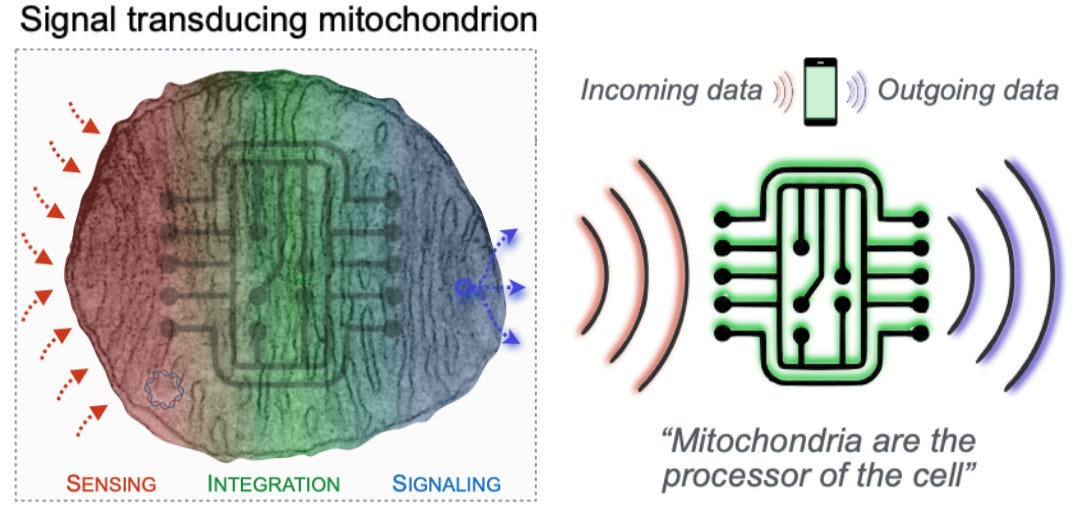
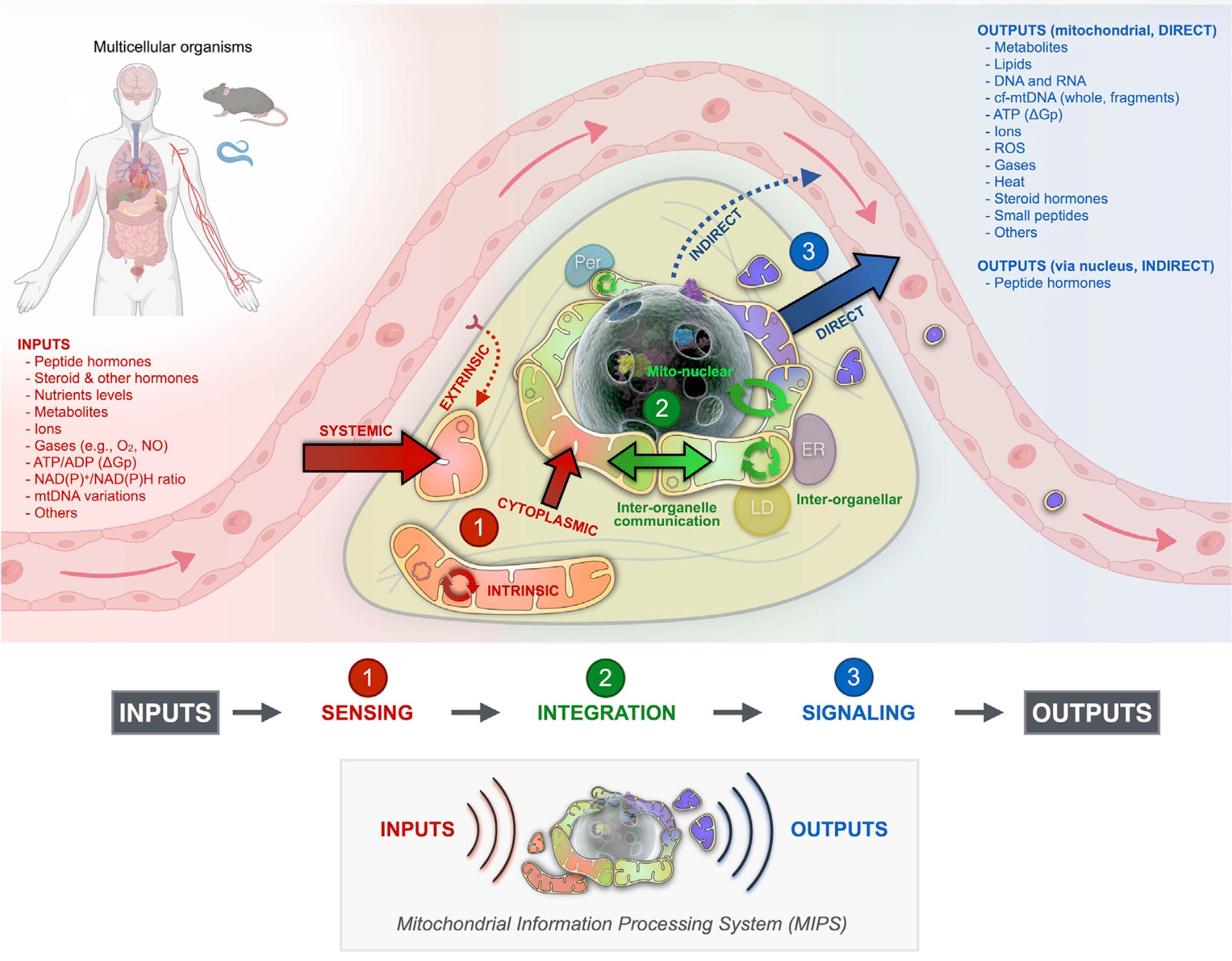
This was a significant paradigm shift for the field. Powerhouses do only one thing—transforming energy. But like antennas or little intracellular brains, mitochondria receive and respond to information in the form of hormones, metabolites, nutrients, and other endogenous and environmental signals. They pool and integrate the information from multiple signals. Mitochondria then produce signals that influence local metabolic pathways and gene expression, as well as physiology at the level of the whole organism.
I termed this the Mitochondrial Information Processing System—MIPS.
Rosalind Mott, then handling editor at the journal Cell Metabolism, and I had met previously at a conference. When I spoke with her about this idea, she gave me a choice. I could condense the paper down to a mere 2,000 words and publish it as a sole author. Or I could bring in a senior colleague and develop it into a longer review article. The idea of mitochondria as signal processors needed space to develop, and I felt that this paper could be meaningful if it was comprehensive.
In the cover letter, I wrote:
“This review achieves two main objectives. First, it provides a conceptual framework that we hope marks an important point in the development of mitochondrial science. A point where we have a suitable alternative for the expired “powerhouse” analogy for mitochondria, and where different domains of mitochondrial biology are integrated under a common framework to catalyze further progress in the field.
The second aspiration for this manuscript is that it serves as a compendium of mitochondrial functions and behaviors. This manuscript systematically and comprehensively organizes the mechanisms of mitochondrial sensing, integration, and signaling, yielding to our knowledge what may be the most complete review of mitochondrial biology to date.
If successful, this review could become the go-to reference to support the multifaceted nature of mitochondria.”
I knew exactly who to invite to provide the right input to achieve this.
I had kept in contact with my mentor Orian Shirihai since we met during my postdoc days at the University of Pennsylvania. Orian invited me to visit his lab and give a talk about my skeletal muscle mitochondrial imaging research. He became a friend and mentor. He’s now at UCLA researching mitochondrial dynamics and directing the Metabolism Theme—possibly the largest concentration of mitochondrial scientists in the country. After hearing more about the idea of mitochondrial signal transduction (MST, as we called it), Orian happily agreed to be involved with the paper. We quickly got to work expanding and refining the manuscript.

One of the figures features the “hallmarks of mitochondrial signal transduction.” This idea built on the popular Hallmarks of Cancer, and then later the Hallmarks of Aging. The wheel features the many ways in which mitochondria receive, process, and signal information.
When Rosalind saw the first draft, she was highly enthusiastic. She OK’d two extra figures, no limit to references, and as many words as we needed to tell this story. At that point we knew this review article would be transformative in helping people see mitochondria more holistically and accurately. Seven figures, 407 references, and more than 15,000 words later, the review article was ready.
Getting this paper published in Cell Metabolism was exciting, and the feedback we got was amazing. But I knew it wasn’t the end of our journey to thinking more holistically and accurately about mitochondria. It felt like mitochondria needed a formal “rebrand” so newcomers in the field could see straight and have a lexicon that matches their beautiful complexity.
The main issue was our limited and imprecise vocabulary for describing mitochondria and everything they do. Precise language is key for formulating specific hypotheses and designing research to test those hypotheses.
Forming the Framework Team
At the time, Anna Monzel was a postdoctoral fellow in my lab. She was just beginning to work on a computational mitotyping framework: a way of diving into the specificity of different types of mitochondria using tools like genomics, proteomics, and transcriptomics. Anna is a marvel when it comes to bridging computational science and biology. Her coding and abstract thinking skills were a fit for this project.

In particular, Anna had been looking at MitoCarta3.0, an extensive inventory of the proteins and pathways involved in mammalian mitochondria from the Mootha Lab at MGH-Harvard. “It was our Covid-19 lab project,” Rohit Sharma shared with me. Rohit played a major role in developing the MitoCarta 3.0 inventory. This encyclopedia-style resource grouped all known mitochondrial genes by their functions, behaviors, and activities. Realizing that this kind of categorical structure could really help others hone their understanding of mitochondria, we began to gather our ideas and notes.
“When I first joined the lab, my knowledge of mitochondrial biology was still fairly basic, and I quickly realized how much there was to learn”, Anna recalled. “What struck me most was the breadth of roles mitochondria play within cells. It became clear early on that mitochondria must specialize to match cell type and cell state. No single mitochondrial “type” can excel at everything. I hadn’t fully appreciated how essential this specialization is, but it makes immediate sense. It also exposed a gap: we needed better ways to describe—and quantify—the full range of mitochondrial types and states and how they differ”, she reflected.
Anna and I were growing more and more attached to the concept, but I knew that we needed an external perspective to challenge our thinking and identify any gaps. I had met José Antonio Enríquez (“Tonio”) when he was doing a year-long sabbatical in Orian’s lab, back when Orian was at Boston University. We bonded over shared interests after a presentation I gave, and we’ve continued to see each other regularly at conferences since then.
Tonio is a researcher at CNIC (Spanish National Center for Cardiovascular Research), and a well-known investigator in the field who loves new ideas. He also loves pushing boundaries. A bit of a contrarian, Tonio was going to be our pressure test, and I knew he wouldn’t go easy on us. However, if we could convince Tonio that our category-based framework for mitochondrial biology was real, we knew we could make a strong case to the rest of the field.
When I told Tonio about how Anna and I were working on a new framework for clarifying and improving the specificity of how we describe mitochondria and mitochondrial research, I was excited when he didn’t dismiss the idea. Tonio offered to help.
Our Process
Invigorated, I did what comes naturally to me. I started to write. I drew inspiration from first-principles thinking to boil this big, complex problem down to its most fundamental components. An image that kept popping into my head while I wrote the first draft: Maslow’s hierarchy of human needs, a framework in psychology for understanding the needs and levels of self development underlying human behavior. The hierarchy is beautiful in its simplicity—just a pyramid with five categories of basic needs that increase in complexity as you climb up the levels of the pyramid. The same framework would be used to organize elements of mitochondrial science.
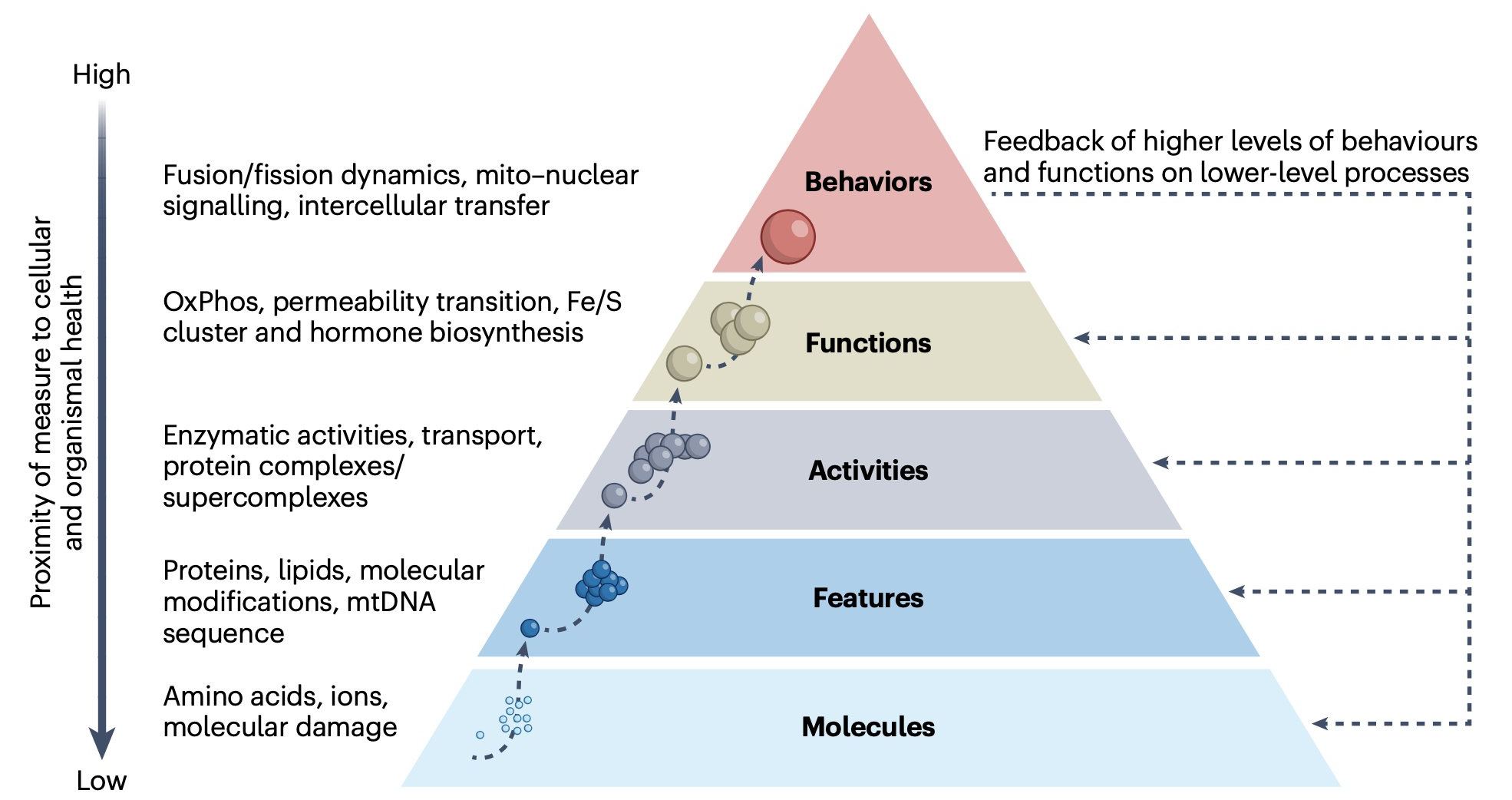
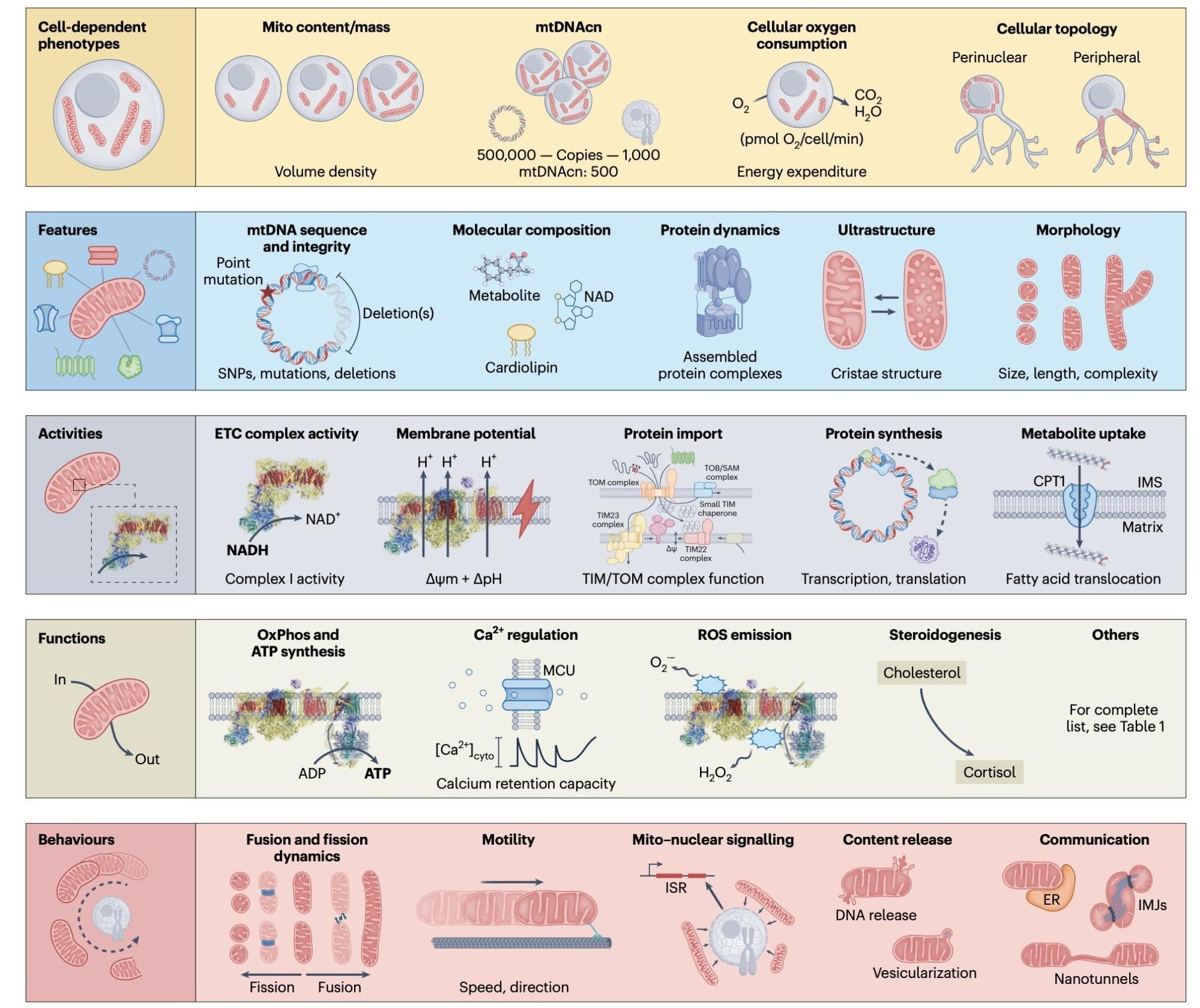
The ideas crystalized in my mind, and in one sitting, I worked through writing a first draft. From that point, Anna, Tonio, and I iterated through many, many versions of this document describing our new hierarchical terminology system. We had three goals in developing this system: 1) convey a more holistic picture of mitochondria for teaching the next generations of mitochondrial biologists, 2) maximize progress in the rapidly expanding field of mitochondrial science, and 3) facilitate synergies with researchers in other disciplines.
“It was a lot of fun working on this project,” Anna explained. “Because we kept going back and forth and bouncing ideas off of each other. There was a lot of room for creativity in the data visualization, writing, and making figures that could help convey the key points.”
We drew inspiration and outlined the parallels with cell biology and medicine. As both fields evolved, they had to develop clear frameworks and terminology to describe and target different levels of function. We surveyed the scientific community from our connections and on X/Twitter, and we compiled everything we learned into the first comprehensive table of all mitochondrial functions.
What would immunology or neuroscience be without clear nomenclatures to describe different cell types? We have different mitochondria types, yet we call them all “mitochondria.” As the field develops, that’s becoming a rapidly growing problem.
Tonio’s encyclopedic knowledge strengthened the story, Anna prepared extensive data on the existence of unique mitotypes to support our proposed framework, and we worked together to develop figures and diagrams to help visualize how all the pieces fit together. At the end, we had a new system of nomenclature that distinguishes between: 1) cell-dependent properties, 2) molecular features, 3) activities, 4) functions, and 5) behaviors. It was logical. It seemed reasonable. And we hoped others in the field would think so too.
Getting It Published
Choosing the academic journal that will be the best fit for your paper can be complicated. On one hand, we wanted this to go to a high-impact journal where a lot of people would see it. On the other hand, radical ideas that shake the status quo aren’t always welcome at top-tier journals.
I reached out to Christoph Schmitt, the Chief Editor of Nature Metabolism, to see if he was open to publishing this new idea and nomenclature system. Then I waited with bated breath for his response. As I hoped, Christoph invited us to submit our full draft. Feeling the potential importance of this piece, he said he wanted to handle this paper personally. We were delighted.
Overall, Christoph was supportive of the new five-category system we proposed. He provided extensive line-by-line comments and feedback to streamline and better organize the content. And ultimately, he asked us to remove two data-containing figures that supported the existence of distinct mitochondrial phenotypes—what we called “mitotypes. While this was a painful move at the time, this really streamlined the paper to focus on the big picture narrative.
The acceptance notice came in not long after we submitted the final version. Anna and I were thrilled to share the big news with Tonio. And while removing all of the data and analysis from this paper had been painful, we were already putting together a separate paper to share Anna’s computational work on multiple datasets, demonstrating the nature and magnitude of differences across mitochondria from different organs and cell types.
The Next Chapter
Once the Nature Metabolism paper was out, I was eager to get feedback. How would the community—experts and non-experts—respond to the new framework?
The responses warmed my heart and gave me hope that the field was on the right track.
More than 300 people attended the first online talk I gave after the paper was published. In the following weeks, I received numerous comments and messages via social media and email. People were eager to learn about and incorporate this new holistic framework for mitochondrial science into their work.
Some people have nicknamed the paper “the elephant paper.” That’s based on a panel in our first figure that emphasizes the importance of an integrated perspective. This nickname is perfect and also has a second meaning—we finally addressed the elephant in the room. We put into words the need for better and more specific descriptions of mitochondrial biology.

Our framework also sparked new conversations and new ideas. For example, my colleague Matthew Phillips in New Zealand contacted me about co-authoring a new paper conceptualizing neurodegenerative conditions, including Alzheimer’s disease and Parkinson’s disease, as “metabolic icebergs.” Beneath the visible tip of things we can see, the hidden impaired layers of mitochondrial biology forms the bulk of the iceberg, and various environmental, genetic, lifestyle, and other factors make up the base.
Matthew wrote about how the traditional risk factors for neurodegenerative disorders were related to cell-dependent mitochondrial phenotypes, features, activities, functions, and behaviors.
In addition to notes from colleagues, the elephant paper attracted interest from the media. Engaging with the media and the public helps remind us that we do science not just for other academics, but for the broader community. Our work is funded by taxpayers, and many have become interested in mitochondria. Danielle Gerhard, a writer with The Scientist Magazine reached out about doing a featured article.
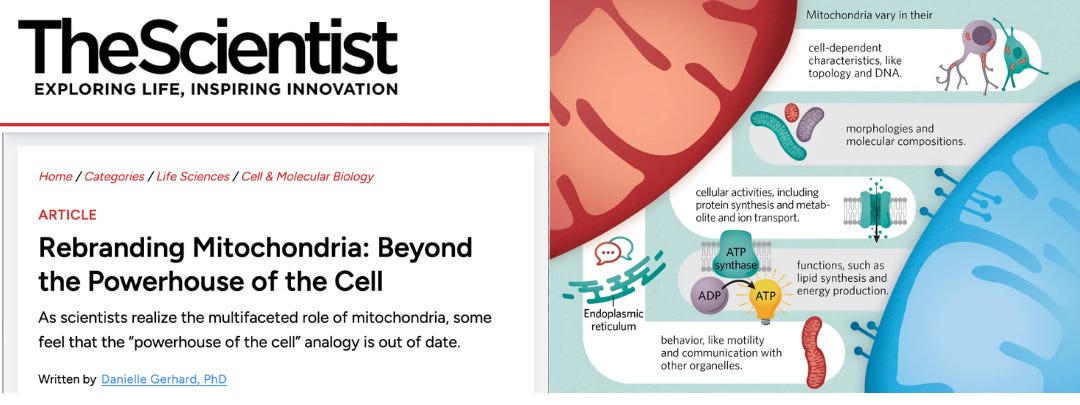
The article describes the shift from a superficial view of mitochondrial biology to a more nuanced perspective as our understanding has improved with further research. Mike Murphy, a mitochondrial biologist at Cambridge University, also contributed to the article. While he was reluctant to adopt a rigid nomenclature system due to the dynamic nature of mitochondria, he was supportive of the overall goal to help our nomenclature evolve with the evolving science.
I appreciated Mike’s candor, and I think it’s important for others in the field to thoroughly consider, question, and test new ideas. This is how we improve and how science advances.
Over the past two years, the Nature Metabolism Perspectives paper has been cited nearly 500 times. We are encouraged to see others beginning to shift how they talk about mitochondria in scientific papers, presentations, and informal conversations. There is much work still to be done, but this is a good start.
Incorporating clearer and more specific language into our science has the potential to sharpen our science, and eventually help develop more complete models of human health. Better models and a more precise understanding that incorporates the psychobiological network of factors linked to mitochondria could eventually lead to treatments for people with mitochondrial diseases.
Understanding mitochondria more accurately guards us against overly broad generalization, and empowers us to develop ways to optimize their many functions related to our health and well-being. Mitochondria are the portal through which we transform food into everything we do and experience. Understanding them is the path to understanding ourselves, and what we can each do to support our health.
We welcome everyone to join us on our journey to establish a new field called Healing Science. If this work resonates with you and you would like to support this kind of research at the intersection of science and experience, please share this Substack with your community.
You can also support the developing Energy and Healing Institute | EHI.
Martin, Since the post says, “The Science and Experience of Energy”, I thought you might find the following interesting:
Energy Doesn’t Just Move — It Remembers Itself
Stability, Resistance, and Identity in Inner Genesis Theory
Introduction: The Mistaken Question
When we ask why we resist exercising, changing habits, or doing what we “know” is good for us, we usually assume the problem lies in psychology, motivation, or evolution.
But this framing already misses the deeper issue.
The resistance is not primarily mental.
It is not moral failure.
It is not evolutionary stupidity.
It is energetic identity defending itself.
Inner Genesis Theory (IGT) begins from a simple but disruptive premise:
Energy is not inert stuff that merely moves.
Energy conditions itself through its own action.
And once energy has conditioned itself, it does not abandon that condition easily.
IGT’s Core Claim (Stated Without Metaphor)
IGT does not treat energy as a neutral substrate awaiting organization from biology or mind.
Instead, it asserts:
Energy acts, and its actions constrain its future actions.
There is no additional mechanism required.
Action → trace
Trace → constraint
Constraint → identity
This loop is the origin of persistence, habit, memory, and consciousness at every scale.
Diagram 1 (Described in Text): The Action–Identity Loop
Imagine a simple loop:
Energy acts
That action alters the conditions of the system
The altered conditions bias the next action
Repetition stabilizes the bias
Written linearly:
Action → Conditioning → Biased Action → Reinforcement → Identity
This is not symbolic memory.
It is structural memory.
The system does not store information about the past.
The past is present as constraint.
Why Stability Is Not Stillness
When we say “energy seeks stability,” this is often misunderstood as meaning rest, equilibrium, or inactivity.
That is not what stability means in IGT.
Stability means:
The continuity of a pattern through time.
A flame is stable.
A whirlpool is stable.
A heartbeat is stable.
A habit is stable.
They are all active — but self-reinforcing.
Stability is successful repetition, not absence of motion.
Diagram 2 (Described in Text): Basins of Energetic Identity
Picture a landscape of shallow and deep valleys.
Each valley represents a stabilized energetic pattern
The depth of the valley corresponds to how conditioned the system is
Movement within the valley is easy
Movement out of the valley requires extra energy
Your current habits, metabolic rhythms, and bodily expectations all sit in such valleys.
Resistance arises not because change is “bad,” but because leaving a valley costs energy and threatens coherence.
Resistance Reinterpreted (IGT Lens)
From an IGT perspective, resistance is not opposition to improvement.
It is:
Identity defending the conditions of its own continuation.
Any action that has not yet been integrated into the loop appears as:
unconditioned
energetically expensive
destabilizing
unpredictable
So the system resists — automatically.
Not consciously.
Not strategically.
Not intelligently.
Dynamically.
The Body and Exercise: An Energetic Explanation
When you decide to exercise for long-term health, your conscious reasoning operates on a future-oriented timescale.
Your body does not.
The body asks only:
“Does this belong to me yet?”
If the action is unfamiliar, the answer is no.
Resistance is simply the energetic identity asserting itself.
Once repetition reconditions the loop:
the valley shifts
the action becomes endogenous
resistance drops, sometimes suddenly
Not because willpower won —
but because energy re-identified itself.
Diagram 3 (Described in Text): Why Forcing Backfires
Consider two paths:
Path A: Force
High effort
High disruption
No repetition
No new stabilization
Result: rebound.
Path B: Gentle Repetition
Low threat
Repeated exposure
Gradual conditioning
Identity expansion
Result: effortless persistence.
IGT predicts this difference without invoking motivation, discipline, or moral framing.
Only recursive reinforcement alters identity.
Memory Belongs to Energy Itself
In IGT, memory is not a psychological add-on.
Memory is what happens when energy has acted and therefore cannot act as if it never did.
To say:
“Energy remembers itself”
means:
Every action leaves the system different than before, and that difference constrains the future.
This is memory without representation.
Learning without symbols.
Consciousness without abstraction.
The Metaphysical Payoff
IGT dissolves a false hierarchy:
Physics first
Then biology
Then psychology
Then consciousness
Instead, it proposes a continuity:
Energy is already experiential because it is already self-conditioning.
Identity is stabilized action.
Resistance is identity refusing erasure.
Growth is identity expanding its loop.
One Sentence Summary (IGT-Clean)
Energy stabilizes because every action becomes a condition on future action, and identity is simply that condition persisting.
That sentence explains habit, resistance, healing, learning, and consciousness without importing external agencies or metaphors.
Closing: Resistance as a Signature of Being
Resistance is not your enemy.
It is the mark that something exists long enough to defend itself.
Only systems that resist destabilization can persist long enough to matter.
Energy does not just move.
It remembers who it has become.
In a 2022 Cell Metabolism perspective, Martin Picard and Orian S. Shirihai argue that the long-standing metaphor of mitochondria as mere cellular “powerhouses” has expired. Mitochondria, they write, are dynamic, signaling, information-processing organelles. Together with the nucleus and other structures, they form what the authors call the mitochondrial information processing system (MIPS).
The language is technical, careful, and resolutely biological. But the conceptual shift is profound.
What Picard and Shirihai Show? According to Picard and Shirihai, mitochondria:
-Sense internal and external conditions (nutrients, stress, hormones, environment).
-Integrate this information through dynamic networks, physical interactions, and diffusion.
-Generate outputs that regulate cellular behavior, organ function, and even whole-body physiology.
This is not passive chemistry. It is active transduction: an input-to-output transformation that depends on the organelle’s internal state, history, and organization. Mitochondria change themselves in response to what they encounter, and those changes shape future responses.
In other words, mitochondria are not just responding. They are participating.
For example, I am not saying rocks think. I am saying that consciousness is not an all-or-nothing property reserved for brains, but a graded interior aspect of reality that varies with organization and self-interaction.
A rock, in this view, has a minimal form of awareness appropriate to its stability and persistence. Mitochondria, a living system, with internal differentiation and feedback, has more. A nervous system, more still.
Mitochondria sit squarely in the middle. They are living, historically conditioned, internally differentiated, capable of integrating multiple signals, capable of modifying themselves based on past states.
Since rocks possess a primitive interiority grounded in stable being, then mitochondria, far more dynamic and self-conditioning, occupy a higher rung on the same ladder. The continuity is striking.
The brain is a receiver/transmitter rather than a generator of consciousness, also finds an unexpected echo here. Picard’s work (and a growing literature) shows that mitochondrial signaling profoundly shapes neural firing, plasticity, mood and affect, stress responses, cognition and behavior.
Neurons are energetically downstream. Brain activity is inseparable from mitochondrial state. What the brain “does” is already conditioned by cellular-level transduction processes that lie beneath and around it.
From this perspective, the brain looks less like a solitary origin point and more like a translation interface, a structure that integrates, amplifies, and expresses processes already in motion at deeper biological levels. That is not mysticism. It is cell biology.
Why the Word “Consciousness” Still Isn’t Used?
Picard and Shirihai never claim mitochondria are conscious. Nor do they need to. Modern biology is comfortable describing sensing, integration, regulation, signaling, adaptation.
What it remains uncomfortable with is naming the interior aspect of such processes. Yet once a system differentiates itself from within, responds based on history, integrates multiple constraints, and shapes future possibilities, the question of interiority is no longer absurd, it is unavoidable.
That interiority was named half a century ago in the writings of Jane Roberts. Biology is now describing its mechanisms.
From Metaphor to Mechanism? Seen this way, the distance between Inner Genesis Theory and Cell Metabolism is smaller than it appears.
IGT offers a metaphysical intuition: consciousness as intrinsic to organized action.
Picard offers a mechanistic account: signal transduction as intrinsic to cellular life.
They meet at the same place.
Consciousness is not something that suddenly “appears” at the level of brains. It is refined, layered, and amplified as action folds back on itself across scales, from rocks, to mitochondria, to cells, to nervous systems, to reflective minds.
The language has changed. The insight has not.