

LIVED EXPERIENCE
In this piece, I share some early thoughts on the energetic basis of life and the mind. I question the too often unobserved assumption that we hold (particularly scientists) that everything we know and experience must arise from molecular building blocks.
Most of us—particularly if you’ve grown up in the West and trained in science—have operated under the largely unobserved assumption that we’re molecular machines. That we’re kept alive by energy—like your phone is kept alive by its battery. Or like your car is powered by gasoline.
But in reality, we are energetic systems. All living organisms are dynamic energetic processes. We are the energy flowing through the energetic circuitry of our metabolism and our mitochondria.
We are the flow of energy that keeps the molecular machine you see in the mirror alive. Not the machine through which it flows.
That’s why when you stop breathing and you cease to exist, the dead molecular machine remains—but you don’t. Because you are the energy; not the stuff it flows through. I say more on this in a previous post and in the ENERGY book.
Like our primary nature is energetic, all of our experiences are energetic—meaning that they arise only with the transformation of energy.
We hear, see, and feel through energy transformation. Light, sounds, and temperature turn into electrical signals in an energy-dependent manner, powered through mitochondria.
Think about it: all that you know and have ever experienced of the world around you has been filtered and constructed through a process of energy transformation, unfolding every minute within your body-brain system.
In this post, I don’t claim that energy flow “explains” consciousness. Rather, I ask whether the body’s energy dynamics shapes the contents, intensity, and felt quality of conscious experiences. And whether taking an energy-based approach to these questions is likely to help us move closer to an understanding of consciousness than current molecular or neural frameworks have enabled.
Is the mind fundamentally an energy pattern?
Reflecting on Consciousness and the Mind
What does this energetic view of our experiences say about consciousness?
The best science around consciousness, including leading theories on what the mind is and where it comes from, don’t explain how conscious experiences would emerge from matter.
Assuming that consciousness and mind emerge from chemical and electrical processes in the brain requires a meaningful leap of faith. That assumption is not rational in the same way that we understand how the battery in your phone allows you to call, text, or stream. Stuff like that is based on known physics. Emergence, it in purest form, isn’t.
In the material world, we’ve harnessed physical principles, building on the properties of nature and the material world. That’s how we engineer technology. As a result, microchips produce displays and behaviors of stunning complexity, which are reducible and can be attributed to known properties.
As far as we know, and as far as we have rational, empirical reasons to believe—no similar sophisticated physical principles or properties should lead to the subjective experiences that make up the mind. Or qualia–the felt quality of lived experiences.
In other words, there is nothing in our science to date that says that molecular interactions should or could give rise to the quality of our experiences, or the remarkable richness of our mind.
Rather, according to Bernardo Kastrup’s analytical idealism framework and others, the mind is more likely the precondition for the material expressions of reality as we experience it.
Kastrup’s idea is that mind and consciousness—what we know for sure to be real, since we experience it—are primary. And it’s that quality of mind that is the basis of everything.
His point is that it’s the mind, and the experience itself, that makes it possible to perceive the physical reality we are so familiar with. Not the other way around.
A similar perspective comes from Donald Hoffman, a cognitive scientist, in his book The Case Against Reality: Why Evolution Hid the Truth from Our Eyes. Great book.

Hoffman argues that our perceptions of the world—space, time, objects, and even the brain itself—are not real representations of an objective physical reality. Instead, they form a user interface.
What we experience as the material world, Hofmann explains, is more like a desktop icon on a computer screen: useful, but hiding the true, underlying complexity. Here is a good interview with Hofmann.
That idea aligns with Kastrup’s analytical idealism.
Both challenge the assumption that matter is primary and consciousness emerges from it, proposing instead that mind/consciousness is fundamental, and what we call physical reality is a constructed or projected appearance within it.
These ideas about the mind are obviously heavily debated. And dozens of theories of consciousness have been catalogued.
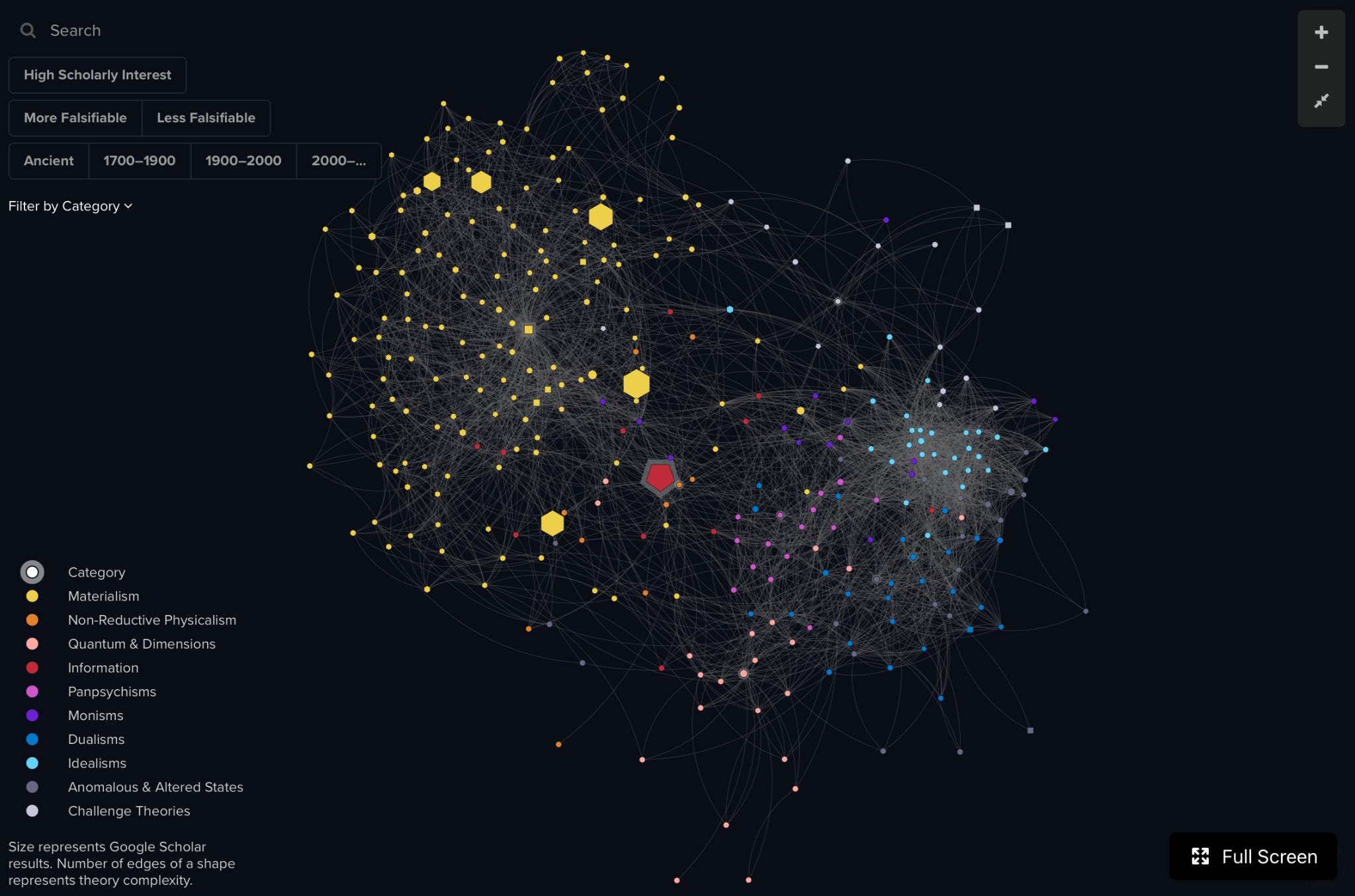
Here, I’m intentionally not presenting a full, balanced view of the issue. Just a little nugget to help us contemplate the idea that the human mind may fundamentally be an energy pattern. An experience deeply intertwined with the embodied energetic processes unfolding every second.
How we Experience of Energy
Our fundamental energetic nature is likely why we have evolved states of mind that are so exquisitely sensitive to changes in energy flow. Think of running out of breath for example, or worse, suffocating till you almost die.
Why is running out of oxygen so aversive?
Well, you see, running out of oxygen increases resistance to energy flow in our mitochondria. Without oxygen, there is no electron flow in the electron transport chain. Therefore, running out of oxygen is the most immediate threat to our very existence and our energetic self.
Maybe that’s also why we feel deep emotions physically in our bodies as movements of energy that shift our physiology. Emotions can change our heart rate, heighten brain activity, and increase sweating.
When we feel strongly, our bodies react. Why?
By examining this from the first principles of the psychobiology and neuroscience of emotions, including Lisa Feldman-Barrett’s book How Emotions Are Made, I’ve come to the conclusion that emotions are likely energy-in-motion.

That’s not just a fancy play on words, but rather a first-principles description of what emotions fundamentally are.
What we feel with an emotion may be the movement—or the transformation—of energy.
That could explain why we instinctively cry or laugh when we feel overwhelming emotions. Why we bring our hands to our hearts or feel aroused when we’re moved with deep, profound love. And why we sweat, turn cold, and get weak when catastrophic news hits us.
These are all somatic (bodily), energetic expressions of mind-based experiences.
As Nirosha J. Murugan points out, emotions, then, may be understood, in part, as embodied shifts in energetic state: changes in autonomic tone, metabolic demand, mitochondrial activity, sensory prediction, and action readiness. All of which experienced subjectively as feelings.
In neuroscience, we’ve come to think that by figuring out the molecular features of these experiences, it will make them more real. That they will become more legitimate objects of focus for biomedicine and psychiatry.
I think that position has left us somewhat stuck—mentally, existentially—in this seemingly impossible impasse of physicalism, or materialism. We think we’re the molecular machine, rather than the energy that flows through it.
The consequence: our unobserved materialistic assumption makes us believe that all we know and experience must arise from molecules.
To this day, I fail to see a scientific basis for our materialistic assumptions and the faith behind the concept of emergence. It’s alluring and compelling because our sense keep reminding us of the physical layer of reality. But, in search of the truth about our experiences and the basis of health, I’ve been forced to look for alternatives.
The Value of an Energetic View of Health
Compared to the dominant materialist view that holds that we’re molecular machines, the energetic view of life discussed here is more directly empirical—based on experience, and grounded in science.
As I’ve previously discussed around the interplay of genetics and energetics, an energetic view may bridge two forms of evidence that are often kept separate: first-person experience of vitality, fatigue, emotion, and awareness, and third-person measurements of metabolism, physiology, mitochondrial function, and neural activity.
Energy emerges as the consilience point where biology and experiences jointly emerge.
And in fact, an energetic view of life might even account for some of the hardest and most complex phenomena there are to explain in biology.
Take development, for example. How can a whole human grow up in just nine months from a single egg and flimsy sperm? It’s by kickstarting a new pattern of energy flow—organized by the information compiled in two half genomes—that organisms develop into the beautiful, complex, unique creatures that they are.
Or consider plants. With some heat and sunlight—two forms of energy—plus a bit of water, a dry seed metamorphoses into a living creature able to rise hundreds of feet into the air. It’s the energy flow and transformation that empowers and brings the hardware to life.
Biological structures are created from the very flow of energy they serve. An energetic view of life lets us see how the biological hardware of the body-brain system isn’t likely to be the basis of the mind and consciousness.
Rather, an energy-centric perspective positions the metabolic circuitry of the body, all the way down to synapses and the trillions of mitochondria they contain, as the substrate for energy flow and transformation. It highlights energy transformation in its different forms as the likely substrate from which the richness of our subjective experiences might arise.
Seeing our bodies and our brains through an energetic lens has the power to shape how we approach our own health and how the field of medicine can help us live longer, healthier lives.
But solving that existential challenge requires more than objective science. It entails bringing together multiple scientific perspectives, together with lived human experiences that can only be known subjectively–by you, the conscious self.
In that domains, spiritual traditions like Buddhism likely has a lot to give. We explored this idea on a recent trip to Nepal. A holistic view of the nature of the mind and consciousness isn’t likely to come from biology and molecular neuroscience alone.
When you contemplate consciousness, you–the subjective self–become part of the equation. There’s no way around it.
As I prepare the ENERGY book, I’m still developing visuals and useful examples that illustrate the points from this article. Curious to see how this resonates with your experiences, I felt moved to share some of these early ideas with our community.
What do you think?
Please share your thoughts with everyone in the comments below.
I loved this post, it gave me such a different perspective on consciousness. I recently started a series of writings diving deeper into the mysteries of consciousness, and this reading brought me so many ideas and reflections for future pieces.
Thank you so much for sharing, it was truly a great read!!! It would be such a pleasure to have you as a reader in my series and hear your perspective on these topics ✨🫶🏻
I genuinely feel like you crawled directly into my brain and extracted an entire constellation of thoughts I've been orbiting for years. I’ve been fascinated for a long time by ideas around emergence, energy flow, entropy, and consciousness as process rather than object - the possibility that identity and selfhood may be less like fixed things and more like dynamic patterns continuously maintained through exchange and memory and interaction. I recently saw Brian Cox speak on emergence, and your essay immediately brought Carlo Rovelli to mind for me too, particularly some of his relational ideas around reality emerging through interaction rather than isolated stable states. Obviously these questions are deeply speculative and philosophically contested, but I find the idea of the mind as an energetic process profoundly compelling, especially the framing of emotions as embodied energetic transformations moving through the body. Honestly, this essay felt like striking a tuning fork somewhere deep in my brain. Thoroughly enjoyed it. Thank you for posting ✨