

BEHIND THE PAPER
TSEE guest writer Robin Lanzi, PhD, MPH, is Professor of Health Behavior, Psychology, and Adolescent Medicine at the University of Alabama at Birmingham. For three decades she has worked at the intersection of developmental psychology, public health, and community-engaged implementation science. She is a person with Leber Hereditary Optic Neuropathy Plus, the mother of five sons who all carry the same rare mitochondrial DNA variant,
and a caregiver to her mother.
In this piece, Robin introduces the Agency, Hope, Action (AHA) Implementation Science Framework, a practical way to think about how people, families, clinicians, and communities can move forward when the future is uncertain.
The Question Medicine Cannot Always Answer
For twelve years, I attended mitochondrial disease conferences looking for answers about my family. Then, in June 2026, I found myself standing beside my own scientific poster. This has been an unexpected but meaningful journey.
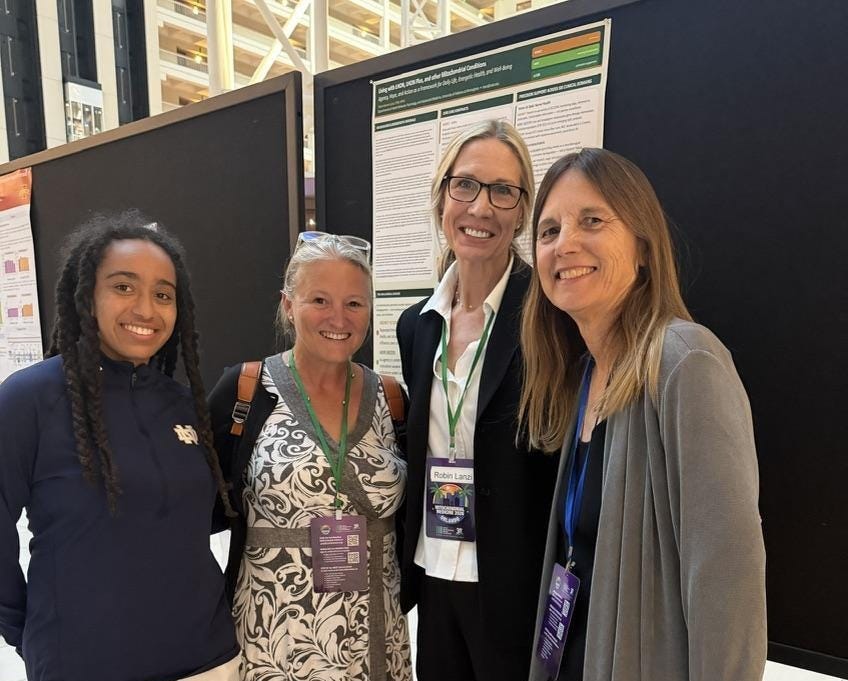
My family lives with Leber Hereditary Optic Neuropathy (LHON), a rare genetic mitochondrial condition that can cause sudden onset of severe central vision loss. Seventeen people in my maternal family line carry the same mitochondrial DNA variant. My oldest son, Stephen, lost his central vision as a teenager. Other members of our family have experienced very different health trajectories. I shared more about our story in a previous post.
Living with a mitochondrial condition has taught us what it means to live with constant uncertainty. There isn’t a simple answer when we wonder what is going to happen next.
Will today be ordinary or life-changing?
Is the blurred spot in my vision fatigue or something more?
Do the headache, exhaustion, dizziness, and other symptoms mean something?
Over time, however, I became increasingly interested in another question, and it’s one that medicine and science do not always address.
How do we live while we are waiting to find out?
Medicine can identify a genetic variant, describe biological mechanisms, monitor symptoms, measure vision, and test treatments. All of that matters.
But after the appointment ends, people go home. They still have to determine whether to go to work tomorrow, how to tell their children what is happening, if they should ask for help, and how much energy they can spend today. They need to figure out how to adapt when the future they expected suddenly looks different.
That gap between scientific knowledge and the realities of daily life became increasingly important to me, both as a researcher and as a mother. This gap ultimately led me to develop the Agency, Hope, Action (AHA) Implementation Science Framework.
A Framework for the Space Between Discovery and Daily Life
Translation is a fundamental focus in implementation science. How do we move useful, evidence-based knowledge into the real world, where people can actually benefit from it?
My career has been devoted to versions of that question. For decades, I’ve studied maternal mental health, parenting, child development, stress, resilience, and community health. Again and again, I saw that knowledge alone was not enough.
For science to improve people’s lives, it has to become usable within the realities of families, relationships, communities, limited resources, and changing circumstances.
Then my own family became part of that story.
When Stephen began losing his vision, we did not have a framework. We had uncertainty.
At one point, we decided to go on what we called a “visual memory cruise” while he could still see well enough to take in the experience. We were not trying to deny what was happening or convince ourselves that everything would be fine. We simply chose to make memories rather than wait passively to discover how much vision he might lose.
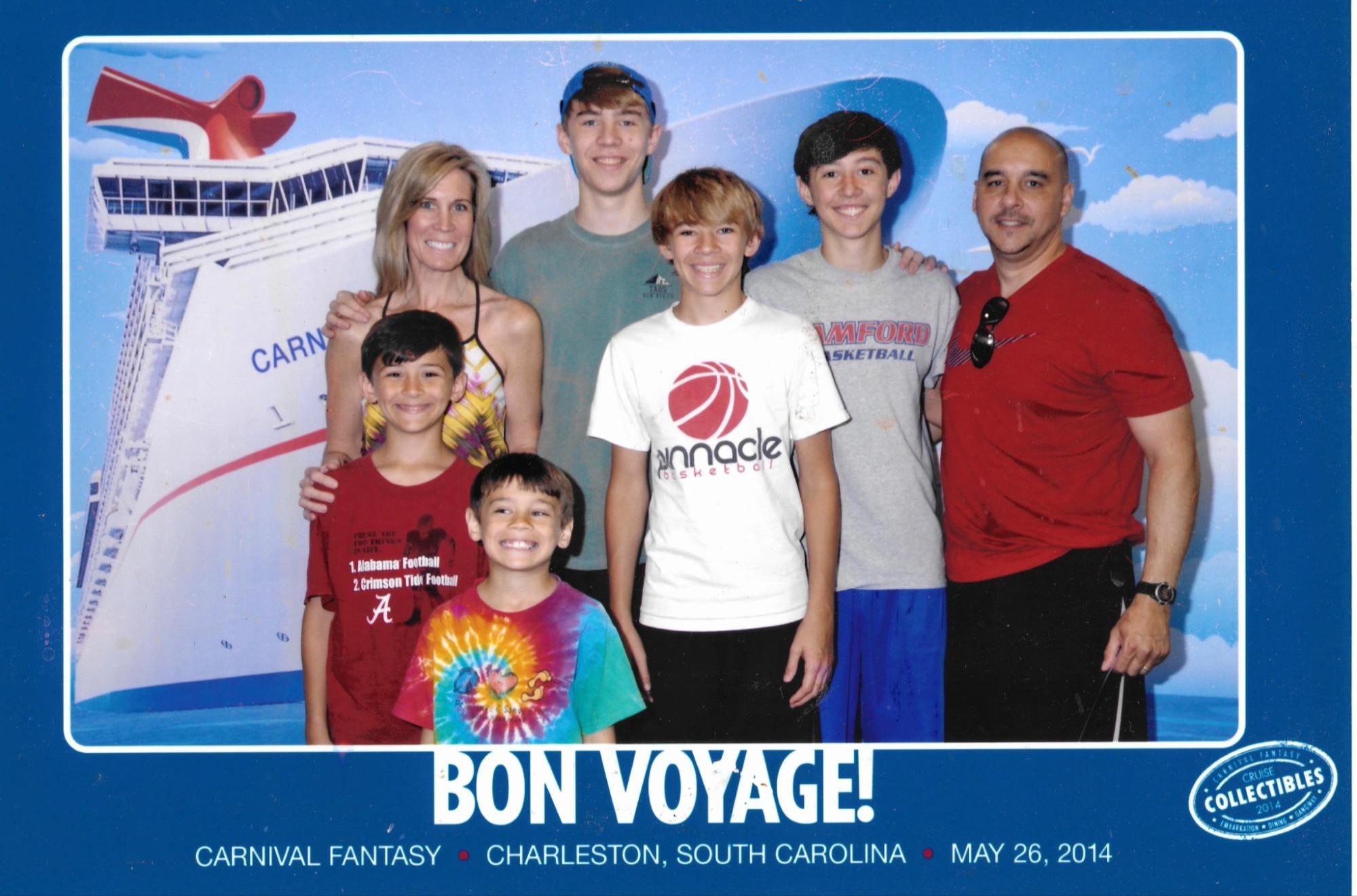
Years later, I came to see that choice differently. It was agency.
We could not control the effects that his mitochondrial DNA variant would have, but we could decide how we would meet the moment.
AHA grew from experiences like that, together with my scientific training and my conversations with patients, families, clinicians, and researchers. It is not a treatment, a cure, or a prediction of what will happen next. It is a way to find your footing when certainty is unavailable.
The AHA Framework
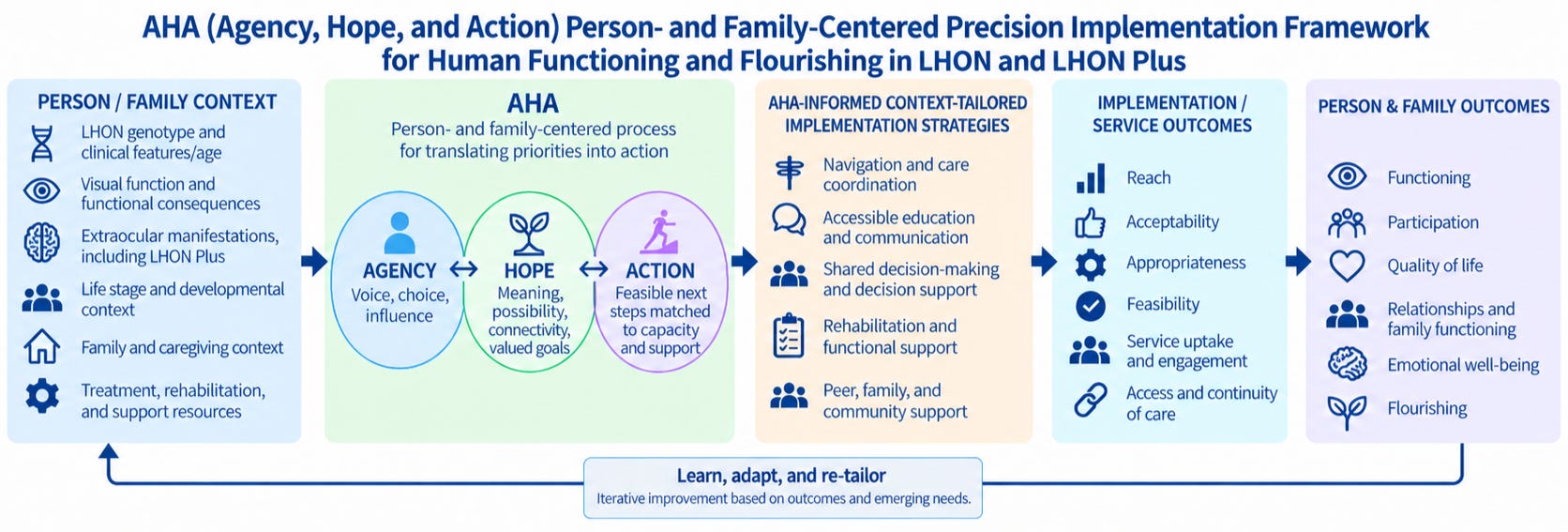
1) Agency: Engaging Meaningfully Within Constraints
Illness can make it feel as though decisions are suddenly being made for you. Your life can feel dictated by biology, medical schedules, inaccessible environments, or other people. Within AHA, agency is about preserving your voice, participation, and ability to make choices within those real constraints.
Agency does not mean controlling symptoms or outcomes, and it does not mean doing everything independently. Sometimes agency means requesting an accommodation or deciding how to spend the energy you have today. It can mean asking someone for help, setting a boundary, changing the plan, or choosing to rest.
The central question is simple: What matters to me,
and how can my voice be heard?
That question can also change how families and clinicians provide support. Instead of beginning with “Here is what you should do,” we can begin with “What matters most to you, and how can I help?”
For me, that distinction is important. Independence is not the standard. Self-direction is.
2) Hope: Staying Connected to What Matters
Hope is a word that we’re all familiar with, but its true meaning is not always clear. To me, hope isn’t forced optimism, pretending everything is okay, or believing things will get better.
Hope does not require pretending that illness, fatigue, grief, disability, or uncertainty are less difficult than they really are. It can coexist with fear, anger, and sorrow. Within AHA, hope means remaining connected to meaning, relationships, purpose, and valued possibilities, even when a positive outcome isn’t guaranteed.
For one person, that may mean continuing their education in a different way. For another, it may mean staying connected to family, faith, creativity, community, or scientific progress. Sometimes hope comes from finding people who understand your experience without requiring a long explanation. Sometimes it comes from recognizing that a future different from the one you imagined can still include love, contributions, beauty, and purpose.
The question to ask yourself is not necessarily “Do I feel hopeful?”
A better question may be: What gives me
a sense of meaning, connection, or possibility?
Hope does not promise that the path we originally imagined will reopen. It reminds us that there may be more than one path.
3) Action: Finding the Next Feasible Step
The third part of AHA is action, but action does not mean simply doing more. That distinction matters enormously for people living with fluctuating energy, illness, caregiving responsibilities, or overwhelming uncertainty.
Sometimes action means getting out of bed or making one phone call. It may mean trying a screen reader for the first time, attending an appointment, delegating a task, or asking a question you have been afraid to ask. And sometimes the most appropriate action is to rest before your exhaustion becomes a collapse.
When people are frightened, depleted, or overwhelmed, a five-year plan may simply become another burden.
AHA asks a smaller and more immediate question:
What is one feasible next step toward what matters to you?
Not the entire journey. Just the next step.
Agency, hope, and action are not meant to operate in a fixed sequence. Agency can make action possible. Hope can sustain engagement. Taking one manageable action can restore a sense of agency or possibility. The relationship among them will change depending on the person, the circumstances, and the moment.
You begin where you are.
Who Is AHA For?
Although AHA was developed partly from my family’s experience with the mitochondrial conditions LHON and LHON-Plus, it can be relevant for everyone.
It is for people trying to live meaningful lives when circumstances cannot be fully controlled.
It is for families and caregivers searching for a way to support someone without taking over.
It is for clinicians who know the medical guidelines but sometimes struggle with the more difficult human dimension. “How do I help this person move forward when we don’t know exactly what will happen?”
It is also for researchers who want their discoveries to have broader impacts beyond academic papers and presentations into the realities of people’s lives.
I am excited to share that AHA is becoming more than a conceptual framework. I am developing practical resources, including a Flourishing Tool, a Traffic-Light Flourishing Map, and resources for families affected by LHON and LHON Plus.

These resources will help people identify priorities, recognize barriers, communicate what they need, and choose feasible next steps.
The goal is not to eliminate uncertainty. Sometimes we just can’t.
The goal is to help people continue participating, adapting, connecting, contributing, and flourishing within it. The hope is that these tools and resources offer one practical option where support is often missing, as people and families find their own ways to participate, adapt, connect, contribute, and flourish amid uncertainty.
Living Fully Anyway
Years ago, after Stephen lost his vision, he said something really profound:
“People are not afraid of dying. They are afraid of living a life not fully lived.”
I have carried those words with me ever since because they capture something essential about why AHA matters to me.
My science has taught me to ask questions. My family’s experience has taught me that some of the most important questions do not yet have answers. AHA begins in that space—not with certainty or with a promise that everything will be okay, but with a way to orient ourselves when the future is unclear.
Agency: What matters to me, and how can my voice be heard?
Hope: What gives me a sense of meaning, connection, or possibility?
Action: What is one feasible next step toward what matters to me?
We may not always get to choose what happens to us. But even within uncertainty, there may still be room for agency, hope, and some form of meaningful action. Even if that action is to rest.
That is where AHA begins.
Want to learn more about the AHA Implementation Science Framework, and how you can apply it to your own life?
Learn more about the AHA research study and how to participate.
Read the full-text pre-print article about the science behind the AHA Framework.
Learn more about Robin’s research.

The visual memory cruise made this concrete for me. Medicine couldn’t tell you exactly what would happen, but your family still had choices to make about the time ahead. We spend so much effort explaining uncertainty that we can forget to help people live through it.
Thank you Robin, this is beautiful!
I hadn't realized you had LHON. My former postdoc has a paper on LHON, to which I contributed a bit. It's very much not about the lived experience, but it's nonetheless a beautiful, interesting paper.
Mother’s curse neutralizes natural selection against a human genetic disease over three centuries | Nature Ecology & Evolution https://share.google/nmPhbyZg6egAPd9JK
Note that the historical data from Quebec appear to show that it used to increase make infant mortality, but actually had mild benefits for women.
I love Stephen's quote about mortality and a meaningful life.