

ENERGY SCIENCE
One of the most memorable physics demonstrations in modern history happened in 1974, and it still serves as a powerful reminder of how energy can change how physical systems behave.
In this post, we delve into the details of the spinning disk demonstration and a more recent demonstration on self-assembling wires to share how they are relevant for understanding the broader impacts of energy on physical and biological systems.
Showcasing the Impacts of Energy Within a Physical System
In his 1974 Royal Institution Christmas Lecture, Eric Laithwaite used gyroscopes to highlight some counterintuitive features of energy and motion. Eric was an electrical engineering professor at Imperial College London, as well as an inventor, educator, and science communicator.

In a particularly memorable moment from this lecture, a young volunteer from the audience easily lifted a heavy spinning disk that was mounted at the end of a long axle. What transpired appeared to eager onlookers like an illusion, but there was no deception or feat of strength involved. You can watch the full lecture here.
The demonstration was impressive. And it made people talk about science. Laithwaite repeated and recorded the experiment where he lifts the spinning disk.
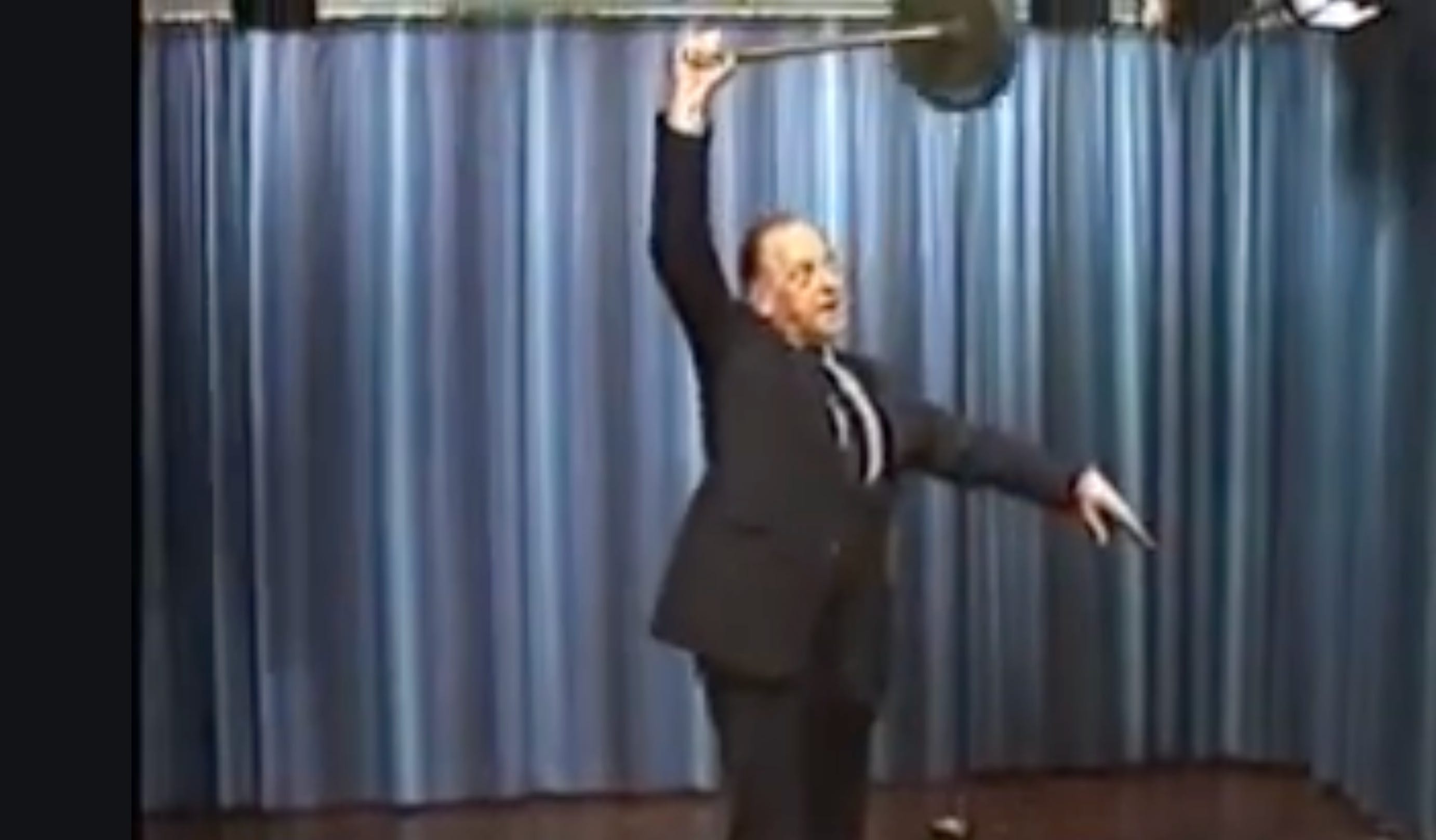
The setup was simple. A heavy disk (18 kg or about 40 lbs) was mounted at the end of a three-foot-long axle. Then it was set to spin at 2,500 rotations per minute.
When the disk was not spinning, it behaved exactly as you’d expect. It was awkward and difficult to lift from the far end of the axle.
But when the disk was spinning rapidly, Laithwaite was able to lift it up over his head with one hand, seemingly with ease.
The spinning disk itself hadn’t changed. Its mass had not disappeared. It wasn’t defying gravity. And it wasn’t breaking any other physical laws.
What happened was that when energy was added to the system by rapidly rotating the disk, the disk’s behavior changed. The system with infused energy became a different system.
How the Spinning Disk Demonstration Works
A still disk behaves like dead weight. If you pull it one way, and it tends to move or fall that way.
But a spinning disk has stored rotational kinetic energy and angular momentum. Once rotating, it resists certain changes in orientation. When gravity or a person’s hand applies a turning or twisting motion (torque), the disk doesn’t necessarily fall in the direction our intuition expects. Instead, its axis can move sideways in a motion called precession.
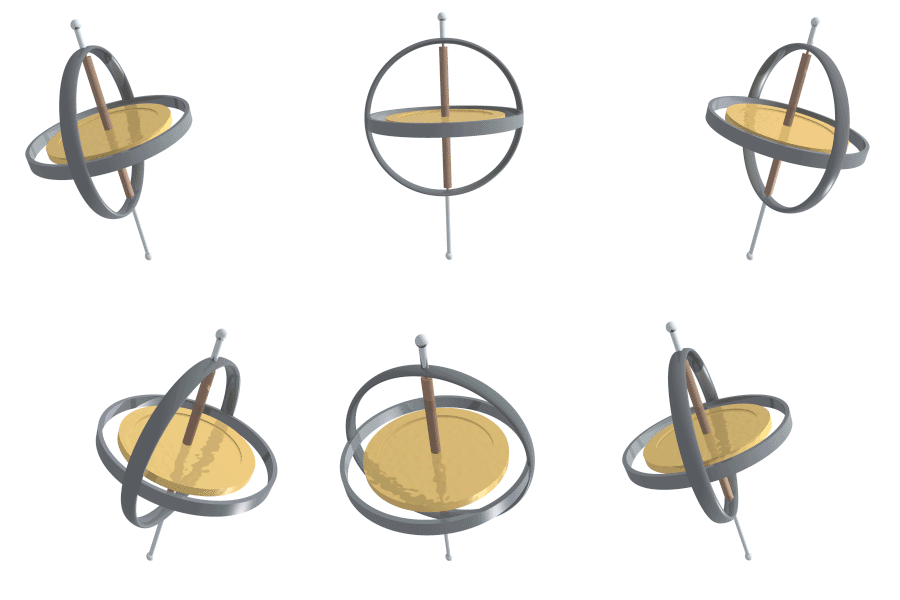
If you’ve ever felt it—with a bicycle wheel or some other device in a physics course—you know it feels really weird. Weird, because it’s counterintuitive.
With precession, force is redirected through the rules of rotating motion. The fast-spinning disk has high angular momentum. As a result, rather than swinging back towards the floor (like you’d expect with a non-spinning disk), the torque caused by gravity produces horizontal circling with the spinning disk system.

That’s why Laithwaite could hold the rod sitting in fixed horizontal position (with its attached spinning disk). Thanks to that emergent behavior, he was then able to lift it up and over his head, with the device following a circular motion.
The extra energy made an entirely new behavior—and Laithwaite’s new trick, possible.
Energy Can Kill You
The rationale energy gave the disk system new properties, including stability, resistance, directional preference, and motion in ways our intuition with static object doesn’t allow us to expect.
Energy is what brings us to life. But extra energy like this can be dangerous.
While the emergent property of the rod and its spinning weight is awe-inspiring, it can, too, be dangerous. And the extra energy to make this trick possible could also kill someone.
During his demonstration, Laithwaite acknowledged that the “wheel has enough energy to throw itself 200 feet in the air.”
If he dropped the rod while the disk was spinning, it would likely have whipped around, rather than falling straight down, likely causing injury (remember, the disk weighed 18 kg/40 lbs). If the rod snapped or the disk detached, he would suddenly have been dealing with an 18 kg projectile and all the associated hazards.
All of this to say, don’t try this at home. The stored energy in the system and resistance to sudden changes make it dangerous if anything goes wrong.
Energy Can Also Organize Matter
A more recent, dazzling demonstration adds an interesting dimension to the conversation about how energy impacts behavior.
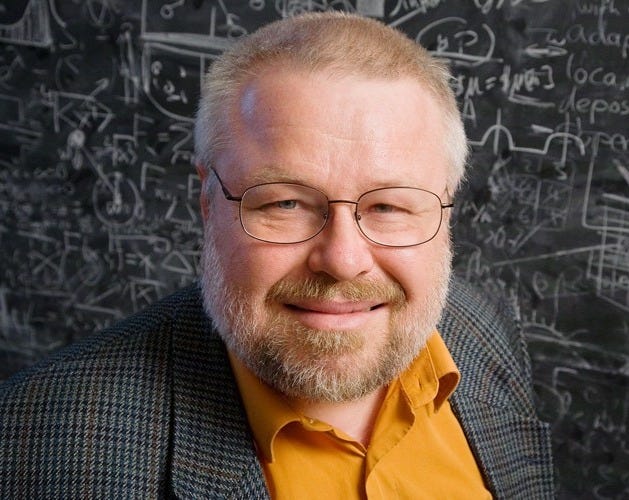
Alfred Hübler, a physicist who worked at the University of Illinois at Urbana-Champaign, studied how small metal ball bearings self-assemble into conductive wire networks in the presence of electric fields. He and his colleagues examined how adjusting the properties of the electric field changed how the wires behaved.

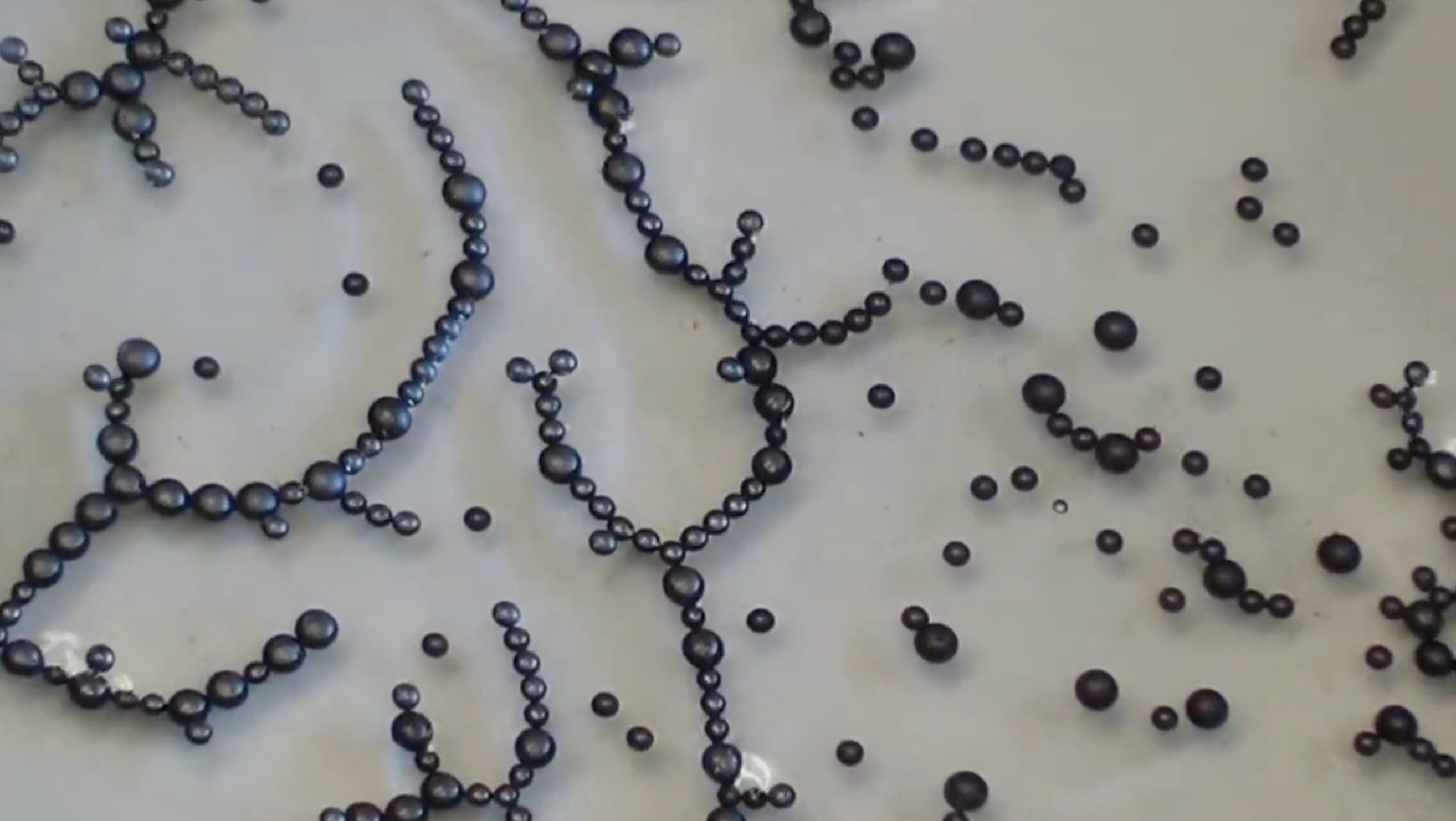
This work inspired the Stanford Complexity Group to record a mesmerizing demonstration of how energy can cause individual objects to self-organize, form structures, and behave in coordinated ways.
As the video explains, the demonstration involves tiny metal ball bearings, castor oil, a petri dish with a negatively charged metal rim, and a source of electricity.
Before the electrical current is turned on, the ball bearings lay motionless in a pile or scattered throughout the oil in the petri dish.
As soon as energy is infused into the system, it brings it to life.
The ball bearings start to move, and behavior emerges. They attract each other, link together, form branching structures, break apart, and appear to seek other connections.
What’s happening here is that the metal balls act as electrical conductors that become polarized, with a positively and a negatively charged side. The difference in charge attracts the balls to each other, with the positive side of one ball connecting to the negative side of another ball. A magnetic field is created, and as more balls link together, the electric potential multiplies, leading them to branch out in organized ways. The oil serves as an electrical insulator and also a buffer to slow down the movement of the balls.
Electrical energy causes dramatic and beautiful changes in how this system behaves. And we can shape aspects of how the system behaves by modifying the energy inputs.
This is another demonstration that you shouldn’t try at home because you need to add large voltages (200x the voltage from a household outlet) to get the ball bearings to self-assemble.
Enough energy, again, to throw off the comparatively delicate energetic circuitry of your body and kill you, if something went wrong.
Thinking Beyond Spinning Disks and Self-Assembling Wires
The spinning disk and self-assembling wire demonstrations are more than fun party tricks though. They allow us to reframe how we think about energy.
Energy is more than just fuel.
Adding energy changes how a system works and what it can do.
For example, getting a bicycle to stay balanced when it’s not moving is difficult. However, once the bicycle is moving forward, it becomes much easier to balance. A toy top is unremarkable when it’s laying still. But once it is spinning rapidly, the top can stay vertical, wobble, and precess.
Under different energetic conditions—speed, electricity, or other forms of energy—the same objects respond differently to the world around them.
Knowing this, it’s clear that systems aren’t just defined by the matter that they are made of, but also how energy moves through them. Materials, structure, motion, and energy flow are all important factors that shape how a system behaves.
Energy does not just power behavior. It can create and change behavior. As far as we know, energy transformation is what turns the inert fatty blood that is your brain into the most remarkable organ linked to the mind and consciousness.
Biological systems are significantly more complex than the more basic physical systems in the demonstrations we highlighted in this post. They are more malleable and have more degrees of freedom. But they are governed by the same rules when it comes to physics and energy.
These energy-based demonstrations invite us to reflect on how energy can create and change behaviors at all levels of human psychobiology: from our mitochondria to our cells, tissues, organs, thoughts and behaviors.
Visit our website to explore the energetic principles behind the science of energy,
and the research our lab is doing to better understand links between energy, mitochondria, the mind, and health.
In the description of the experiment involving the small metallic spheres, the electric field induces polarity in the spheres, allowing them to “polymerize.”
We know that certain molecules, such as water, have polar properties. Could this type of electric field have influenced the polymerization of biomolecules on the early Earth, giving rise to molecules that are present in living organisms today?
In the video, he also mentions competition among the increasingly complex structures formed by the spheres. Could this competition be analogous to natural selection, potentially involving the evolution of increasing complexity as well?