

ENERGY SCIENCE

The tenure process isn’t typically visible from outside academia. In the spirit of openness and to illuminate the origin of our Mitochondrial Psychobiology research program, I wanted to share this process with the TSEE community.
That exercise gave me the chance to think about how far the field has come, the discoveries we have been part of, and how we can continue to push the field forward. Exciting times!
Here at The Science and Experience of Energy, we’ve written about particular research discoveries, projects, or themes. But once in a while, it’s important to take a step back and look at how these individual pieces of research fit together. This allows us to appreciate the connections between topics, identify the gaps in our knowledge, and plan for the future.
In 2022, I had the opportunity to engage in a multi-year reflection on our research, and to think about the big-picture questions we are working to answer.
This reflection happened in the context of “going up for tenure” at Columbia University. I had to integrate my lab’s research program into a one-hour presentation, to hopefully convince my colleagues that I met the criteria to be given “permanent” status at our university (whatever permanent means).
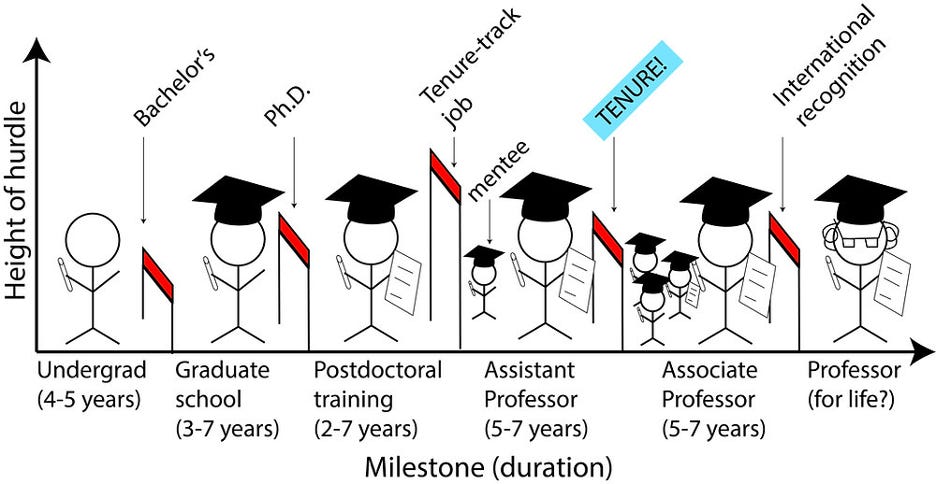
In academia, this is a meaningful professional milestone because at places like Columbia, if you don’t get tenure within 6-7 years, you need to leave. It’s up or out. It was also a meaningful moment in my career because it was at this point that our different lines of work were starting to come together into an integrated whole.
What’s below is a summary of our path, interspersed with bits from my 2022 tenure talk—the one-hour presentation I had to give. You don’t have to watch any of the videos to get the gist, so feel free to ignore them if you prefer sticking to the text.
Why We Study Mitochondria
A person’s health and their disease risk aren’t determined solely by genetics. We know that modifiable factors such as behavior, environment, diet, access to healthcare, and psychosocial experiences can all affect health.
However, we don’t yet know how lived experiences become embedded in our biology.
For example, how does a stressful or even an urban environment influence our genes, our cells, our organs, and ultimately our resilience and risk for diseases?
Energy flow is the unifying force that connects these systems. And by transforming energy and playing a central role in communication in the body, mitochondria may be key to understanding the links between mind, body, stress, and health.
By learning more about our mitochondria, we may be able to unlock new ways to promote health, support the body’s natural resilience, and cultivate lasting vitality throughout life.
This background, shared in more detail in the clip below, was critical for setting the stage for why this research matters and the kinds of impacts it could have.
The Path to This Point
In hindsight, it’s easy to paint a compelling picture of how one thing led to another in an organized, logical series of events. And that is definitely something many scientists aim for when giving a tenure presentation.
But in reality, neither life nor science usually follows a clear, predictable, linear path from start to finish. I think that is an important message because sometimes unexpected discoveries can lead us in exciting new directions.
I’ve shared some career milestones (and why I’m a little obsessed with energy) in an earlier post, so I won’t rehash all of those experiences. However, here are a few of the key pieces of the puzzle that led up to my tenure talk in 2022:
Interdisciplinary training and interests
Discovering diverse mitochondrial forms and functions
Studies on how mitochondria communicate
Understanding the relevance of mitochondrial signaling in mitochondrial disease and aging (we’ll cover this topic more in future posts)
Connecting mitochondrial health and the human experience
This early portion of my career path culminated in the renaming of my lab from the Mitochondrial Signaling Lab to the Mitochondrial Psychobiology Lab. Under our new name, we began focusing more on the connections between molecular processes within mitochondria and the human experience.
Better understanding these brain-body, mind-mitochondria interactions could allow us to leverage them to promote human health.
Our Progress Across Five Main Research Themes
Work in the Mitochondrial Psychobiology Lab has centered on five interrelated themes, and I share details about our projects in each of these areas.
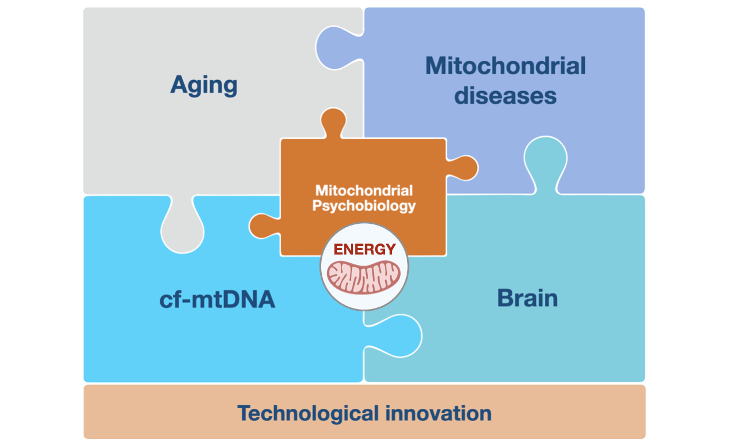
1. Mitochondrial disease
Through our preliminary research and the Mitochondrial Stress, Brain Imaging, and Epigenetics (MiSBIE) Study, we examine brain-body processes, mitochondrial diseases, and the links between energy and health. We talked in-depth about the MiSBIE Study, how it came to be, and our recent MiSBIE Symposium in a series of prior posts.
More recently, we’ve launched the Mitochondrial Daily Energy Expenditure (MDEE) Study, which builds upon our findings from the MiSBIE Study by examining another dimension: energy expenditure and how much energy it costs to stay alive.
I talk more about these projects in this video clip:
2. Aging
In the realm of aging, our experiments have shown that stress-related hair greying is linked to changes in mitochondrial proteins and can sometimes be reversed. These findings suggest that some aspects of human aging may be more malleable than we previously thought.
Our work on cellular aging using a cellular lifespan system showed that mitochondria that aren’t working properly can push cells to an energy-expensive state with increased protein secretions, activated stress response pathways, and accelerated aging.
Together, these findings support the idea that disrupted mitochondria may increase the energetic cost of living through “hypermetabolism.” This idea may explain some of the symptoms we see in mitochondrial disease as well as earlier mortality in these populations.
3. Cell-free mitochondrial DNA (cf-mtDNA)
We learned that acute psychological stress can trigger the rapid release of cell-free mitochondrial DNA (cf-mtDNA) into the bloodstream. This raised the question of whether mtDNA may act like a stress signal or stress hormone, leaving the mitochondria to have potentially far-reaching effects on our physiology.
Standardizing how cf-mtDNA is measured and ensuring procedures are valid and well-documented for others in the field to use has been another important endeavor in the lab. Ongoing work in our group is exploring whether cf-mtDNA can be measured noninvasively in saliva, which would have many benefits for designing new studies and potential healthcare applications.
4. Brain
In collaboration with a team of experts, we’ve also begun to investigate how mitochondrial activity and features may shape brain function and our psychological states. This work has included studies of the effects of psychosocial exposures on mitochondria in human brain tissue, mtDNA movement into the nuclear genome of brain cells, and brain-wide differences in mitochondrial properties.
We’re developing the MitoBrainMap, a detailed mitochondrial atlas that connects organelle-level bioenergetic data with whole-brain neuroimaging. We discussed this project in more detail in previous posts, highlighting the science and the story of how it was done.
Together, our brain-related research projects may help reveal how mitochondrial defects affect brain circuitry, mental health, neurodegeneration, and diseases like Alzheimer’s.
5. Technological Innovation
Another area that we are excited about is measuring, classifying, and quantifying what is going on with our mitochondria in health and disease. In particular, we can now quantify mitochondria with different features or “mitotypes” found in various cell types.
We’re also beginning to look at how mitochondrial biology changes over time, and how those changes vary by cell type, age, sex, and other common biomarkers. This work is helping establish better foundations for studying mitochondria in humans and understanding mitochondrial signaling dynamics.
What We’ve Learned
Our research has expanded from its initial focus on studying mitochondrial communication to investigating their relevance for aging, stress responses, the brain, and mitochondrial disease.
We and other labs around the world are continuing to investigate how information flows both from mitochondria outward to cells, organs, people, and communities, and also from lived human experience back inward to the mitochondria.
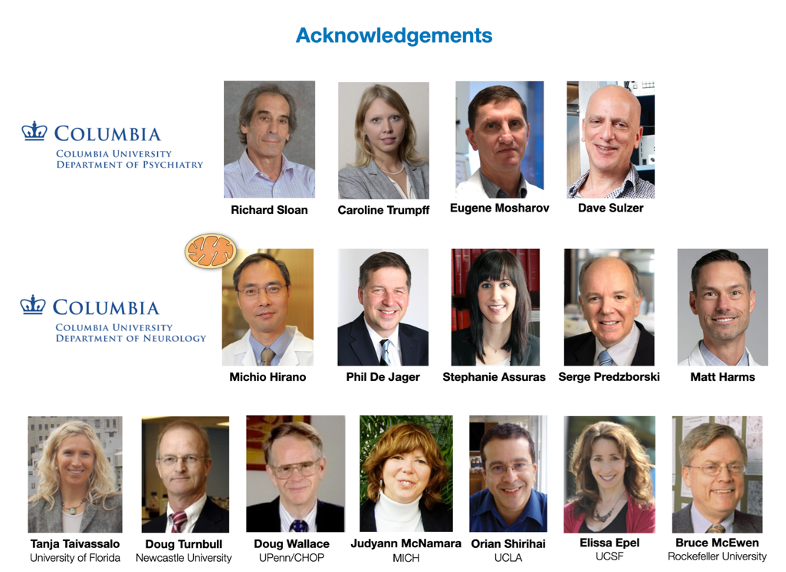
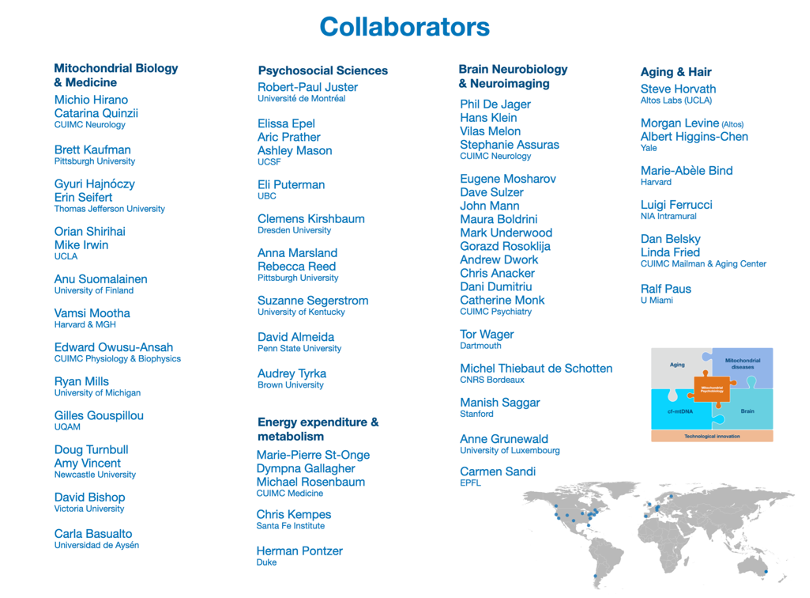
The work described in this post and in my tenure presentation would not have been possible without the contributions and support of many amazing people.
If you have an hour to kill, you can watch the full-length presentation on YouTube to learn more about the roles that my colleagues, mentors, collaborators, and lab members have played in these projects.
Our Plans for the Future
Back in 2022, looking to the future, I outlined three main areas I was hoping we’d make progress in (video clip below). I hoped to further expand our work to use physics and bioenergetics to understand hypermetabolism in mitochondrial disease, study how stress and aging alter cellular processes and time perception, and continue to refine the MitoBrainMap. We’ve made progress in all three areas.
But what is the ultimate goal?
At this point, I feel strongly inspired to use what we’ve learnt from mitochondrial psychobiology to inform the next stage of our work—focused on understanding the basis of health and the healing process.
That involves integrating the science of energy—what keeps us alive and well. And the human experience—what makes life worth living. Bridging the science and experience of energy to understand the healing process is the focus of the new institute we’re developing—the Energy and Healing Institute ⎸ EHI. More on this soon!
Thank you for reading and joining us on this adventure.
Curious about mitochondria and how they move, connect, and support our energy needs? Visit MitoLife to learn more and discover your energetic self through mitochondria.
Thank you. This distinction is necessary 👍 I truly believe your model validates the perceived energy status in so many chronic conditions and hormonal transition phases, and finally gives it a language."
thank you for sharing !