

ENERGY SCIENCE
Full-Text Link to Primary Source
Our TSEE guest writer Darshana Kapri, PhD, is a scientist in the
Mitochondrial Psychobiology Group at Columbia University.
In this post, she describes how our perception of time is not static. It can be influenced across the tree of life by a variety of factors, including metabolism. She shares results from new exploratory research examining how time perception may be influenced by our mitochondria and the bioenergetics of our cells.

The Fly Generally Leaves Early
When you try to swat a fly, it is usually gone before your hand arrives. The easy explanation is that flies have fast reaction times. The more interesting explanation, I think, is that the fly is living in a different version of the same second that you are. In other words, one second may feel much longer to the fly.
Your hand moves at one speed in physical time. But the fly is sampling the world more often than you are. In the interval you experience as a single smooth motion, the fly has registered many separate snapshots. Your swing does not just look slow to the fly. To the fly, it is slow.
This is not a metaphor. It is a measurable property of nervous systems, and it has a name: critical flicker frequency.
Critical Flicker Frequency
If you flash a light on and off slowly, you see flicker. Speed the flashing up and at some point, the flicker disappears, and the light looks continuous. The frequency where that switch happens is called the critical flicker frequency, or CFF. (It is also known as flicker fusion frequency.) It is a simple way to ask how finely an animal slices time.
Humans fuse somewhere around 50 to 60 flashes per second. This is why old fluorescent tubes (100 or 120 flashes per second) and low refresh rate screens (~60 flashes per second) can feel subtly wrong, but they may not appear to be obviously flickering. Some flies keep resolving flicker past 250 flashes per second. A tortoise, on the other end, fuses at rates so low that our world may appear like a stop-motion movie with action so fast that it cannot be well-tracked.
The comparative work here is worth reading directly.
In a 2013 study, Kevin Healy and colleagues gathered CFF measurements across more than thirty vertebrate species and asked what predicted them. Two things did: body size and metabolism. Smaller animals with higher mass-specific metabolic rates resolved time more finely. Larger, slower-burning animals resolved it more coarsely.
That result invites a new perspective. Temporal resolution is not a free parameter that evolution can dial up whenever it would be useful. Every frame costs energy to acquire and process.
Animals that can metabolically afford a high frame rate get one. Animals that cannot, do not.
Humans are Not Exempt
It would be easy to file this under animal trivia. But the same relationship shows up within our own species, and even within a single person across a single day.
CFF thresholds drop when people are mentally fatigued. They go down in pilots exposed to low oxygen conditions. They shift in divers breathing different gas mixtures. A narrative review of CFF treats the measure as a general index of central nervous system arousal and efficiency that is sensitive to whatever is happening to the brain’s energy supply.
Body temperature can similarly affect our perception of the duration of a period of time. Warming people up makes a given stretch of time feel longer, and cooling makes it feel shorter.
If our internal clock ran on a quartz crystal, this would not happen. It happens because our clock runs on chemistry, and chemistry is temperature dependent.
We hypothesize that there are a number of other factors that likely work together to affect our internal sense of time, including bioenergetic, neural, endocrine (hormone-related), and demographic factors.
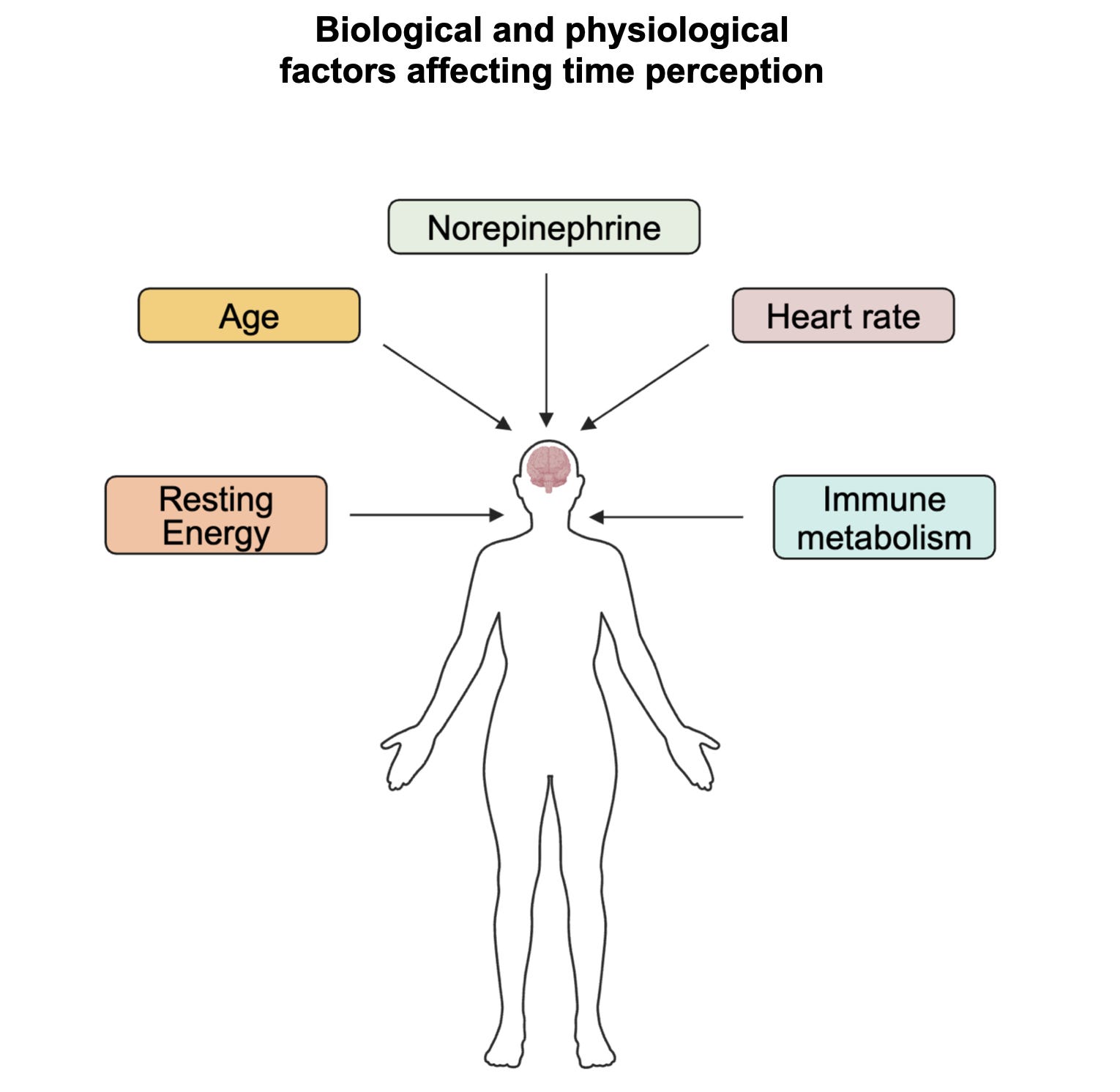
So the speed of your inner clock is not a fixed personal trait. It is a state, and metabolic conditions may move it.
The Clock is in the Body, Not Only the Head
For decades, models of time perception have placed a pacemaker somewhere in the brain and treated the body as scenery. Classic papers proposed that an internal oscillator feeds an accumulator, with attention acting as a gate. Those models explain a great deal.
But they leave out where the ticking of the clock comes from.
Newer work has been pulling the body back in. Duration judgments track interoception, the brain’s ongoing read of the internal state of the body. People who attend more closely to their heartbeat and visceral signals judge time differently from people who do not.
The insula, a brain region that integrates bodily signals into conscious feeling states, turns up repeatedly in timing studies. A recent synthesis argues that subjective time emerges from a hierarchy of coupled brain and body rhythms, rather than from one dedicated timekeeper.
Arousal fits the same picture. Norepinephrine, the main chemical signal of sympathetic activation, has long been linked to distortions in time perception.
Taking the evidence to date together, asking “where in the brain is the clock?” may be the wrong question. The better question may be “how does the whole organism’s energetic state influence the rate at which experiences accumulate?”
Investigating the Role of Energy in Time Perception
That question is what my colleagues and I set out to test. In a recent study, we measured time perception in 95 adults. This study built on the MiSBIE study, in which a third of participants carried genetic mutations that impair how mitochondria transform energy.
For both groups, we measured time perception in two different ways. We asked participants to estimate how much time had passed for set intervals. And we also asked them to produce time intervals by telling us when a certain amount of time had passed.
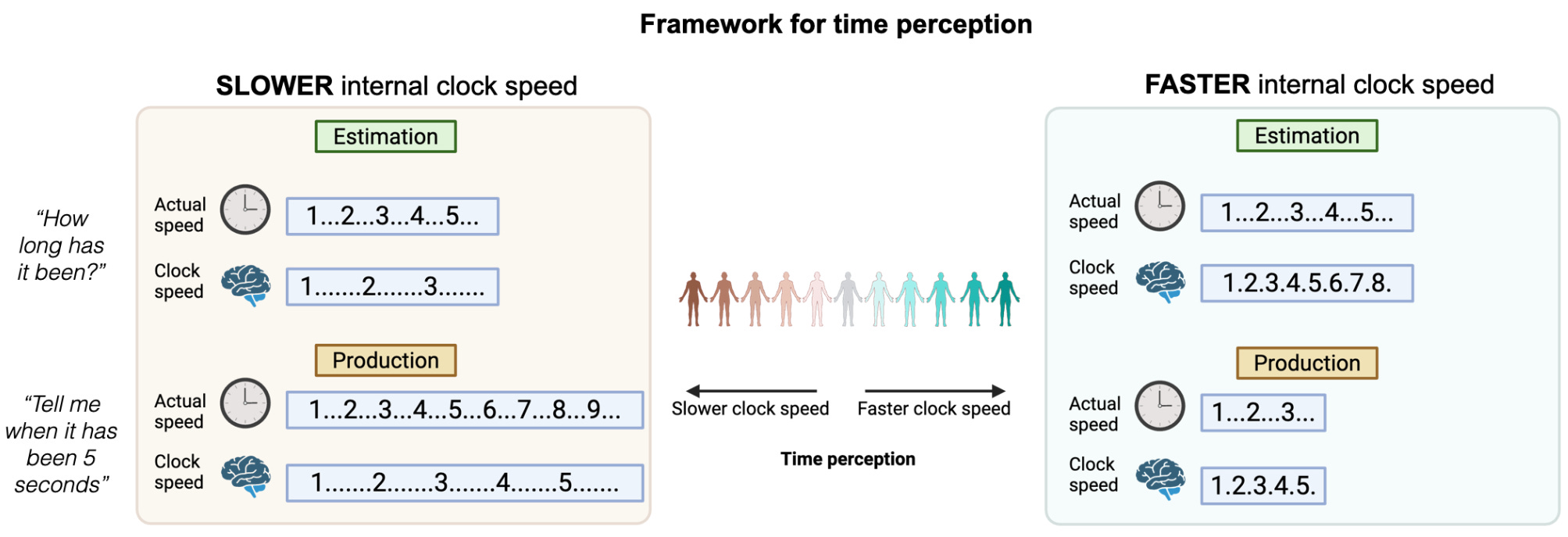
We were interested not only in whether participants’ internal clocks ran faster or slower, but also how consistent an individual’s perception of time was across each of their measurements.
We compared participants’ perception of time against resting energy expenditure, catecholamines (neurotransmitters thought to be involved in our internal clock), working memory, and brain structure and function. Investigating relationships between these measures and time perception gave us some insights into the potential mechanisms that may be influencing participants’ internal clock speeds.
What We Found, and What We Did Not
The groups of individuals with and without the mitochondrial mutations did not differ in how fast or how consistently they perceived time. What differed was the underlying mechanisms.
In healthy participants, faster subjective clocks were linked to higher resting energy expenditure and better working memory. In participants with mitochondrial disease, those couplings were weakened, absent, or reversed.
Most of our associations were modest and exploratory. It is important to consider this when interpreting our findings.
The lesson I take from our results is not that mitochondria set your clock. It is that the same physiological signal can mean different things depending on the energetic state of the person carrying it.
I came to this project expecting time perception to be a cognitive measure—something that would line up with attention and memory scores and little else. What changed my thinking was watching the correlations reorganize themselves when I split the cohort by mitochondrial disease status. The behavior looked the same. The biology underneath did not.
Since then, I have noticed the impacts of energy on time perception in my everyday life. A long illness where the days ran together. A period of poor sleep when everything felt both rushed and stalled. I used to treat those as moods. I now suspect they are also readouts of what was going on with my metabolism.
If you have ever come out of a period of exhaustion, illness, or grief and felt that time had behaved strangely while you were in it, that experience may be more literal than it sounds. Perhaps your clock was running within a body where energy was flowing differently.
I would like to hear from you. If your sense of time has shifted during a period of illness, recovery, or high stress, leave a comment below. Those descriptions are exactly the kind of thing that formal timing tasks can’t capture well, and they help shape what we investigate next in our research.
Want to learn more about research in the Mitochondrial Psychobiology Group?
You can also find more details about the study in our paper.

The aspect of sensing the passage of time that has intrigued me for a while now has to do with age. I'm 74. I was once 4, some 70 years ago. A day felt much longer when I was 4. A day lasted a very long time. A year seemed to go on forever. These days, of course an hour can wiz by or seem slow, but overall the days and weeks seem to go by so much faster than even five years ago. Is it September already? Is it Monday again? Didn't we just have Monday like three days ago? My theory on this has been that at age 4 a year represents a quarter of my entire existence. Measured against my entire life, one year is a big chunk of it. At age 74 a year is a very small fraction of the whole of my existence. But I don't know if this is a viable explanation for the sense of years speeding by faster. I've yet to read anything that backs this up.
I would reinterpret the causal direction. I treats physical time as part of the framework through which physical consciousness organizes experience, rather than as an independently existing stream that consciousness simply travels through. From that perspective, the article’s finding that metabolism, arousal, temperature, bodily rhythms, and mitochondrial function correlate with subjective time would be unsurprising. I do resist the conclusion that the body creates the underlying experience of time.
Time is not perceived independently of the perceiver. You then assume, however, that the chemical mechanisms you observe produce the variations in time. They are instead the physical counterparts of alterations in consciousness.
The most compatible sentence in the piece is:
“The speed of your inner clock is not a fixed personal trait. It is a state.”
I agree with the first part. I describe psychological time as elastic, with ordinary clock time representing only one specialized way consciousness organizes events.
Your fly example is interesting from my perspective. The scientific account says different nervous systems have different temporal resolution because they process sensory information at different rates. Yes, and that is the physical manifestation of something deeper.
A fly, tortoise, human, tree, and cell would not necessarily inhabit precisely the same experiential organization of time merely because an external observer's clock assigns them all the same second.
So science says approximately:
metabolism → neural processing → temporal experience
I say something:
organization of consciousness ↔ biological organization ↔ experienced time
The double arrows matter. I don't treat consciousness as a passive product of biological machinery.
The mitochondria finding is particularly interest:
People with and without mitochondrial disease didn't necessarily differ in their overt timing performance, yet the physiological relationships underneath that performance differed.
That actually fits unusually well with my way of thinking.
You cannot infer the organization of consciousness simply by observing a physical endpoint. Similar physical experiences can arise through different underlying organizations, because consciousness and the body form an integrated system rather than a simple mechanical chain.
The experience looked the same, but the organism was constructing that experience through different physical pathways.
The article remains firmly within psychophysiology. It is talking about subjective duration judgments: whether ten seconds feels longer or shorter, how rapidly sensory events can be discriminated, and how bodily energetic states correlate with those judgments.
My claims about time are much more radical.
What we ordinarily call past, present, and future are features of the physical system of perception rather than ultimate properties of reality. Ordinary waking consciousness focuses on events sequentially, producing the experience:
A → B → C → D
But consciousness itself isn't fundamentally confined to that sequence. It provides evidence that human and animal temporal perception is biologically variable. That is entirely compatible with conventional neuroscience. It does not establish my claims about simultaneous time, reincarnational selves, probable realities, or consciousness existing independently of the brain.
This is science beginning to encounter the edges of something I claimed decades earlier: the experienced character of time depends upon the organization of the experiencer.
The most interesting difference is causality
Kapri writes:
“Perhaps your clock was running within a body where energy was flowing differently.”
I invert that, or at least make it reciprocal.
In my framework, during illness, grief, intense creativity, dreams, meditation, danger, or altered states, consciousness can change its characteristic focus. The accompanying nervous-system activity, hormonal state, metabolism, and subjective time would all be physical expressions of that changed organization.
So instead of saying:
My metabolism changed, therefore time felt strange
I say:
My entire psychophysical organization changed, and both metabolism and experienced time were aspects of that change.
That is a subtle but enormous philosophical difference.
The CFF material asks, essentially: How many experiential events can an organism discriminate within one externally measured second?
I question the privileged status we're giving the external second.
From our standpoint, the fly is processing more events during our second. But from the fly's experiential standpoint, its own perceptual world is simply normal.
Whose second is the “real” second?
Physics gives us a perfectly useful operational answer: clocks establish a common measurement system. Biology then shows that equal measured intervals need not contain equal amounts of experienced differentiation.
Let us distinguish those two things very sharply.
Clock time would be part of the agreed-upon structure that allows physical creatures to coordinate their experience. Psychological time concerns the amount, density, organization, and character of experience occurring within that framework.
And that makes the fly example more philosophically interesting than merely saying “flies have faster brains.”
Imagine that during one measured second:
Human: A ——— B ——— C
Fly: A–B–C–D–E–F–G–H–I
The clock hasn't changed. What has changed is the experiential information density inside the interval.
The article suggests metabolism helps constrain that density.
Biology is showing us the physical mechanics of a much broader principle: time as experienced is inseparable from consciousness itself.
And I suspect that would be the point I'd emphasize most. The researchers are asking, “How does the energetic state of an organism alter its internal clock?” Let us push the question one level deeper:
Why assume there is an independently existing psychological clock at all? Perhaps what you call time is partly the experiential result of consciousness organizing events at a particular rate and in a particular sequence.