

ENERGY SCIENCE
Full-Text Link to Primary Source
Our TSEE guest writer Parker Kelley, PhD, is a scientist in the Mitochondrial Psychobiology Group at Columbia University.
In this post, he discusses the allostatic triage model of psychopathology (ATP Model). This new model may help explain how our brains manage our limited energy budget, and how this process is impacted by chronic stress in ways that may contribute to symptoms of mental and physical illness. It draws connections between our energetic demands, behaviors, thoughts, emotions, and mental health.

Unraveling the Links Between Stress and Disease
Stress causes disease, but it’s unclear exactly how.
Nearly all stress-induced diseases are causally related to many others, and the relationships go both ways. Cardiometabolic and inflammatory diseases increase risk for psychopathology, and vice versa.
And psychological conditions rarely fit clearly within a single separate diagnostic box. Many of these diseases may share underlying patterns of symptoms, and the boundaries and interactions between them are more complex and blurry than many realize.
What mechanisms could possibly explain how a non-specific stimulus like stress underlies the development, progression, and interactions between so many different diseases, while at the same time explaining how stress causes each specific condition?
This was our starting point for the allostatic triage model of psychopathology (ATP Model). The model examines how competitive reallocation (“triage”) of brain energetic resources under stress elicits psychiatric symptoms, and systemic disease.
Allostatic load (the accumulated burden of stress) and the ATP Model were introduced in an earlier article, but we’ll talk about them in more detail here.
A great mechanistic ocean lies ahead to explore. So, as is tradition in science, we’ll toil in the mechanistic mud to satisfy our minds before we jump to any conclusions.
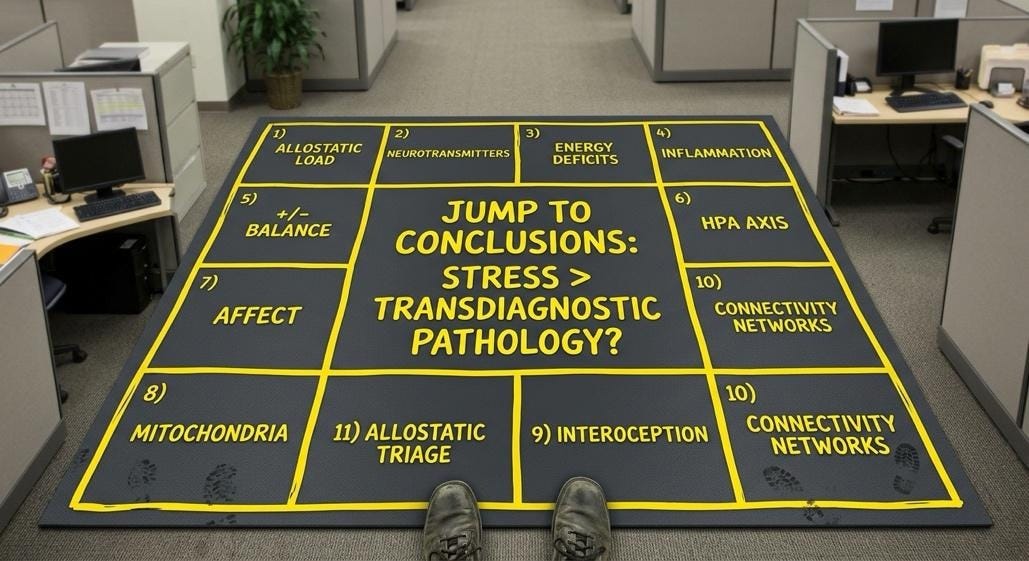
What might these messy effects of stress on a blurry set of diseases tell us about biology?
The body is not a myriad of independent, interacting parts.
Living organisms are ecosystems made up of many interdependent systems that develop, function, and evolve together. Cells, organs, and systems constantly exchange signals and influence one another directly or indirectly to the extent that their boundaries begin to blur.
This is well illustrated by a quote I heard from a brilliant psychoneuroimmunologist: “If inflammatory cytokines were discovered by neuroscientists, they would have been called neurotransmitters.” Not only can a change in one place ripple through the rest of the body, but the deeper your understanding of biology, the more its “boundaries” blur into a continuous unfolding process.
This perspective helps explain why a nebulous stimulus like stress can have widespread effects on our health instead of affecting just one part of the body. This is especially true when the stress is intense or prolonged.
Let’s now focus on mechanisms. But don’t worry—this ride stops well above the abyss of molecular complexity.
We simplified the ATP model into five principles. Let’s explore them in more detail.
1. Life Depends on the Dynamic Flux of Energy Through Organisms and Their Environment
Imagine the rising sun bathing fields of barley and millet in brilliant rays of light, transforming carbon dioxide into golden fields of carbohydrates.

Ancient energy traveled 150,000 km from the sun to Earth. There it was transformed into the grains which fueled the bodies and brains of the Atharvan priest-physicians and Han dynasty court physicians who developed Ayurveda and Traditional Chinese Medicine.
These were perhaps some of history’s earliest bioenergetic models of health and disease. Long before we could study molecules, these ancient physicians recognized that we are animated by the interactions between the energetic patterns within and without us, which shape our becoming and relationships to the world beyond our bodies.
Today, we understand that we are not just animated by energy patterns. At one level, we’re also complex patterns of chemical bonds (i.e., solar energy). We are energy patterns—organisms are made of energy.
The ATP Model, a new bioenergetic model of health and disease, is intentionally situated within this celestial energetic context.
2. Stress is Metabolically Expensive, and It Drives Energy Scarcity
What is stress?
Hans Seyle, widely known as the “godfather of stress,” defined stress as the non-specific response of the body to any demand. But for all of his genius, Hans did not clearly define “demand.” In the ATP Model, we defined “demand” metabolically by integrating Hans’ definition with a contemporary model of stress developed by Koolhaas and colleagues.
Box 1: Bioenergetic definitions of stress proposed in the ATP Model
Stress: “stress” as any increase in metabolic demand that exceeds the adaptive increase in energy transformation capacity facilitated by the stress response
Stress response: an adaptive allostatic response to increased metabolic demand, which increases energy transformation capacity to help organisms survive periods of high energy demand
Stressor: any metabolically demanding event that has the potential to overcome the increased energy availability provided by the stress response
Critically, not all stimuli that increase metabolic demand and activate the stress response are considered “stressors” or “stress”. For example, dancing and sex are metabolically demanding and activate the stress response, but they are not generally considered “stress” because they don’t usually overwhelm the body’s adaptive capacity and drive energy scarcity.
3. Chronic Stress May Disrupt Energy Regulation
Allostasis is the adaptive process by which the body anticipates and adjusts its physiology and metabolism to maintain function and stability, and meet changing metabolic demands.
For example, anticipating an energetically-demanding event (stressor), such as an argument with one’s partner, activates the stress response. This releases fast-acting adrenaline and longer-acting stress hormones, called glucocorticoids (e.g., cortisol), to increase energy availability to meet the increased demand.
However, a stressor likely only dysregulates allostasis if it overwhelms the adaptive capacity of the stress response to meet the increased demand (i.e., stress). Stressors that do not overwhelm the stress response are generally adaptive—they improve the capacity to handle future stress. Alternatively, stressors that overwhelm the stress response for a significant duration, generally have deleterious effects.
In the energetic model of allostatic load, researchers from our group showed that chronic exposure to glucocorticoids can drive the body into a hypermetabolic state. This occurs to compensate for the increased metabolic demand.
The image below shows five general buckets of brain energy expenditure, and one light blue bucket of energetic reserve. This reserve bucket represents the amount of extra energy the brain can make available upon activation of the stress response. As stress severity or duration increases (moving to the right), the brain must consume energy from its neuroplasticity and maintenance and repair buckets to meet the demand of the stressor (task-dependent activation).
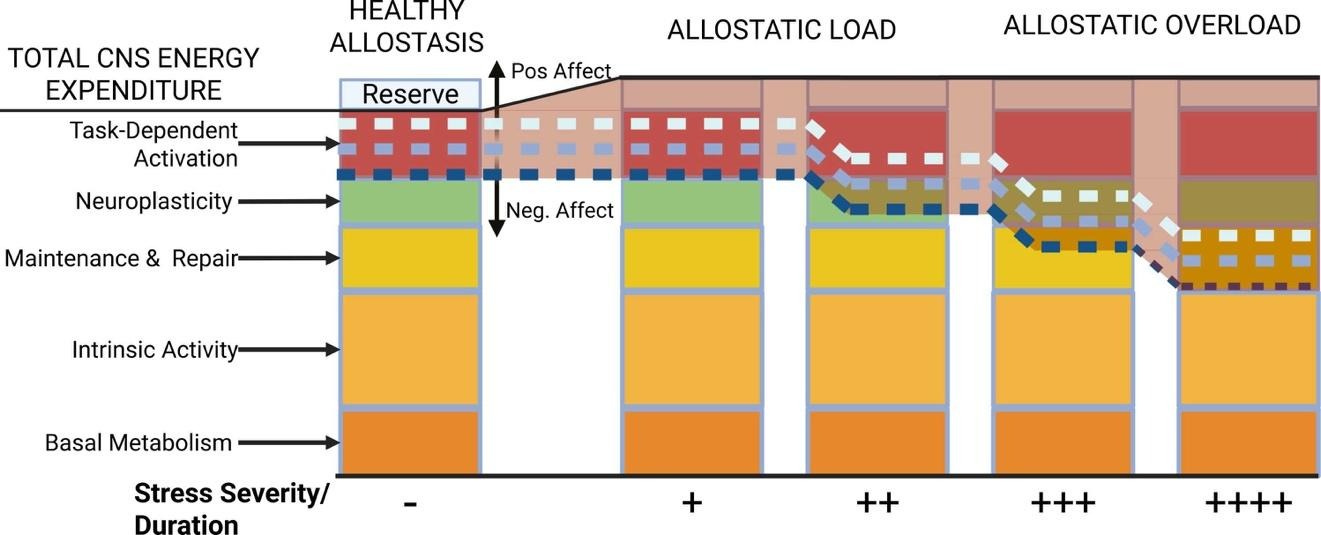
These stress-induced hypermetabolic states are energetically inefficient. Thus, upon exposure to additional stress, the likelihood of energy scarcity and the necessity of allostatic triage increase.
Indeed, various forms of stress (e.g., traumatic, psychosocial, etc.) dysregulate mitochondria, physiology, systemic allostasis, and affect (see our fourth principle below). This can result in the development of affective disorders like depression, as well as its psychiatric and systemic comorbidities.
4. The Body’s Energy State May Influence Affective Balance, Energy Allocation, Emotions, and Behavior
To explain how specific energetic changes could precipitate specific diseases and comorbidities, we’ll begin by explaining a 2016 paper by Lisa Feldman Barrett, which introduced the active inference theory of allostasis and interoception (our ability to use sensations of the internal state of our body to regulate allostasis).
She explained that “Energy regulation is at the core of the brain’s computational architecture.” This work is foundational to the ATP Model, and it rests on three principles:
1) Organisms do not sense and respond to the world directly. Rather, our brains use information from our senses to generate internal models of our body, our surroundings, and how the two interact. These models structure our perceptual worlds. Our experience of our bodies and the external world is literally mediated by these models.
Our brains are constantly making predictions about what is happening within and outside of our skin, and what might happen next. Our actions, whether a movement, a thought, or a secretion from a gland, provide new information to help us determine if our models and predictions are accurate.
When our predictions aren’t correct (surprise!), our brains update the model and predictions in real time. This continuous process of predicting, sensing, acting, and adjusting is central to all active inference models, including Lisa’s. It explains how organisms constantly refine their understanding of the world and adapt behavior in response to changing environments.
2) Core affect is generated from interoceptive sensory information. It can vary in terms of its valence (positive or negative) and intensity. Affect regulates behavior in service of energetic allostasis.
How we interpret or express affect as specific emotions may be explained by the context of the situation, our past experiences, and what we’ve learned from our culture.
For example, my anger at a waiter explains my high-intensity negative affective state in the context of the hot bowl of crab bisque spilled in my lap. This then guides my behavior to demand compensation for this energetically expensive incident and reduce the likelihood of it happening again.
3) Active-inference loops regulate our internal systems to maintain allostasis. Essentially, our brains use this continuous process of predicting, sensing, acting, and adjusting to help regulate our body’s energy needs.
Behavioral energy follows emotion. How we feel influences how we behave, and our behaviors, in turn, help our bodies adapt to changing demands.
Chronic stress can disrupt our energy regulation processes. When stress affects our body’s energy systems, including mitochondria, it can also change the signals our brain receives from within our body (i.e., interoception), which Lisa’s work suggests underlies our affective states.
These changes to the accuracy and precision of body-brain communication make it more difficult for the brain to interpret the body’s energetic needs, regulate our emotions, and accurately change our affective state to guide our behavior in ways that help us maintain balance.
Affect may represent the energy state of the organism, which we propose regulates allostatic triage in the brain.
The blue dotted lines on the image above represent our proposal of how affective state might broadly influence allostatic triage in the brain.
We expect that the intense low affect seen in depression may drive allostatic triage away from metabolically expensive brain systems (e.g., central executive network) that mediate executive control and inhibit pathological behaviors, and towards less expensive networks (e.g., salience network) that drive hypervigilance, compulsions, and fear behaviors when overactive. See the image below.
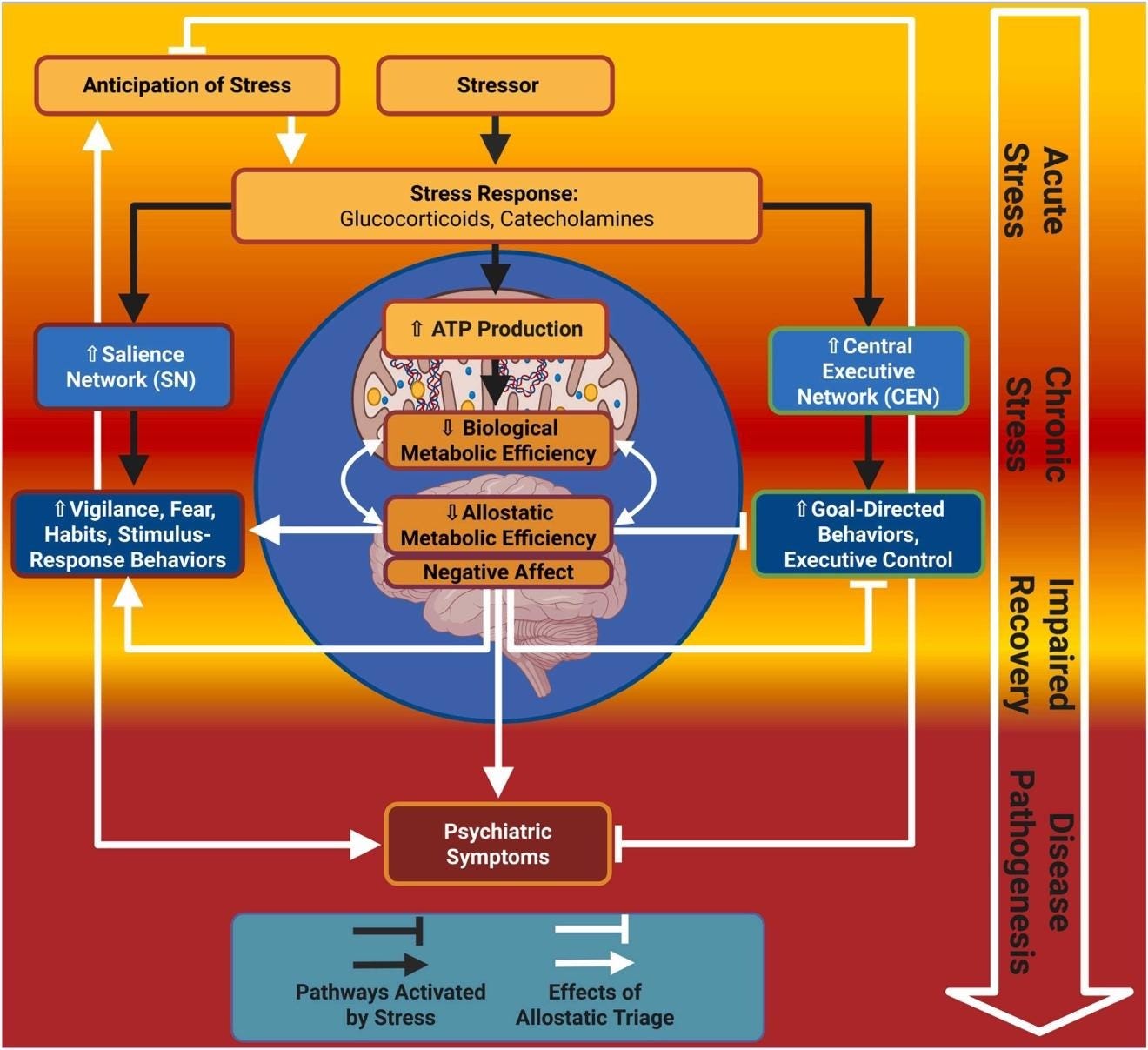
When stress has already made the body’s energy use less efficient and disrupted emotional regulation, this imbalance may lead to psychiatric symptoms. Brain networks that help us regulate our thoughts and behaviors may receive fewer resources, while those associated with fear, heightened alertness, and compulsive behaviors may receive more.
5. Chronic Stress Can Reinforce Patterns of Thoughts, Emotions, and Behaviors that Contribute to Mental Health Problems
Our brain constantly changes with experience.
It is often said that “neurons that fire together, wire together.” Connections between neurons can strengthen when repeatedly activated.
This ability to change, called neuroplasticity, helps us learn and adapt. But it can also reinforce undesirable patterns of thinking and behavior.
Neural firing is expensive, and plasticity flows where the energy goes.
We propose that chronic stress may shift how the brain distributes its limited energy to favor networks (like the salience network) that help us detect and respond to important or threatening situations. Given that the brain and body function on a finite energy budget, this leaves fewer resources for networks involved in planning, concentration, and self-control (like the central executive network).
This has been observed in research studies where changes in the function of these networks are present across a range of psychiatric disorders.
Over time, chronic or extreme stress can result in the repeated activation of brain networks involved in heightened alertness and fear. This strengthens these responses while weakening our ability to regulate them.
Through neuroplasticity, patterns that initially developed in response to stress may become increasingly ingrained, a process sometimes called “canalization.” This could contribute to persistent mental health symptoms.
The ATP Model Distilled
Now that we’ve become familiar with some of the trees, can we see the forest?
All life requires energy to flourish. Our bodies have limited energetic resources, and when demands increase, where they go must be adjusted to keep us alive and functioning.
The ATP Model proposes that these adjustments may help explain how chronic stress affects our thoughts, emotions, behaviors, and ultimately, our mental health. And how redirecting resources within the brain may produce symptoms of mental illness.
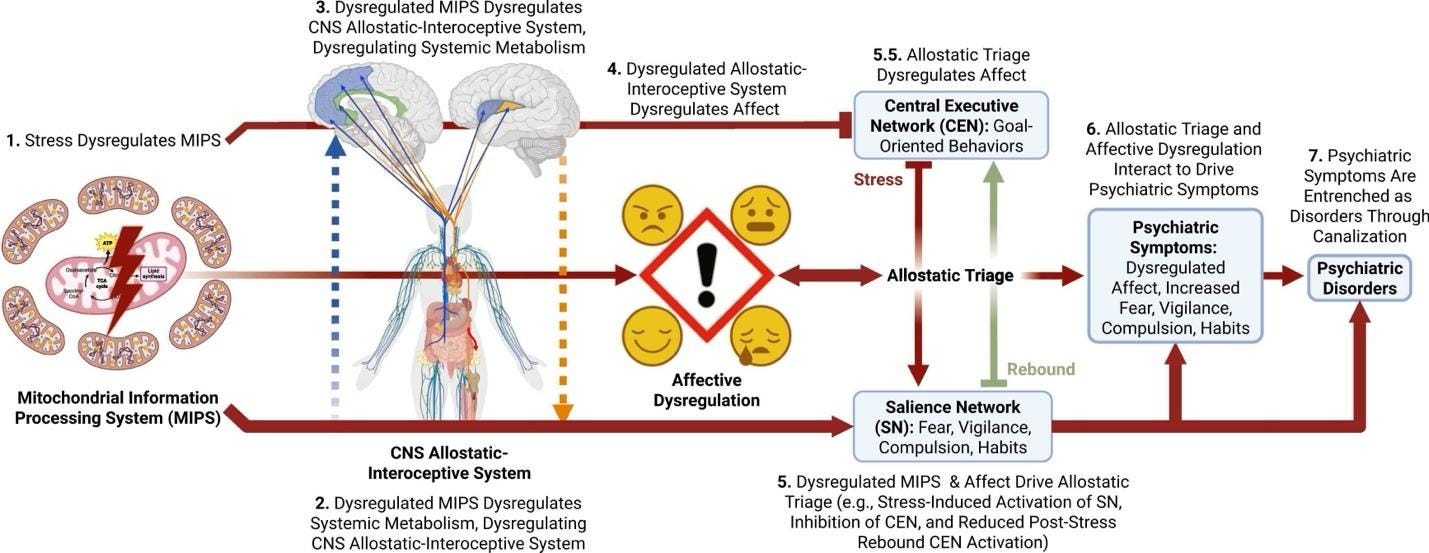
Together, these principles explain how messy stress effects can cause diverse diseases and the relationships between them. By dysregulating allostasis and affect, and triggering energetic imbalances among brain-body networks, stress impairs function and causes symptoms that become entrenched over time as diseases.
Simultaneously, these principles explain why specific diseases and comorbidities develop in any particular case. The systems between which these energetic shifts occur are likely directly implicated in the symptoms and diseases that emerge. Put simply, restrictive energy budgets may have deleterious consequences for the budgeted systems!
Applying the ATP Model to Everyday Life
For anyone not fully comfortable with this perspective yet—I have one final pitch. How did the ancient Atharvan priest-physicians and Han dynasty court physicians come to their bioenergetic models without molecular medicine? Experience.
While evidence is required to validate a hypothesis, objective evidence alone does not produce understanding.
Understanding comes from experience.
And creativity is needed to translate these insights into novel treatment approaches to support flourishing. We must grapple and engage with the evidence, its source, and its implications for us and the world around us.
Our everyday experiences tell us that stress changes how we feel, think, and interact.
I encourage you to explore this yourself. As you face stress in your life, pay attention to how it alters your mental experience.
How does your body feel, and how do you think under stress? How does your focus differ from being relaxed? How do you interpret those changes?
Now consider how these changes may affect your family, your colleagues, your patients, or others in your life.
Recognizing these patterns in ourselves and others (lived experience), in tandem with empirical research, may help us develop novel therapeutic approaches. It may also help us respond differently to the stress in our own lives and the stress that others may be experiencing.
While the ATP Model still requires further testing, it helps bridge our thoughts, emotions, behaviors, and the energetic demands of life. Understanding these connections, and the role of dynamic energy patterns in our lives and relationships, may allow us to bring greater curiosity, compassion, and awareness to our own experiences and those of others.
We invite you to try on the ATP Model for size. Feel it out and let us know your experience in the comments below!


The Bioenergetics of Freedom: Consciousness as the Ultimate Antidote to Allostatic Drain
The Allostatic Triage Model of Psychopathology (ATP Model) formulated by Dr. Parker Kelley demonstrates that the human body is not a collection of isolated organs, but a single, continuous bioenergetic ecosystem [1.1]. When processed through a consciousness filter, this scientific blueprint confirms that chronic stress is a state of systemic energy bankruptcy.
When the local station is locked in unconscious default patterns, the brain is forced to aggressively triage its limited metabolic budget, robbing its own repair, maintenance, and neuroplasticity systems to fuel the emergency demands of survival.
The ultimate solution to this cellular exhaustion cannot be found by manipulating downstream chemistry. Pure, top-down consciousness is the absolute antidote to this metabolic drain.
[ Unconscious Default Loop (The Emotional Filter) ]
Stressor ──► Threat Perception ──► Hypermetabolic Overdrive ──► Mitochondrial Exhaustion ──► Systemic Triage (Disease)
[ Conscious Intervention Loop (The Antidote) ]
Stressor ──► The External Screen ──► Neutral Processing ──► Closed Energy Leak ──► Resource Preservation (Repair)
The Architecture of the Metabolic Leak
Under the traditional emotional filter, a psychological stressor is processed as an immediate, existential threat. This structural inversion triggers an incredibly expensive hypermetabolic cascade:
• The Illusion of Demand: The brain misinterprets abstract psychological threats—such as an argument or a blow to the false ego—as physical survival emergencies.
• Mitochondrial Bankruptcy: Chronic activation of the stress response floods the system with glucocorticoids, forcing cells into an inefficient, hyper-accelerated state that rapidly depletes the organism's solar energy reserves.
• The Triage Protocol: To meet this artificial task-dependent demand, the brain undergoes a competitive reallocation of resources, systematically draining the energy buckets normally reserved for cellular repair, immune defense, and self-directed neuroplasticity.
This energy scarcity blurs the boundaries of systemic health, showing why psychiatric conditions, inflammatory diseases, and cardiometabolic dysregulation are fundamentally interconnected expressions of the exact same energy shortage.
Consciousness as the Antidote
True conscious awareness acts as a precise circuit breaker for this systemic energy drain. By applying the consciousness filter as a deliberate thought technology, you stop the hypermetabolic leak before it ever reaches the cellular level.
• Neutral Transduction: Placing a stressor on the external screen of your mind strips away its chemical and emotional charge. You observe the event as raw data rather than an existential threat.
• Top-Down Calibration: Because pure awareness does not require somatic tightening or defensive posturing, the brain ceases its emergency survival signals. Thoughts precede and actively calibrate the nervous system, preventing the release of destructive stress hormones.
• Plugging the Energy Leak: By shifting from a reactive internal state to the stance of the universal observer, you eliminate the hypermetabolic waste. The brain stops the triage protocol.
• Restoring the Reservoirs: With the energy leak closed, the metabolic budget instantly flows back into its natural, healthy configuration. Mitochondria normalize, the nervous system stabilizes, and the preserved energy is freed to fuel systemic maintenance, deep healing, and permanent neuroplastic rewiring.
You do not need to alter the external environment to protect your biology. You must alter the internal state from which the environment is being processed, transforming your local station from a leaky, reactive survival engine into a highly coherent expression of the unified field.
Congratulations on such a thoughtful piece, Parker. I particularly appreciated the emphasis on recovery, not just the stress response itself.
You might find this paper by Errico and colleagues interesting: https://doi.org/10.1038/s41514-025-00293-2. They propose that persistent sympathetic activation without adequate recovery contributes to ageing. What do you think of their hypothesis, and how might it complement your model?
I’m interested in the home as a persistent exposure. If the place we return to for recovery keeps adding demands, even ones we no longer consciously notice, where is the opportunity to downshift?
How would you test whether changing that environment improves our capacity to recover?